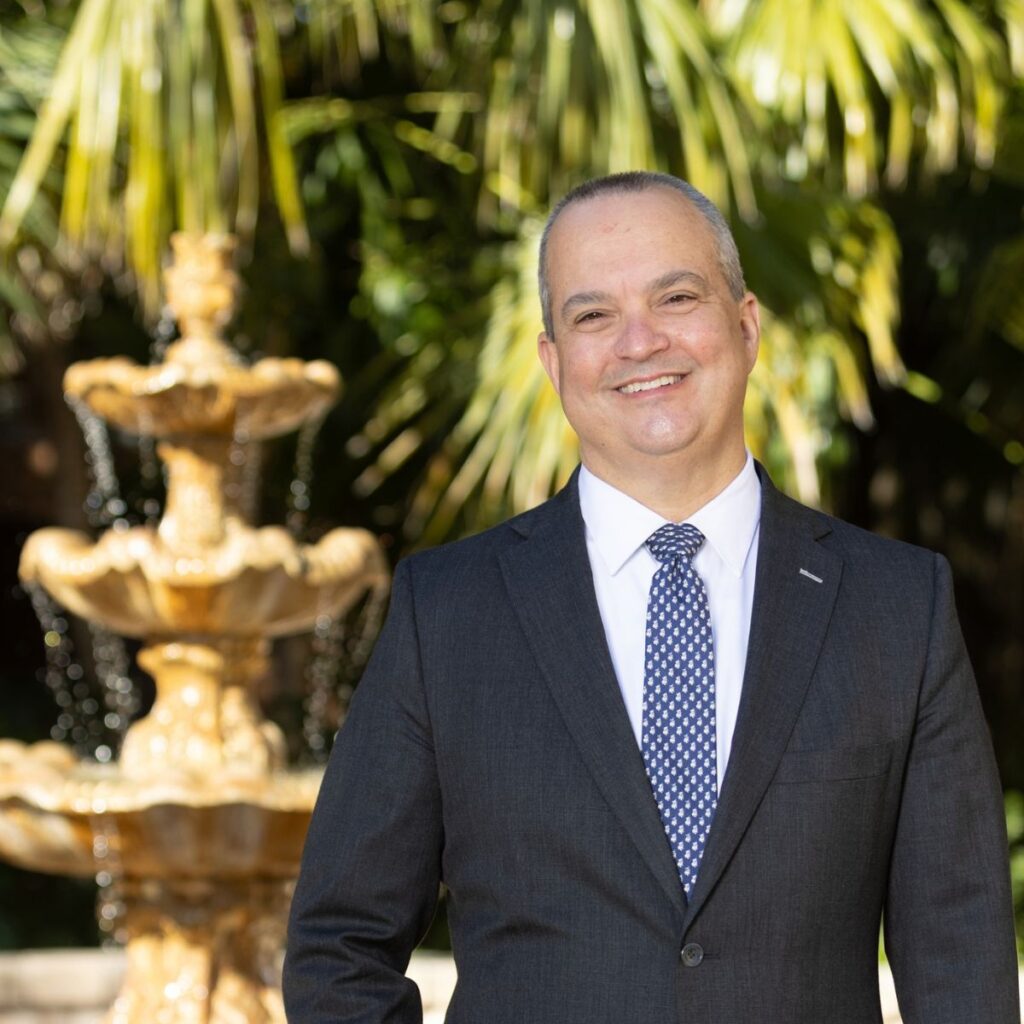
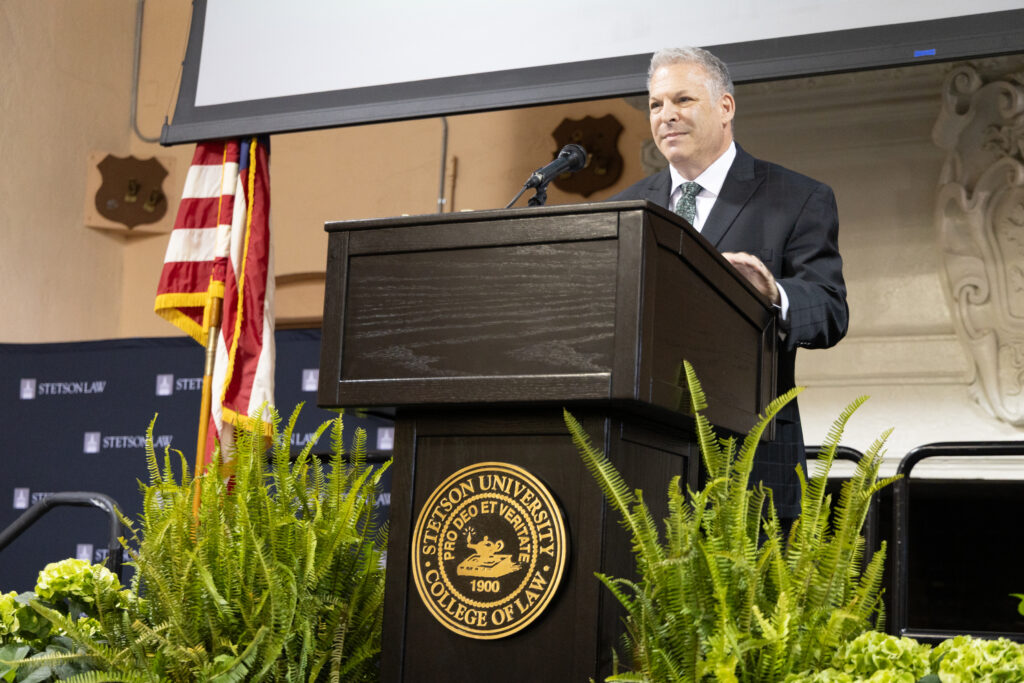
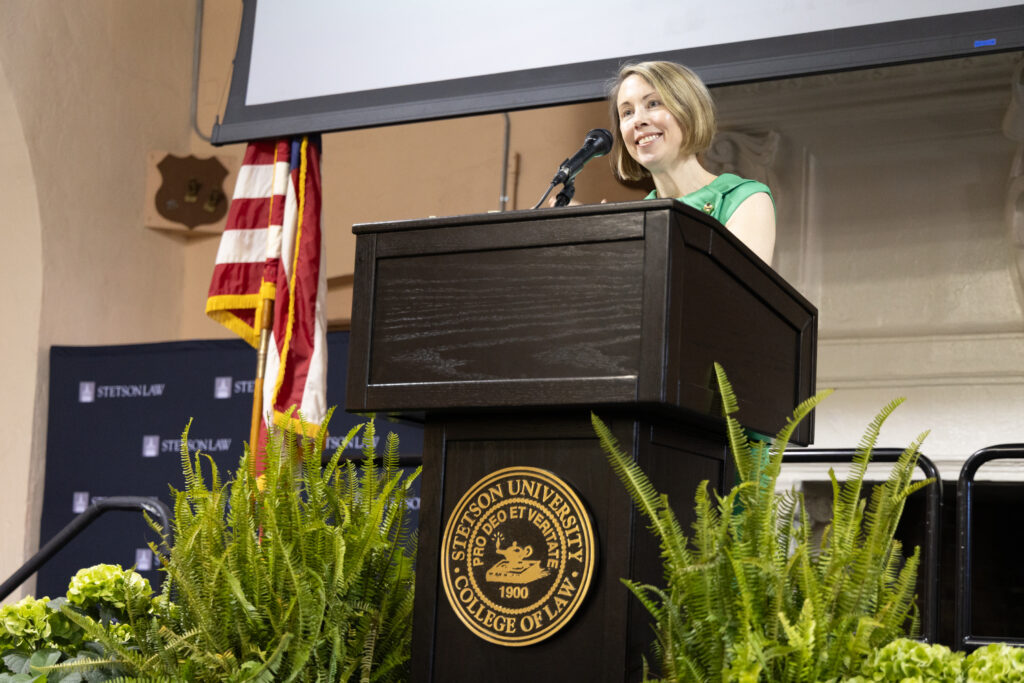
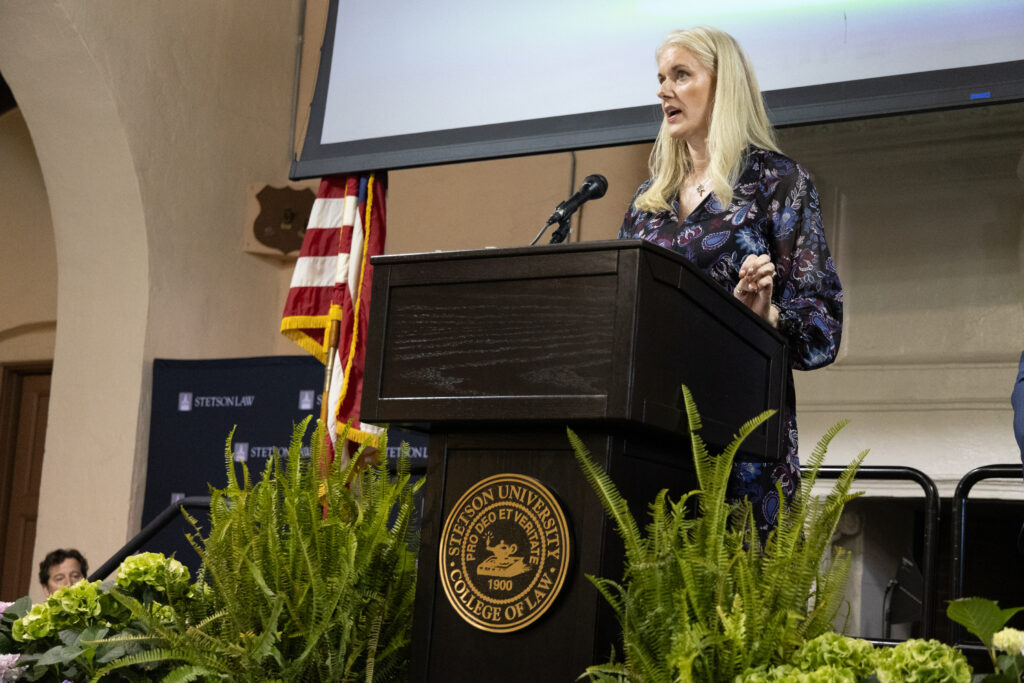
In your bid to purchase Blackacre, that fictional parcel of land familiar to generations of law students, you may be able to sign legal documents using your smartphone. But many of the legal concepts that still shape property ownership in the U.S. were already centuries old when the Mayflower set sail. Today, Stetson Law Dean D. Benjamin Barros is helping lead a national effort to determine whether those rules can be simplified and modernized for a new era.
A national nonpartisan organization, the ULC develops model legislation for state lawmakers to consider, often with the aim of clarifying and modernizing current laws without losing meaning or diminishing legal protections. The committee is examining whether the ULC should propose a uniform law that simplifies our property law by eliminating unneeded complexity that has accumulated over hundreds of years. This work can ultimately influence estate planning, family inheritance, and the transfer and development of property.
As reporter, Barros serves as the primary academic authority for the committee. His research and analysis will support its decision on whether to recommend that the ULC draft a uniform or model act. He will help provide the committee with research and analysis as it evaluates whether longstanding legal doctrines governing property ownership can be simplified and modernized.
“Many of the core principles in our property law are unnecessarily complex because they have their origins in feudal England. They often reflect issues that were present 500 years ago but aren’t present today,” Barros said. “I am excited to help with this project exploring ways to make our property law simpler and more clear. I’m grateful to the ULC for this opportunity.”
A nationally recognized property-law scholar, Barros has authored a highly regarded casebook on the topic and was founding editor of the Journal of Law, Property, and Society, a peer-reviewed publication by the Association of Property, Law, and Society. Notably, his 2008 paper, “Toward a Model Law of Estates and Future Interests,” anticipated many of the issues now under consideration by the committee and explored how these doctrines might be simplified through model legislation. His appointment reflects both his subject-matter expertise and his leadership within legal academia
The committee’s recommendations could ultimately influence future law-reform efforts and, if advanced into a drafting project, help shape model legislation designed to promote greater clarity, consistency, and predictability in state property laws.
If the committee recommends drafting model legislation, its work may help shape laws that state legislatures across the country will consider, potentially supporting more robust property rights for future generations.
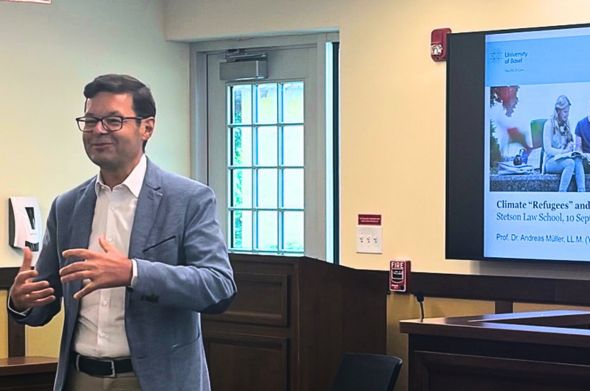
Dr. Andreas Muller speaks about the challenges of addressing what are commonly referred to as climate refugees.
What happens when climate change and disasters force people from their homes, but international law offers no single framework for protecting them?
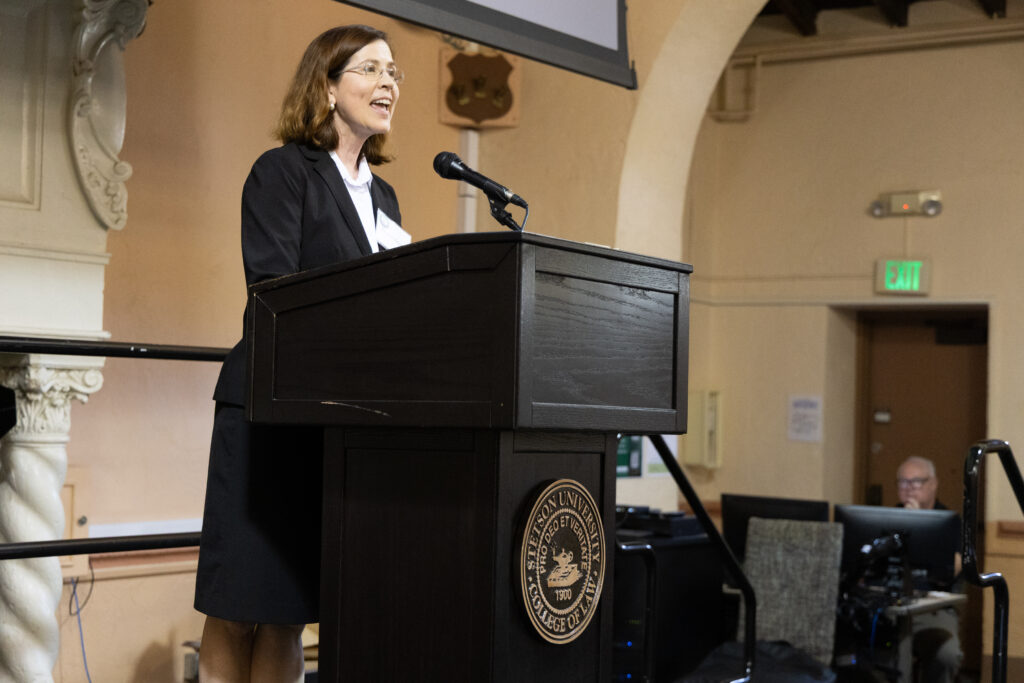
Before an audience of law students representing a broad range of interests, Dr. Andreas Müller, Professor of international law, human rights law, and European law at the University of Basel (Switzerland), examined the ways nations might work together to support people displaced by rising seas and other effects of climate change – often referred to as climate refugees.
Disaster-related displacement is already occurring on a vast scale: 45.8 million internal displacement movements were recorded worldwide in 2024 alone. Rising sea levels threaten the long-term habitability of low-lying Pacific Island communities and may contribute to migration to more stable locations. Changing weather patterns, including more intense heat and more frequent droughts, may also render some areas no longer livable.
“The tendency is clear,” Müller said. “We have a rising number of people who are displaced due to disasters and climate change.”
Yet existing international law has yet to fully address the scope of the issue.
Most people displaced by climate change or natural disasters do not fall within the legal definition of a refugee, which requires a well-founded fear of persecution on specified grounds. International human rights law, meanwhile, may protect people in particularly serious cases by preventing states from returning them to places where climate-related conditions pose a real threat to life. Because “refugee” has a specific legal meaning, Müller suggested using the broader terminology of climate- or disaster-related displacement and displaced persons.
Regional agreements may offer a path forward
While there are nonbinding policies to guide nations, many factors make it challenging to create a global framework to prepare for large population movements, from political considerations to differences in legal systems and language. The 1951 Refugee Convention grants refugee status to individuals facing persecution based on race, religion, nationality, political opinion, or membership in a particular social group.
Human rights law may prevent nations from returning someone to a place where climate-related conditions pose a serious threat to life. In 2019, the U.N. Human Rights Committee ruled that, in extreme cases, deporting individuals to such conditions could violate human rights obligations.
With no universal framework on the horizon, time may be running out.
“Starting from the bottom, we can say with great likelihood that there will be no universally binding treaties any time soon,” Müller said. “We can’t wait for that.”
Agreements among nations within distinct geographic regions may offer a way forward, he said. The Falepili Union, for example, is an agreement between Australia and Tuvalu that provides a pathway for a set number of Tuvaluan citizens to migrate legally to Australia each year. In Latin America, the Cartagena Declaration on Refugees includes broader protections for people fleeing circumstances that seriously disturb public order, language that could potentially apply to certain climate-related displacement scenarios.
Other regional arrangements, including in Africa and Europe, could also help inform future policy.
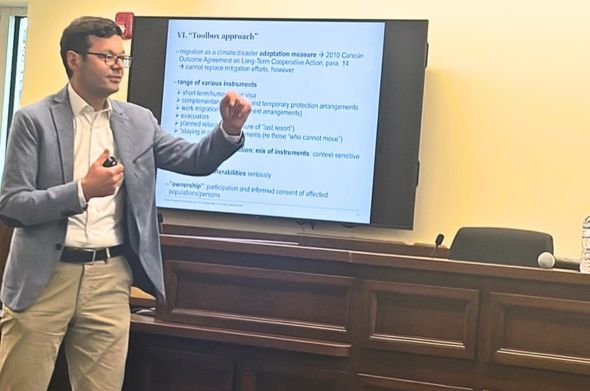
Dr. Andreas Muller discusses how the international community can support populations displaced by a changing climate.
Given the wide array of climate impacts and the distinct challenges they pose, a one-size-fits-all solution likely would not make sense, Müller said, but the constellation of existing frameworks might inform a “toolbox” approach for policymakers.
“We can only solve this together,” Müller said. “It’s a big problem, we know it.”
A cross-campus collaboration
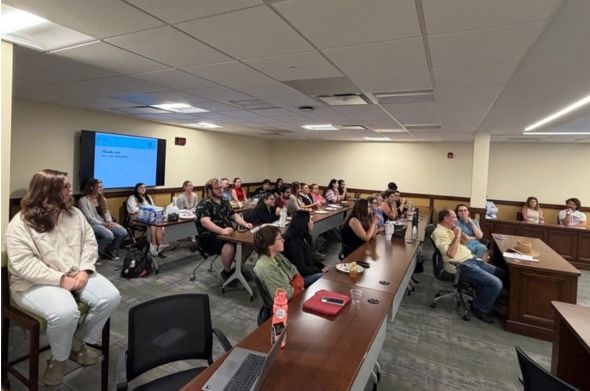
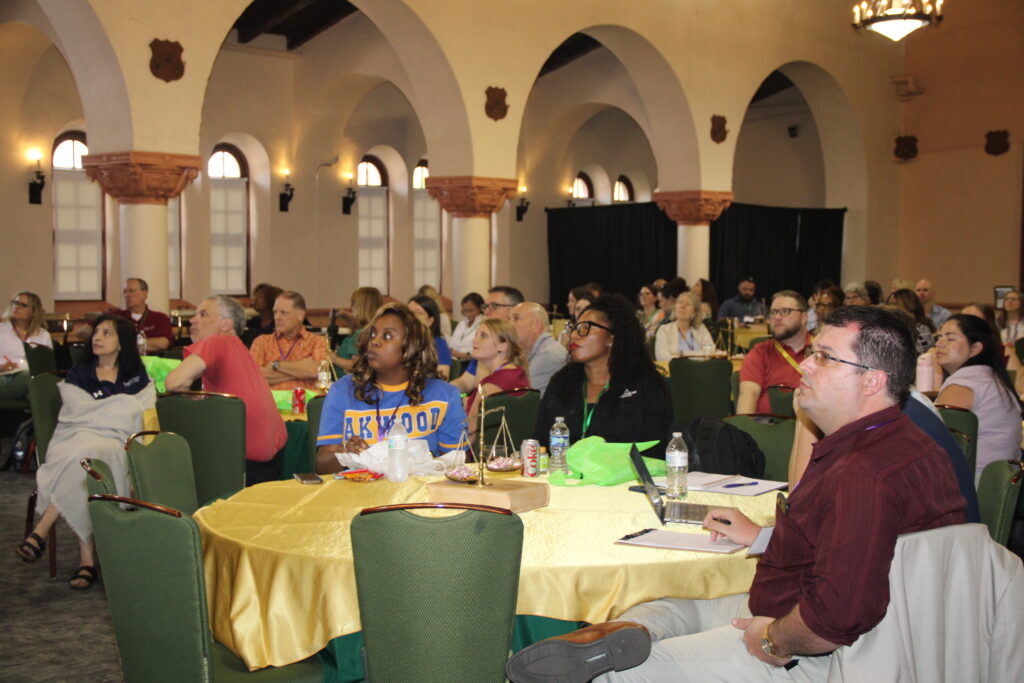
The event was organized by the International Law Society, Immigration Law Student Association, International Programs, and the Institute for Biodiversity Law and Policy. For the more than 30 students in attendance, it demonstrated the value of approaching complex global problems across different areas of law.
“Bringing speakers like Professor Müller to campus is vital for students, and I am happy that the International Law Society, along with our co-sponsors, was able to deliver such an event,” said Chloe Bailey, president of Stetson’s International Law Society. “This intersection is why it is important to work across disciplines and understand how each interacts with the other.”
About 30 students attended a lecture by Dr. Andreas Muller about international law and climate refugees.
The lecture also reflected Stetson Law’s efforts to expand its international law programming and create opportunities for students to engage directly with scholars from around the world.
“One of the goals of our international law programming is to bring students into direct conversation with international scholars working on legal problems that cross both borders and traditional doctrinal boundaries,” said Dr Klara Polackova Van der Ploeg, Associate Professor and Faculty Co-Director for International Programming. “Professor Müller’s visit was a particularly valuable example: climate-related displacement sits at the intersection of international, human rights, migration, and environmental law, and the discussion showed students how those fields interact when the law is confronted with a genuinely global problem.”
Law Professor Peter Lake, director of Stetson’s Center for Excellence in Higher Education Law and Policy
With Professor Peter Lake at its helm, Stetson’s Center for Excellence in Higher Education Law & Policy is a hub for professionals working in the higher ed sector.
From expert-led webinars on national policy shifts to a national conference on Clearwater Beach every spring, the Center brings together industry leaders to speak openly about work and life in a dynamic law and policy landscape.
Now, the Center is poised to launch a cutting-edge Master of Jurisprudence (MJur) in Higher Education Law and Policy that will begin taking applications in late 2026. Fully accredited by the Southern Association of Colleges and Schools Commission on Colleges, this new degree program will invite higher ed professionals to deepen their knowledge of law and policy via a curriculum designed with keen sensitivity to operational realities in the field.
“Demand for training opportunities in the field related to law and regulatory compliance, such as compliance with Title VI and Title IX requirements, is currently at an all-time high,” said Lake. “Here at the Center, we can offer the tools and expertise to meet that demand with this new degree program.”
Nimble, innovative curriculum
Ideal for higher education administrators who seek greater command of the legal, regulatory, and policy issues that shape colleges and universities, the program does not require students to hold or seek a JD, nor does it require the commitment of time and resources associated with a conventional JD program.
The program consists of almost entirely online courses, some of which will have asynchronous elements, and is structured to allow higher education professionals to continue working in the field while attaining the degree. There is just one live, in-person attendance requirement: the annual national conference, where students will interact with presenters and attendees on Clearwater Beach.
Students will learn from and work with an established network of scholars and experts in the legal field related to higher education law and policy, including Lake.
Courses will take deep dives on subjects like the foundations of higher education law and policy, the legal/regulatory system that governs the field, and others.
Built-in flexibility for a changing landscape
Selective and challenging, the program is designed to be completed in as little as two years, but participants whose schedules do not allow for completion of the program in its ordinary course may revisit the degree within up to six years.
Successful completion of the program will result in the ability to better navigate areas such as federal regulatory compliance, governance, risk management, student and employee rights, and institutional policy development.
To support professional development within the broader higher ed community, some course offerings will also be available as a la carte, certificate of completion granting trainings on topics such as Title IX compliance.
“This program is tailor-made to suit the needs of higher education administrators working in what has become a legal and regulatory compliance-focused field,” Lake said. “We are thrilled to now offer this one-of-a-kind program to ambitious professionals who aspire to lead their institutions into the future.”
Law Professor Kristen Adams speaks at a Stetson Law event.
Working as a bank teller over several summers during her college days, Stetson Law Professor Kristen Adams developed a curiosity about cashless transactions and how they are regulated.
“I became completely fascinated with the laws of payment systems,” Adams said.
In the years since, the longtime Stetson Law professor has developed a subspecialty in payment systems and is now a recognized expert in the area, which encompasses checks, promissory notes, credit, and cryptocurrency. Recently, Adams was appointed to an influential position in which she will lend her expertise to a group studying legal and policy issues relating to payment fraud.
To Adams, the undertaking is the culmination of a nearly lifelong dream.
“This has been an enormous honor to receive,” Adams said. “It’s something that I’ve wanted to do for at least as long as I’ve been a professor.”
Shaping anti-fraud laws in the digital age
Working with the ALI, the ULC develops and updates the Uniform Commercial Code (UCC), a comprehensive set of model laws that states can adopt to modernize and standardize rules governing commercial transactions.
In the ULC and ALI process, a reporter is a nationally recognized scholar who conducts extensive legal research, drafts proposed statutory language and official comments, and helps guide the committee through the drafting process. It is a prestigious role for which the nation’s top legal scholars are chosen.
The joint study committee was created to address an alarming rise in fraudulent checks and wire transfers in recent years. As a reporter, Adams will evaluate how current laws support banks, businesses, and individuals when fraud occurs. Based on her analysis, she will recommend updates to modernize the current code so that it can more effectively address cyber threats and scams.
By investigating emerging trends, industry practices, and court decisions, drafting proposed UCC language and official comments, and providing objective legal guidance to committee members, Adams is engaging in the same type of work that she teaches her students to perform.
Addressing a new frontier
Reporters are generally highly respected law professors or legal experts selected for their deep, specialized knowledge of commercial law. The position is typically by invitation.
The scope of her work – amending the code to address checks and wire fraud – is narrow but extremely timely.
“There are forms of fraud that may not have existed when the code was written,” Adams said.
She has met with Federal Reserve officials, AARP representatives, consumer groups, banks, and other stakeholders with the goal of developing recommendations that could take the form of amendments to the UCC, official commentary, proposed federal legislation, or regulatory changes.
Adams said the committee is moving forward quickly on the project and could complete its study in as little as six months.
Stetson Law added faculty with a dynamic range of expertise in 2026.
As the 2026 academic year begins, Stetson Law welcomes new and visiting faculty representing a diverse range of specialties. Their expertise and experience will enhance the College of Law’s robust offerings and empower students to build the skills that will make them exceptional, ethical legal professionals.
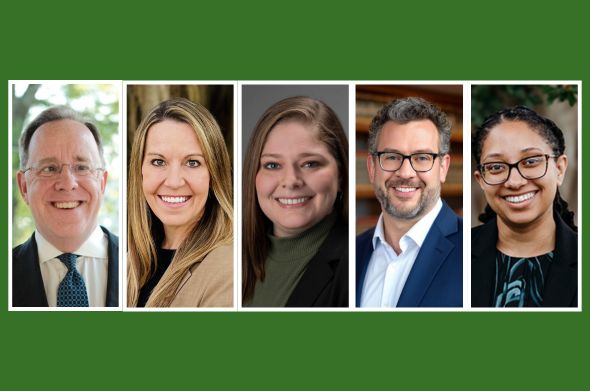
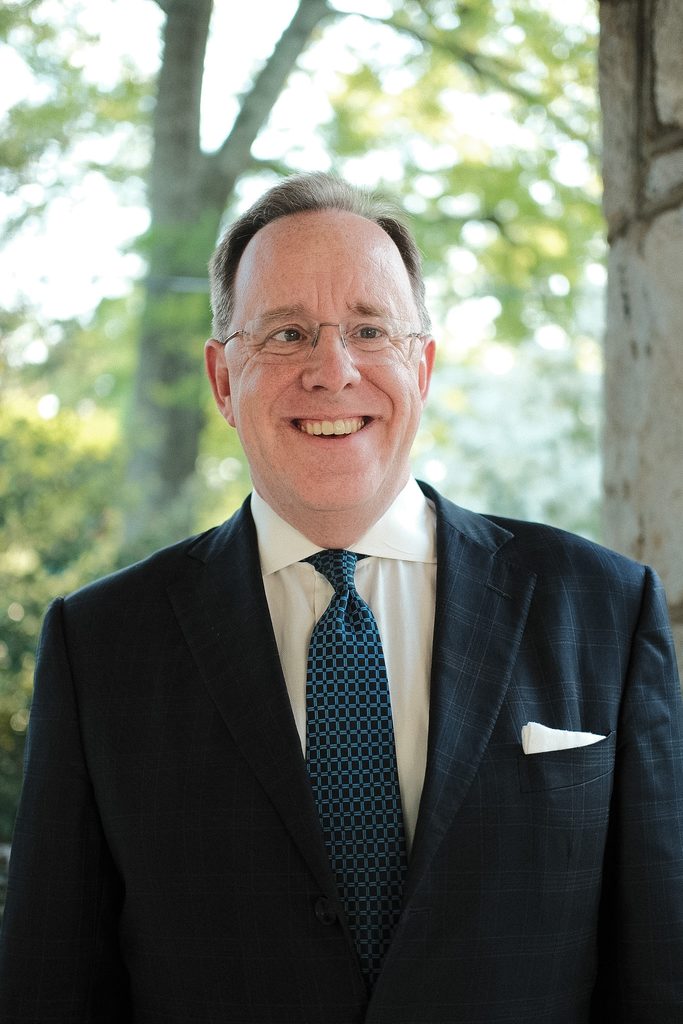
Professor of Law W. Edward “Ted” Afield – Tax Law
Professor Edward W. “Ted” Afield
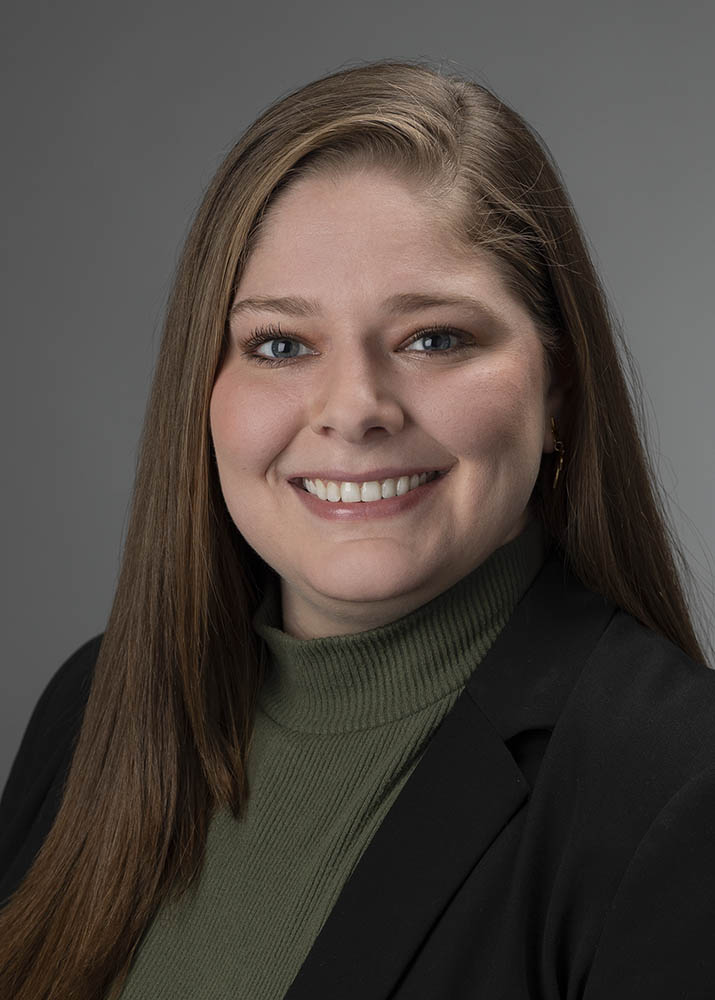
Specializing in federal taxation and business law, W. Edward “Ted” Afield joins the Stetson Law community following faculty and leadership roles at Georgia State University College of Law and Ave Maria School of Law, including serving as vice dean and associate dean. Early in his career, Afield practiced law in Tampa and clerked for Judge Charles R. Wilson on the U.S. Court of Appeals for the Eleventh Circuit. His research focuses on tax compliance, professional regulation, and the intersection of tax law and religion, with publications in leading law journals. Afield holds an AB from Harvard, a JD from Columbia Law School, and an LLM from the University of Florida.
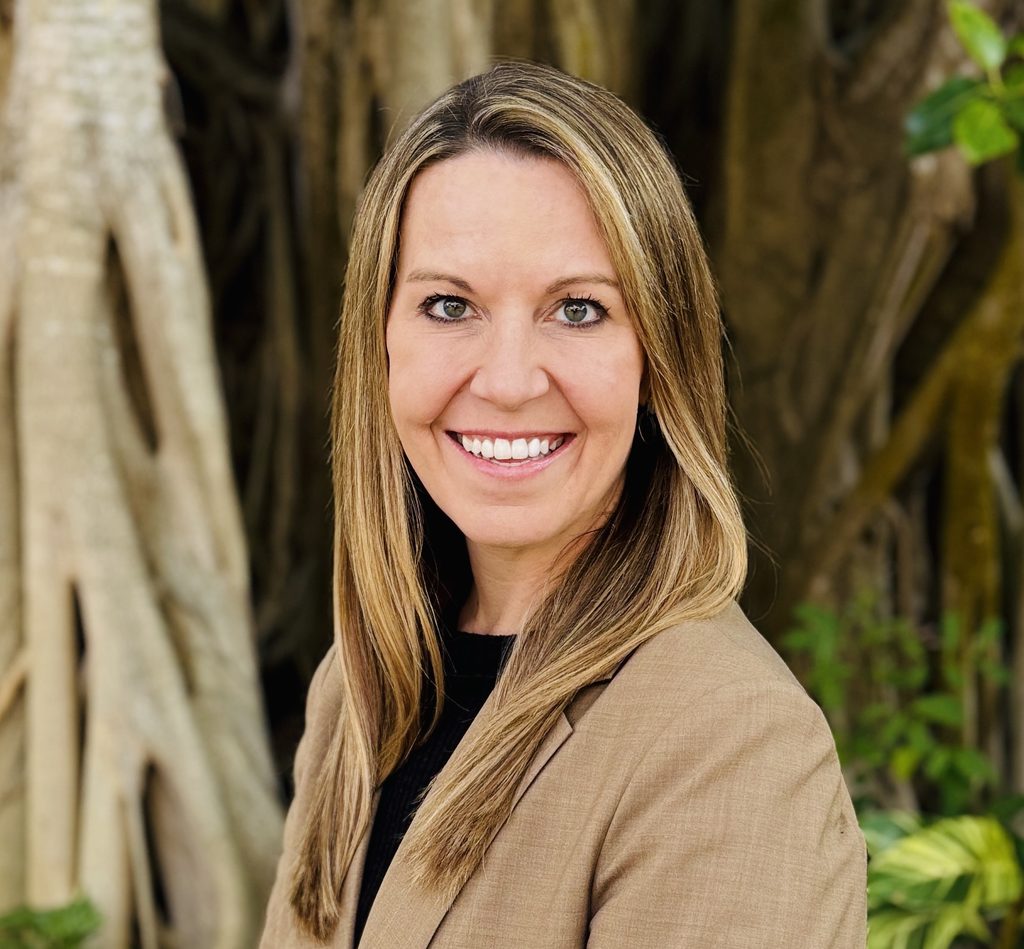
Assistant Professor of Law Kate Donoghue – Evidence, Criminal Law, & Criminal Procedure
Assistant Professor Kate Donoghue
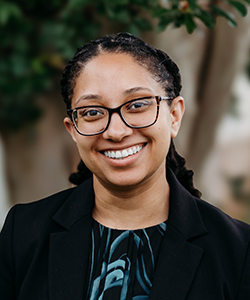
A driving force behind Stetson’s reputation as an advocacy powerhouse, Katherine “Kate” Donoghue teaches evidence, jury selection, and trial advocacy and directs Stetson’s celebrated Trial Team. Her scholarship focuses on evidence, advocacy, legal ethics, jury decision-making, and the impact of emerging technologies, particularly artificial intelligence, on the legal profession. A leading voice on AI’s role in advocacy education, she develops innovative advocacy training tools and presents nationally on legal education and technology. Before academia, she practiced commercial litigation, represented vulnerable children as well as domestic violence survivors, and served as a prosecutor in Connecticut. An award-winning educator and advocate, she holds a JD, magna cum laude, from Fordham Law School and remains active in legal scholarship and professional training nationwide.
Assistant Professor of Law Victoria Litman – Drug Law, Law & Religion
Assistant Professor Victoria Litman
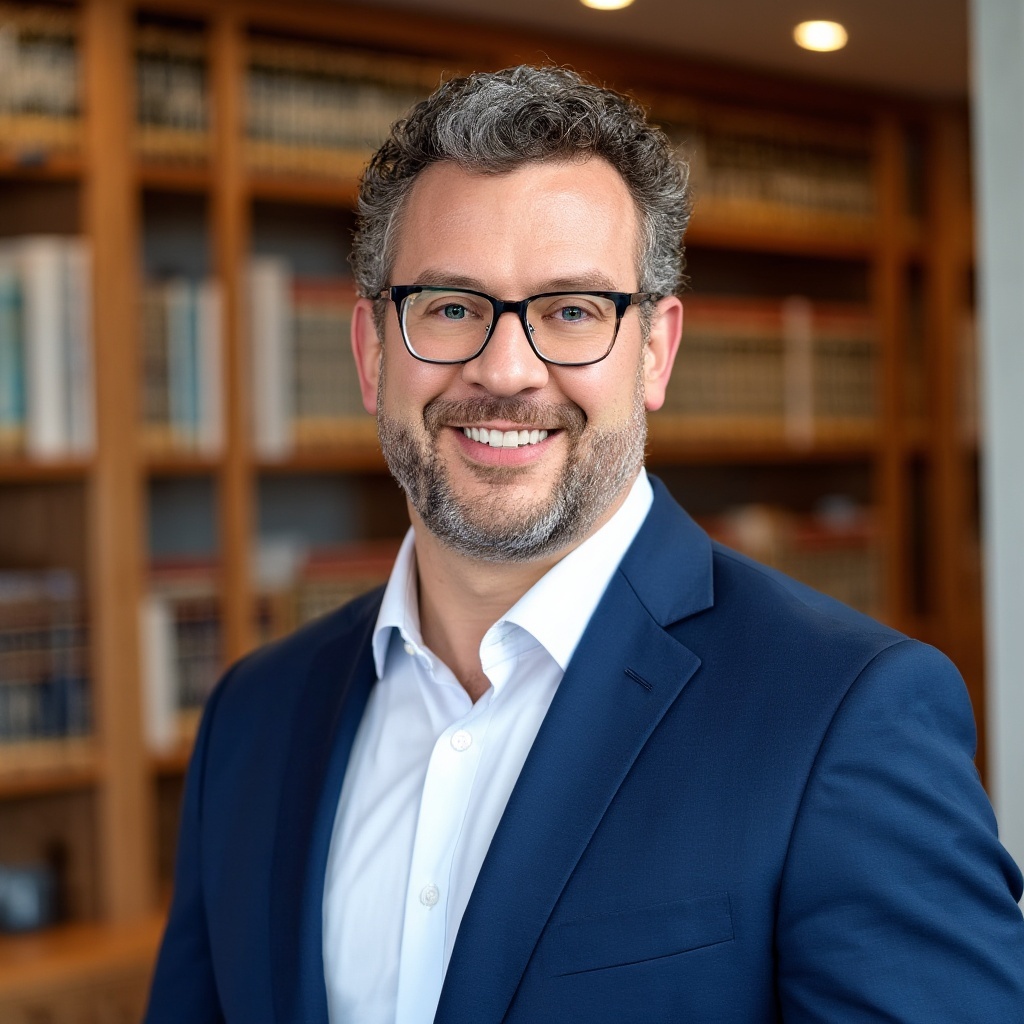
Specializing in drug law, law and religion, nonprofit organizations, and constitutional law, Victoria Litman is a nationally recognized expert in cannabis and psychedelic law and policy. Her scholarship explores drug regulation, religious freedom, taxation, and federalism. She has been affiliated with Harvard Law School’s Petrie-Flom Center, contributing to research on psychedelic law and spiritual experience. Previously a nonprofit tax attorney, she advised cannabis and psychedelic organizations on tax-exemption issues. Her scholarship around shifting federal-state power dynamics has earned her national recognition and she has taught at Roger Williams University School of Law. She earned her JD at New York Law School and holds an LLM from Georgetown University Law Center.
Bruce R. Jacob VisitingProfessorof LawBrianna Rosier Kabwika– Professional Responsibility
Bruce R. Jacob Visiting Law Professor Brianna Kabwika
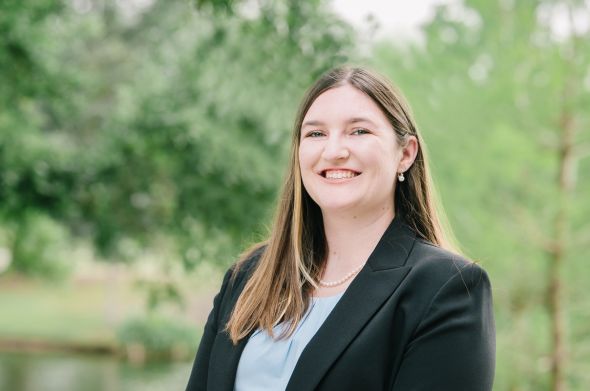
Teaching professional responsibility at Stetson Law, Brianna Rosier Kabwika has extensive experience teaching and researching in such areas as children’s rights, climate and environmental justice, state constitutional law, property, family law, and trusts and estates. Before joining Stetson, she served as a fellow and staff attorney with the nonprofit Our Children’s Trust, where she developed innovative constitutional climate litigation strategies focused on young people’s right to a stable climate. She previously practiced civil and criminal litigation in Idaho. A graduate of Brigham Young University’s J. Reuben Clark Law School, Rosier Kabwika earned her BA in criminal justice from the University of Central Florida, and remains an active scholar, attorney, and advocate committed to advancing justice and constitutional rights.
Assistant Professor of Law Gregory G. Schwab– Civil Procedure, Constitutional Law
Assistant Professor Greg Schwab
Gregory Schwab’s scholarship focuses on executive power and administrative law, with particular emphasis on gubernatorial emergency powers. Before entering academia, Schwab served as general counsel of the Commonwealth of Pennsylvania, leading an office of more than 500 attorneys and advising state leadership on major legal issues, including voting rights, redistricting, and pandemic response. A former government lawyer and litigator, he is also a Uniform Law Commission commissioner, writer, and frequent speaker on state governance and constitutional law. He earned his JD at the University of Maryland Francis King Carey School of Law.
With expertise spanning advocacy, constitutional law, taxation, legal writing, professional responsibility, and law’s complex relationship with religion, these faculty members further elevate Stetson Law’s mission to educate the next generation of exceptional lawyers and leaders.
Every couple hopes for the perfect wedding. While wedding-planning usually involves guest lists, cake tastings, and flowers, few expect bankruptcy court to be part of the checklist.
In early June 2026, Stetson Dispute Resolution Board alumna Sierra Scott ’25 and her fiancé learned that their wedding venue, Red Mesa Cantina in St. Pete, had abruptly closed and filed for Chapter 11 bankruptcy, leaving couples wondering what would happen to the deposits they had paid to reserve their wedding venue.
At the June 4 hearing, the Bankruptcy Court determined that consumers were entitled to recover only $3,800 under the Bankruptcy Code, a figure far smaller than the deposits many couples had paid to reserve their wedding date. For couples with weddings only weeks or months away, the news was devastating. They now faced the challenge of finding a new venue while trying to recover the deposits they had already paid.
Recognizing the importance of the issue, the Court invited interested parties to submit legal authority addressing whether customers could recover more than the amount typically protected under the Bankruptcy Code.
Although Scott’s wedding was not until 2028, she did not hesitate.
“I felt that, as an attorney, I had both the ability and the responsibility to help where I could,” she said.
Scott volunteered to research the issue and prepare a memorandum of law for the court’s consideration. She was initially nervous about researching and writing in an unfamiliar area of law but quickly found herself relying on the same skills she developed as a member of the Dispute Resolution Board.
“One of the most valuable lessons I learned through the Board was how to advocate in situations where the answer is not entirely clear,” she said. “The issue before the court did not have a simple, directly controlling solution. Similar to the negotiation competitions I participated in, I had to evaluate competing arguments, identify the most persuasive authorities, and develop a coherent narrative that connected the facts to the legal principles.”
After considering her memorandum alongside the other filings before the court, the Bankruptcy Court ultimately authorized 100 percent refunds of the affected event deposits. The Court’s Final Order specifically references Scott’s memorandum among the materials considered in reaching its decision.
In open court, the Court also recognized the 2025 Stetson alumna’s efforts, stating:
“Ms. Scott, the other similarly situated brides- and grooms-to-be owe you a pat on the back.”
Reflecting on the experience, Scott encourages current Stetson students to embrace opportunities that take them outside their comfort zones and to remember that the skills they develop through advocacy have real-world applications.
“Those skills are valuable in every area of practice and can make a meaningful difference when people need an advocate most,” she said.
In partnership with a trusted developer, Stetson moves forward on plans to transform the Tampa Law Center property.
Stetson’s Tampa Law Center is on track to be an anchor for an exciting mixed-use development in Downtown Tampa.
Stetson University plans to increase its visibility and deepen its long-standing commitment to Downtown Tampa through a transformative redevelopment initiative in partnership with Bromley Companies. The project will modernize the Stetson University College of Law’s Tampa Law Center and create a vibrant, mixed-use space in a currently underutilized area.
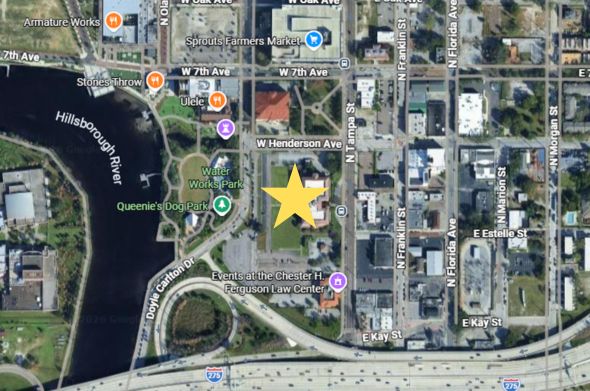
Situated in the vibrant Tampa Heights district near the Hillsborough River and Interstate 275, Tampa Law Center has served students, alumni, legal professionals, and the broader community for more than 20 years. The reimagined campus, which will feature iconic design and prominent Stetson branding, has the potential to become a major urban connection point linking the Riverwalk to Downtown.
“This project will substantially increase our visibility while allowing us to reimagine our Tampa Law Center in a way that reflects the energy and growth of the city – and the ever-changing needs of the legal profession,” said Stetson Law Dean D. Benjamin Barros. “This is an investment in the future of legal education, professional development, and sustainable economic development in the Tampa Bay region.”
Tampa Law Center (indicated by star) sits near the Tampa Riverwalk, Armature Works, and Ulele.
The state-of-the-art facility will advance the vision of Stetson Law remaining at the forefront of legal education by expanding opportunities for professional growth, innovation, and lifelong learning. It will support the continued growth of its part-time juris doctor program known as Flex JD, providing greater access and flexibility for working professionals and non-traditional students. It will also create new opportunities to expand the law school’s micro-credentialing and badging offerings in areas where Stetson Law is a national leader, including advocacy, elder law, and higher education law and policy.
The new law center will be adjacent to a hotel as part of a planned mixed-use development that will connect Downtown Tampa, Tampa Heights, and the Hillsborough Riverwalk. In addition to the law school facility and hotel, the development will add residential, retail, and dining facilities to the property, all within walking distance of some of Tampa’s most iconic destinations like Armature Works, Ulele, and the Tampa Riverwalk.
For the law school, this arrangement provides classrooms for Flex JD courses, a destination for professional education and credentialing programs, and spaces for alumni and networking gatherings. Visitors will have access to a convenient hotel that can accommodate attendees of the numerous regional, national, and international conferences and competitions the College of Law hosts each year. It will also serve as a venue for information sessions to aid in recruitment for undergraduate programs in DeLand.
The site will increase the University’s overall visibility by enhancing awareness of our Law Ready program, housed at our main campus in DeLand with pathways into Stetson Law.
“Stetson University is proud to partner with the Tampa community and Bromley Companies in a major commitment to create a vibrant, revitalized space for the students at Stetson University College of Law,” said Christopher F. Roellke, president of Stetson University. “We are excited about the many programmatic possibilities that this partnership brings us to expand the footprint and visibility of Stetson University through an enhanced physical presence in Tampa.”
Building on Stetson’s Tampa presence
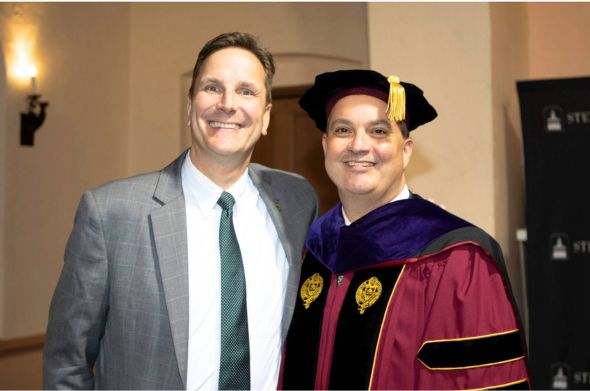
Former Stetson Law Dean Gary Vause (right) and Law Professor Peter Lake (left)
Following a 1997 survey that revealed a growing demand for part-time professional education in the greater Tampa Bay region, Stetson sought to fill that void. Five years later, under then-Dean W.Gary Vause, Stetson purchased the land on which the law center now sits from the City of Tampa.
The Tampa Law Center opened in 2004 and has been integral to Stetson Law’s Flex JD program ever since. Professionals from across Tampa Bay take advantage of evening and weekend classes at the Tampa Law Center and Stetson Law’s main campus in Gulfport to earn their JDs in as little as four years.
In February 2026, the Florida Second District Court of Appeals (DCA), a longtime tenant at the center, relocated to the new Bernie McCabe Courthouse (named for long-time Pinellas County State Attorney and 1972 Stetson Law alumnus Bernie McCabe) in Downtown St. Petersburg.
The vacancy gave Stetson leadership an opportunity to explore ways to enhance the property’s relevance, visibility, and economic sustainability.
A trusted Tampa partner
To support Stetson’s vision for the property, the University has partnered with The Bromley Companies, a firm with a stellar 50-year track record, to create a versatile space along the Tampa Riverwalk that will integrate educational, residential, hospitality, and retail use in a vibrant, walkable environment, with plenty of parking.
Bromley’s recent development, Midtown Tampa, showcases the firm’s expertise in redeveloping urban spaces in a way that sparks economic activity while reflecting the surrounding community. The firm also has extensive experience partnering with universities and communities.
The project will help create continuity between Downtown Tampa, Tampa Heights, and the riverfront, thereby enhancing the area’s desirability.
“This is an extraordinary opportunity to help reshape a highly visible site at one of Tampa’s most important urban connection points,” said Nicholas Haines, CEO of Bromley Companies. “Our goal is to work with Stetson to create a district that supports the university’s long-term mission while contributing meaningfully to the continued growth of Downtown Tampa. The site has the potential to become a true gateway, linking downtown, the Heights, and the Riverwalk through a more active, walkable, and connected mixed-use environment.”
Neighboring the Tampa Law Center, the Hillsborough County Bar Association and Hillsborough County Bar Foundation will remain unaffected and in their current facility while benefitting from increased event space and parking.
While groundbreaking is anticipated in late 2027, the timing of the three-phase redevelopment is subject to continued planning. As currently envisioned, the new law center will be built in the first of three carefully planned phases. The University will retain ownership of the new Stetson Law Center and have permanent access to use of the hotel and parking garage.
Stetson University President Christopher F. Roellke (left); Stetson Law Dean D. Benjamin Barros (right)
To prevent disruption of operations for the Tampa Law Center, demolition of the existing building will occur after the new law center is complete. Current students will experience no disruption of coursework and no loss of parking. It will not impact tuition or operations at Stetson Law’s main campus in Gulfport.
Stetson University’s partnership with Bromley ensures that Stetson will continue to own the law center and that University needs will remain at the forefront. The economic impact to Stetson will be positive, and extensive Stetson-branded signage will enhance visibility from I-275 and along major thoroughfares like North Tampa Street and North Florida Avenue.
“Working with a company with a proven track record like Bromley, we are certain that this project takes a thoughtful approach to redeveloping our Tampa property,” Barros said. “Bromley understands the value of our Tampa Law Center as a place where this region’s most driven professionals come to advance their careers and their earning potential.”
This site will also enhance awareness of the overall Stetson brand while serving as a venue for information sessions to aid in recruitment for undergraduate programs based on the University’s main campus in DeLand.
Stetson’s Tampa Law Center opened in 2004.
With a pioneering approach to community development and a proven track record of truly transformative impacts on the places in which it invests, The Bromley Companies’ portfolio features millions of square feet of student housing, residential units, and comprehensive mixed-use development in Manhattan and Tampa.
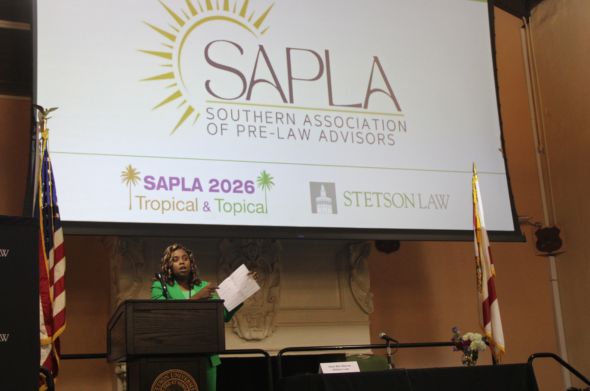
Marcya Burden, current president of the Southeastern Association of Pre-Law Advisors (SAPLA).
With engaging programming and industry insights, the annual Southern Association of Pre-Law Advisors’ conference brought higher education professionals from across the Southeastern US to Stetson Law.
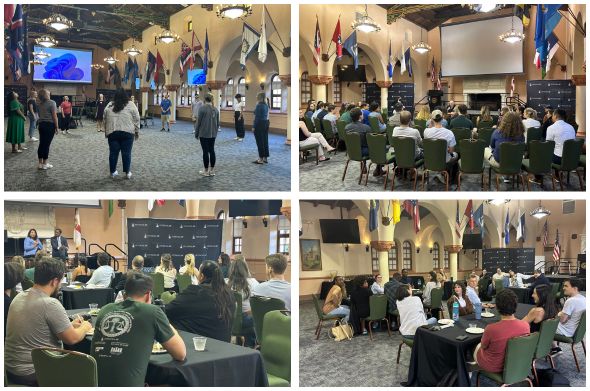
Comprising a broad range of backgrounds – from law professors to career counselors, all of whom play numerous roles within their home institutions – more than 100 attendees heard sharp insights about law school admissions, updates on recent student loan policy changes, and strategies for avoiding burnout. Many were first-time conference attendees; others had never before set foot on the Stetson Law campus.
Advisors had the chance to speak with law schools from across the region as well as test-prep companies and other non-law-school exhibitors – all while getting a close-up view of the stunning Stetson Law campus and learning about its unique offerings for prospective law students.
The June 2026 event marked the first time the event took place at the College, and the first time it occurred in Florida in recent memory – if ever.
“It was very important for us to address what is currently going on in the everchanging landscape of law school admissions,” said Marcya Burden, current president of SAPLA and, among other roles, pre-law director at Oakville University in Huntsville, Alabama. “And what better way to do that than meeting at such a historic law school whose mission and purpose has always been to strive for excellence and to advocate for others?”
A changing & competitive landscape
Even as federal student loans for graduate-level students become more challenging to obtain, student interest in attending law school has never been higher. Yet the number of spots available at many law schools has remained somewhat static. Student GPAs and median LSAT scores have soared as a result, making for stiff competition at law schools across the country.
Those advising undergraduates who are considering a career in law strive to stay on top of these changes as well as how law schools are preparing students for sustainable careers when factors like generative AI pose seismic changes to the field.
“The work you all do is so important,” said Stetson Law Dean D. Benjamin Barros in his remarks to conference attendees. “I think more than ever that prospective students and their parents want to see sustainable career pathways.”
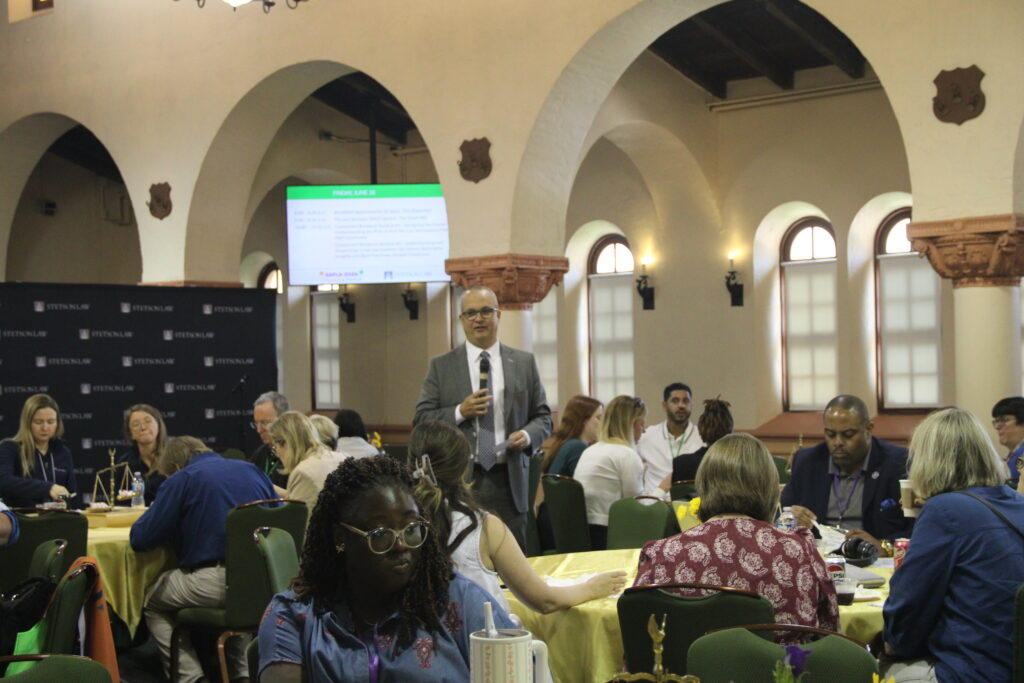
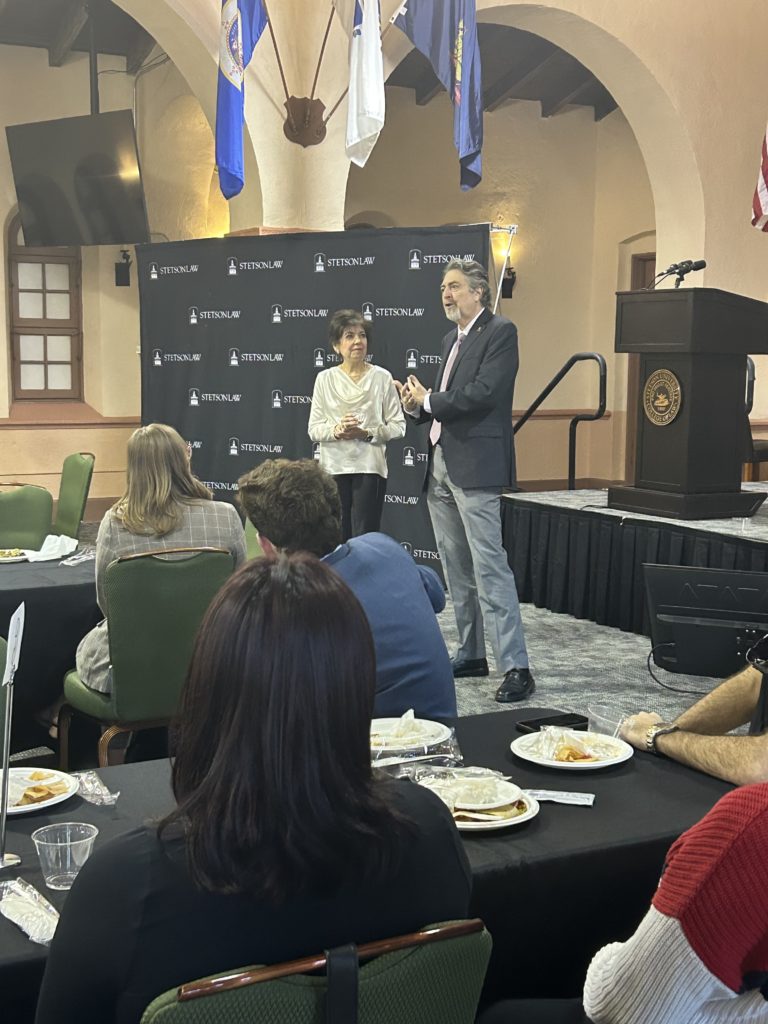
Stetson Law Dean D. Benjamin Barros speaks to pre-law advisors gathered for an annual conference at Stetson Law.
The conference invites attendees to learn from each other while building their professional networks. Networking sessions have led to collaborations on law school fairs and other events – all with the goal of connecting undergraduate students with a law school that will be the right fit and lead to a fulfilling future.
Guiding students in an uncertain future can add a layer of stress for advisors who usually have numerous other roles at their schools but often aren’t compensated for the extra work of advising.
“Most of the prelaw advisors in our region serve in dual roles,” Burden said. “They’re either on the staff side or the faculty side.”
Attendees at the Southeastern Association of Pre Law Advisors 2026 Conference comprised a variety of backgrounds.
That’s why, in addition to programming specific to pre-law advising, SAPLA leadership includes sessions about strategies for avoiding burnout and other wellness-focused insights. This year’s conference also featured an update from the Law School Admissions Council, which administers the LSAT, on how to navigate changes to how the test is administered.
“It has been an honor to host so many important conversations about the changing legal education landscape and what it means for the professionals we entrust with helping students find the right career path,” said Stetson Law Director of Admissions and Recruitment Darren Kettles. “Our team worked hard to provide an environment where attendees could have open conversations, gain sharp insights, and make important professional connections on our beautiful campus – just as we do for our students.”
Exploring Stetson’s offerings
When choosing a site for the annual conference, SAPLA looks for law schools that have signature programs that prelaw advisors will want to share with their students.
With its focus on career readiness, nation-leading advocacy and legal writing programs, community-focused culture, and breathtaking grounds, Stetson Law gave previously unfamiliar attendees food for thought.
“It’s a bit different when you’re viewing it on a webpage versus when you’ve had a connection to the place,” said SAPLA Vice President and Conference Co-Chair Carol Riddock, director of prelaw advisory at Emory University in Atlanta. “Seeing a law school in person gives me a sense of their ethos and their community.”
A new approach to orienting 1L students offers a variety of immersive activities to help students acclimate to law school life.
Stetson University College of Law’s Stetson Inns program was recognized with the 2026 Excellence in Innovation Award: Law Schools award, a new honor from Insight Into Academia magazine. The award honors the Stetson Inns program for its innovative approach to student orientation experience, which has been proven to help students to start building community and confidence during their first days at Stetson Law.
The nation’s longest-running publication dedicated to promoting advancement in higher education, Insight highlights initiatives that lead the way in shaping industry best practices. This new award celebrates law schools that demonstrate a bold, effective approach to rethinking legal education. Through transformative programs and initiatives that reflect how students learn as well as the day-to-day life of law firms, these schools are taking a fresh approach to curriculum, experiential learning, technology and AI integration, access to legal education, professional pathways, and more to better serve the evolving needs of students and meet the rapidly shifting demands and expectations of the legal profession.
Inspired by the British Inns of Court tradition as well as the broader culture of Stetson Law, Stetson Inns is a dynamic reimagining of traditional law school orientation programming.
“The Stetson Inns are where our students explore and begin to develop the competence, candor, diligence, and professional judgement that are essential to success in the legal profession,” said Stetson Law Associate Dean for Assessment and Professional Engagement Anne Mullins, an architect of the program. “We are grateful to Insight into America for recognizing the thought and planning that has gone into this signature program.”
In February 2024, the Podgor and Adams Inns heard from guest speakers, the Honorable Nelly Khouzam and the Honorable Morris Silberman, both judges on Florida’s Second District Court of Appeal.
Insight Into Academia magazine selected the Stetson Inns program because it meets students where they are, it is future-focused, and it has created a measurable impact on students since it launched in fall of 2023.
It invites first-year students to acclimate to law school life in smaller groups led by a faculty mentor (referred to as a “Bencher”) and supported by upper-level students.
Through candid discussions, guest speakers, and other events, students are encouraged to explore professional identity, long-term career goals, and strategies for dealing with the stresses of law school and life as a lawyer. In fall of 2025, the program added a session on ethical use of artificial intelligence in law school and the legal profession, which was led by Dr.Kirsten K. Davis, a Stetson Law professor who has led the national conversation about AI use in law schools and the legal profession.
Students have had an overwhelmingly positive response to the program.
According to an informal survey taken after the initial implementation of Stetson Inns, 97 percent of students said they “started building community during orientation” – up from 54 percent in prior years. Meanwhile, 94 percent of students said they had at least one upper-level student they could reach out to, and 96 percent said there was at least one faculty, staff, or administration member they felt comfortable reaching out to. In prior years, those percentages were 55 and 33 percent, respectively.
Stetson Law will be featured in the July/August 2026 issue of Insight Into Academia magazine.
“The Insight Into Academia Excellence in Innovation Award: Law Schools is a prestigious national honor recognizing law schools driving innovation in legal education,” said Holly Mendelson, co-owner and publisher of Insight Into Academia magazine. “This selective recognition celebrates programs defined by forward-thinking design and measurable impact—initiatives that raise the standard and advance the field.”
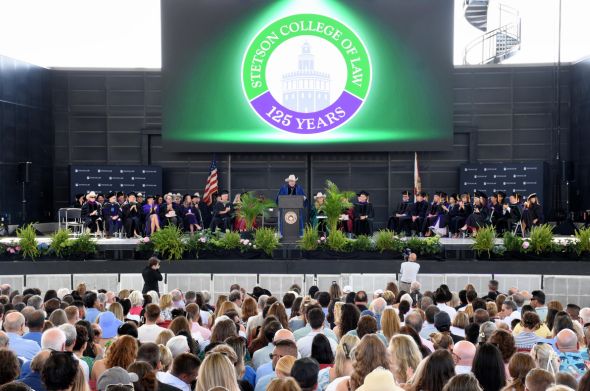
The Stetson Law 2026 Commencement took place at BayCare Sound in Clearwater, Florida.
In the early evening on Saturday, May 16, Stetson University College of Law marked a major milestone for more than 300 students who successfully completed their law school journey.
The Spring 2026 Commencement ceremony took place at The BayCare Sound in Clearwater. The ceremony recognized the classes of December 2025 as well as May and August of 2026.
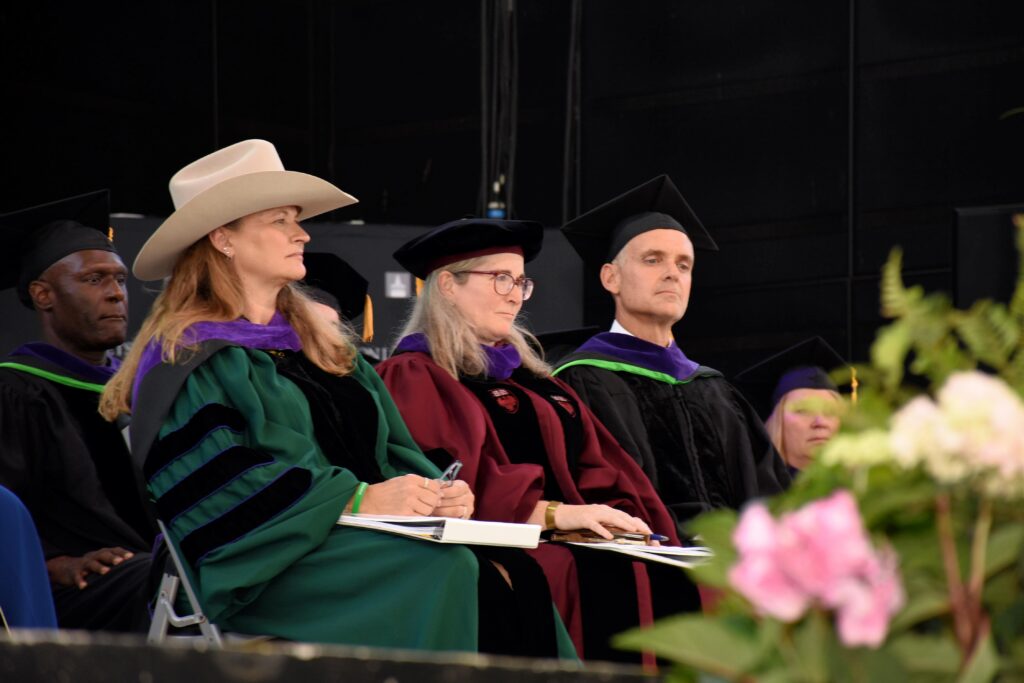
Stetson Law Vice Dean Jason Palmer led the event. He was joined onstage by Stetson University Provost Elizabeth Skomp, Stetson University Board of Trustees Chair Steven Alexander, Stetson University College of Law Board of Overseers Chair Jason Turner, Associate Dean for Assessment and Professional Engagement Anne Mullins, Associate Dean for Academic Affairs and Veterans Law Institute Director Stacey-Rae Simcox, and other distinguished members of the Stetson Law community.
Left to right: Associate Dean for Academic Affairs and Veterans Law Institute Director Stacey-Rae Simcox, Associate Dean for Assessment and Professional Engagement Anne Mullins, and 1996 alumnus Michael Loparco
To kick off the event, Stetson Law Dean D. Benjamin Barros praised the graduating students for showing character as they faced the rigors of law school and mastering the skills that lawyers need to be successful.
“Here at Stetson Law, you learned to lead with empathy, resourcefulness, and commitment,” he said. “That commitment is evident in the more than 27,000 hours of legal and non-legal pro bono service contributed by you and your classmates. That spirit of service will define your careers just as much as your legal skill.”
Stetson University President Christopher Roellke urged the graduates to remain steadfast in their commitment to justice – and said that their success at Stetson Law demonstrates that they can achieve great things even amid times of unprecedented change.
“You have not only met the rigorous demands of a Stetson legal education, you have done so during a time of profound complexity and change in our world,” he said. “In doing so, you have developed the critical thinking, ethical reasoning, and practical skills that will enable you to lead and serve with distinction.”
Alumni words of wisdom
Current Stetson Law Board of Overseers Chair Jason Turner ’04, a successful lawyer in the music industry, encouraged the graduates to remain committed to ethics and professional responsibility for the duration of their careers.
“As lawyers, we are so deeply privileged to do what we do for a living,” he said. “It is a calling with a deeply important responsibility. People will come to you for help with their challenges. And most of all, they are going to trust that you never forget our greatest calling: to represent the client’s interest with the utmost integrity, respect and humility each step of the way. And never forget “who” the client actually is while doing your job – and that no client is ever worth losing your reputation or license.”
Reflecting on the adage, “The best time to plant a tree was 20 years ago. The second-best time is today,” Stetson Lawyers Alumni Association President Howard Williams said the graduates’ Stetson roots will create lifelong connections that will serve them well.
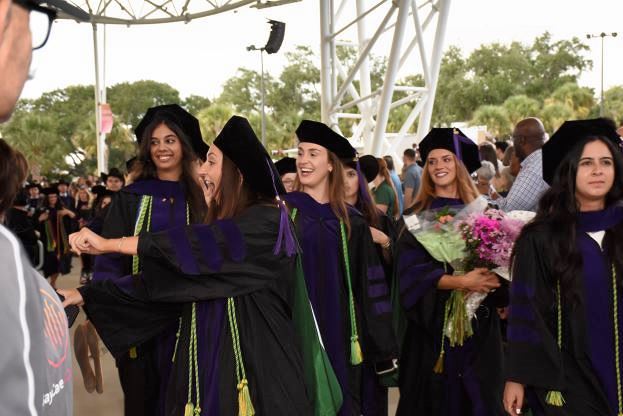
Members of Stetson Law’s Class of 2026.
“Your destiny begins with the tree you are planting today,” Williams said. “Five, ten, 15, or 20 years from now, you will look back and realize this was one of the greatest decisions of your life.”
Student Bar Association President William Austin Dodson applauded his classmates for making it through law school – primarily their final year, which had unique challenges.
“Some say that character is not something law school can teach. I disagree,” Dodson said. “I believe this place has been shaping exactly that in all of us. In the way you supported each other. In the way you showed up when it mattered. In the way you handled setbacks, disagreements, and uncertainty. Those experiences matter. They will stay with you long after today.”
Engaging keynote from a distinguished alum
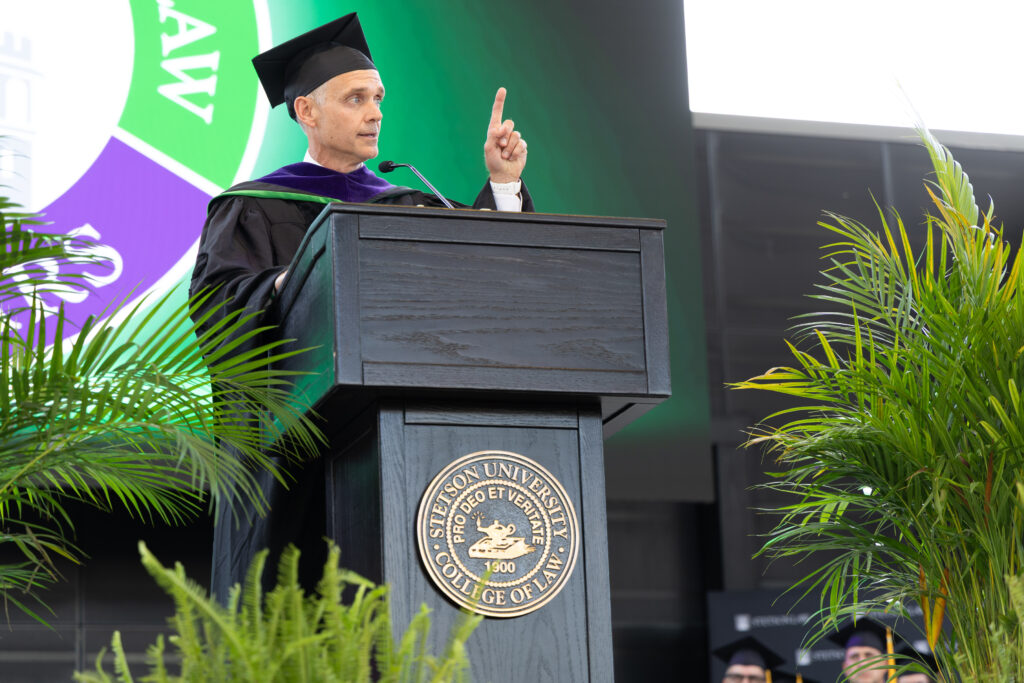
Distinguished tech leader and 1996 alumnus Michael Loparco delivered an engaging commencement keynote.
1996 alumnus and 2026 commencement speaker Joe Loparco
With more than 25 years’ experience building and growing highly technical and cross-border manufacturing businesses, he served as CEO of Symbotic, an AI and software-enabled warehouse robotics and automation company, and spent more than two decades at Jabil Inc., where he was responsible for driving growth, innovation, and digital transformation. Before joining Jabil, he practiced corporate and commercial litigation.
He said the capabilities and qualities Stetson Law instills in its students will empower them to speak confidently, but with humility, in places where they may not yet feel like they belong.
“You don’t need to have it all figured out,” Loparco said. “Because the best parts of your life will not come from the master plan. They will come from the moments you had the courage to step outside it.”
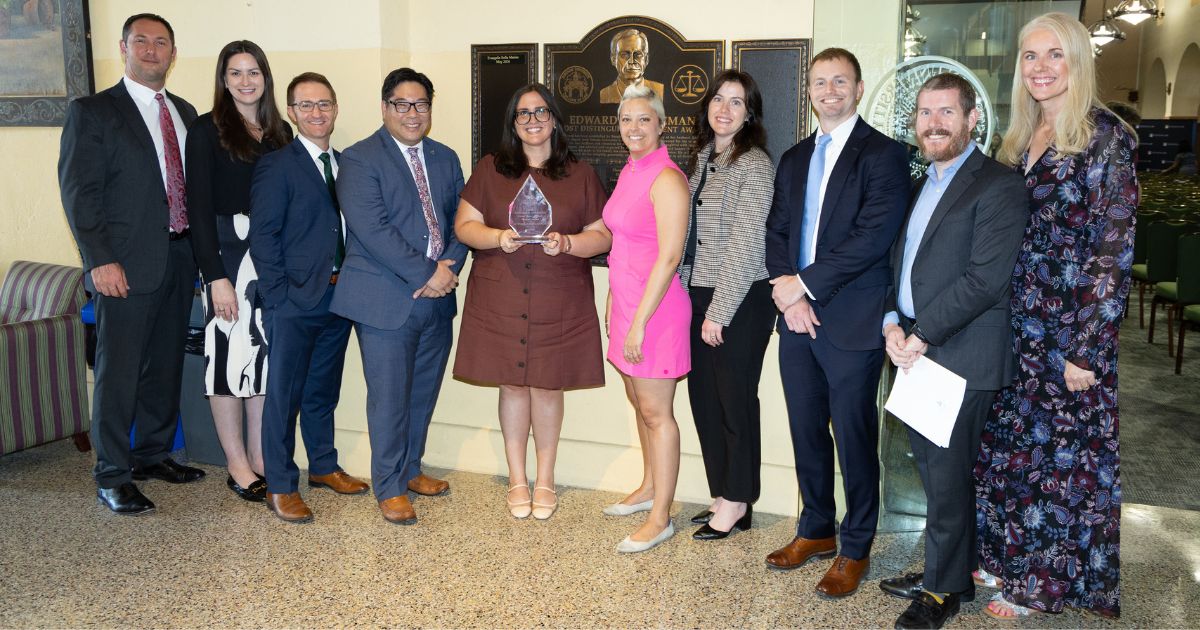
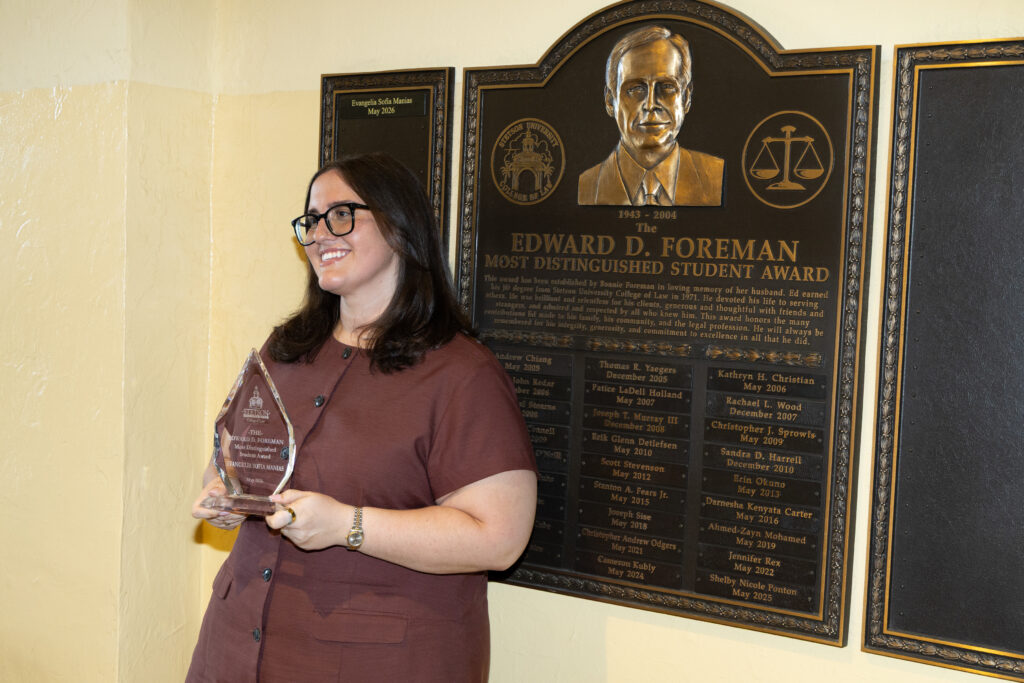
Evangelia Manias, the 2026 Edward D. Foreman Most Distinguished Student honoree, accepted the award while surrounded by past honorees.
On the eve of Stetson Law’s Spring 2026 Commencement, the community honored the students who exceeded the rigorous expectations they faced as law students.
Graduating students were recognized for exceptional academic performance, passionate pro bono service, superior professionalism, and more. The event culminated in the presentation of the College’s three most prestigious student honors: the Walter Mann Award, the Dean’s Excellence Award, and the Edward D. Foreman Most Distinguished Student Award.
“Today, we recognize your contributions to this community and to society at large,” said Vice Dean and Professor of Law Jason Palmer in his introductory remarks to those gathered in the Great Hall. “It is my hope that you will remain committed to improving your community, wherever you might be. Law school not only teaches you to be a lawyer – it also teaches you to be a leader.”
Vice Dean and Professor of Law Jason Palmer.
A Literary Connection
Setting the tone for the ceremony, Stetson University Provost Elizabeth Skomp, a professor of literature, read Ithaka, a 1911 poem written by Greek poet Constantine Cavafy. Inspired by Homer’s Odyssey, it emphasizes the value of experiences gained during a journey over the destination — a message she said encapsulates what she hoped to impart to the students.
“I wish you all the best for graduation and your future academic, professional, and personal endeavors,” she said following the recitation. “As you go out into the world, please take care, be well, and pursue great things as a Stetson Lawyer.”
Stetson University Provost Elizabeth Skomp addresses graduating students at the 2026 Graduate Honors ceremony.
Honoring Outstanding Achievements
Starting with the nominees for the National Order of Barristers, Associate Dean for Academic Affairs and Veterans Law Institute Director Stacey-Rae Simcox announced the awards and honorees.
More than 30 named awards bearing the names of individuals and organizations seeking to recognize achievement in specific areas followed. Among the awards were the Carol R. Samuels Unsung Hero Student Leadership Award, the American Law Institute Continuing Legal Education Scholarship and Leadership Award, and the Pride Award. A complete list of the Awards and their recipients can be found in the Stetson Law 2026 Commencement Program.
The Day’s Most Prestigious Honors
Recognizing a graduating student who has shown the greatest promise of becoming an outstanding leader in the legal profession, the 2026 Walter Mann Award was given to Miracle Ann Amiot.
This year’s Dean’s Excellence Award was presented to Nicholas Colicci in recognition of his extraordinary service to Stetson Law.
Both students served on the Stetson Law Review Editorial Board.
Evangelia Manias, the 2026 Edward D. Foreman Award honoree.
The final award, the Edward D. Foreman Most Distinguished Student Award, was given to Evangelia Manias, a pharmaceutical doctorate holder who was exceptionally active on campus, including serving as chief ambassador of the Stetson Ambassadors.
Her name was cast in bronze and secured to a plaque outside the Great Hall as she was presented with the crystal, flame-shaped award, as well as a check for $5,000.
Continuing a Storied Tradition
Manias is the 28th recipient of the Foreman Award. To showcase its legacy and the qualities it represents, the award was passed between prior recipients before making its way to her.
Past Foreman Award honoree Aleks Jagiella-Litts, JD/MBA ’04, told the gathered audience that the award represents the spirit of service, tireless advocacy, and steadfast integrity of its namesake, Edward D. Foreman. She noted how he was quick to embrace emerging technology and would have been fascinated with generative artificial intelligence and its evolving role within the legal profession.
Aleks Jagiella-Litts, JD/MBA ’04, a past recipient of the Edward D. Foreman Most Distinguished Student Award.
She added that while AI might change the way much legal work is done, the values underpinning the profession will remain the same.
“AI may make us faster,” Jagiella-Litts said. “It may make us more efficient. But it cannot replace judgment, integrity, compassion, or courage.”
The very first recipient of the Foreman Award, Andrew Chiang ’05, presented the award to Manias, who expressed gratitude for the Foremans and thanked the Stetson Law community for providing a supportive environment in which she could thrive.
“Coming from a family of pharmacists, the world of law was completely unfamiliar to me, and I was learning everything from the ground up,” Manias said. “Looking back, I am grateful for how fully this community met me where I was and helped me grow into the student and person I’ve become today.”
Calling all aspiring advocates: Stetson Law is inviting future changemakers to apply for its groundbreaking youth summer program, the Pathways to Justice Academy.
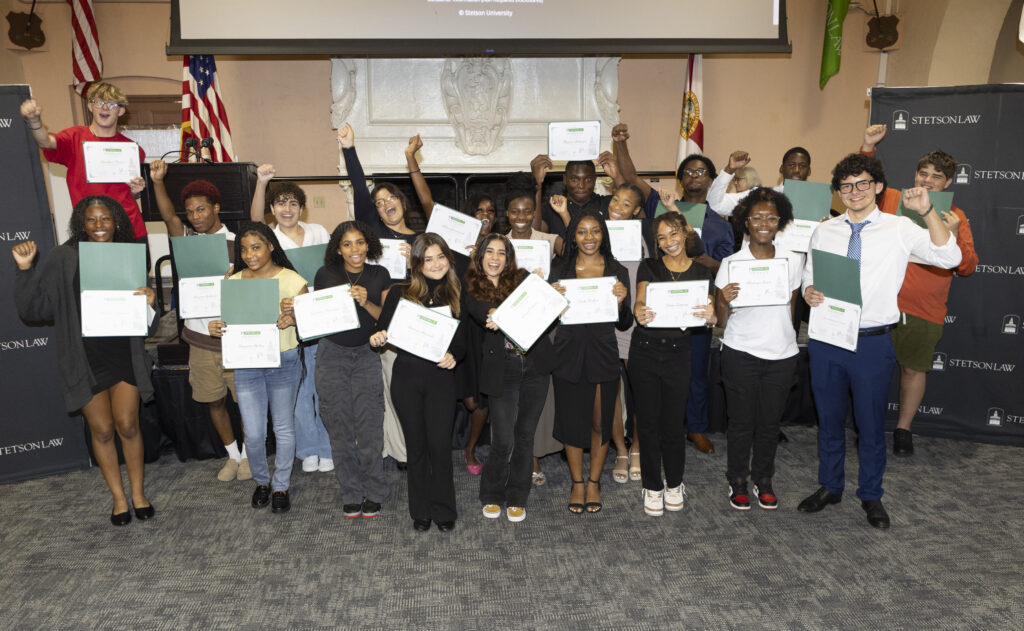
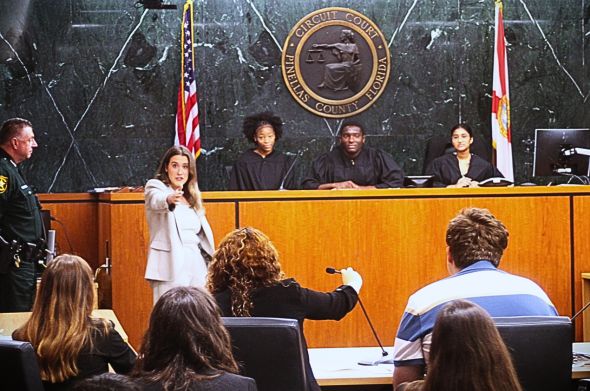
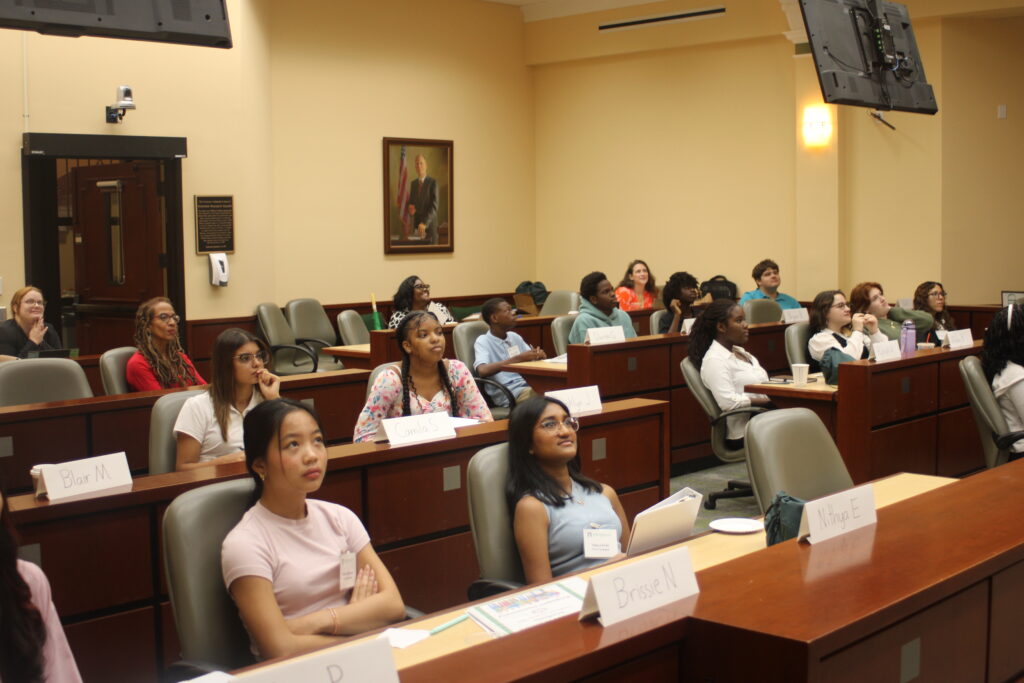
This immersive, hybrid program takes local high school students on a deep dive into public policy and the legal system over the course of one week. With candid conversations, workshops led by legal professionals, and sessions designed to empower students to develop their leadership skills, the academy brings new dimensions to civics education.
“Pathways to Justice is designed to make a lasting impression on students and equip them with the knowledge and confidence they need to effectively advocate for themselves and their communities.” said Stetson Law Professor and Director of Clinical and Experiential Education Christine Cerniglia, who leads the program. “Instead of traditional classroom lessons that cover the three branches of government and how laws are passed, this program meets students where they are through engaging, impactful sessions.”
A pivotal experience
Now in its fifth year, Pathways to Justice has put dozens of students face-to-face with judges, activists, attorneys working within a range of specialties, students, and others who are passionate about creating positive social change.
Pathways to Justice, 2025.
Students learn about the critical role young people had in the Civil Rights Movement and other transformative moments throughout history while getting an immersive look at how legal professionals can help advance important social causes.
“Throughout the program, it really made me realize that there’s so much to being a lawyer; there’s more than what they show you on TV,” said Akira Greenwood, who experienced Pathways to Justice in 2024. For the students who participate, the program’s reach can extend well beyond the week. Thanks to a partnership with Community Tampa Bay’s ANYTOWN® Advocacy Academy Program, interested participants may continue to benefit from the mentorship and engagement with Stetson Law throughout the 2026-2027 academic year.
The details & how to apply
Students aged 15 to 17 who live in the Tampa Bay area are eligible and encouraged to apply.
The 2026 program dates are July 13-17 through both Zoom and in-person interactions on Stetson Law’s main campus in Gulfport, Florida. There will be an in-person, pre-program orientation on Saturday, July 11. Participation is free for all selected applicants.
A Pathways to Justice session takes place on the Stetson Law campus in 2025.
The deadline to apply is June 15, 2026.
The applicants selected for the program and their parent(s)/guardian(s) will be notified directly via email. We will require a Consent Form signed by their parent/guardian to confirm their participation.