Wills for Warriors is a free program for veterans who qualify.
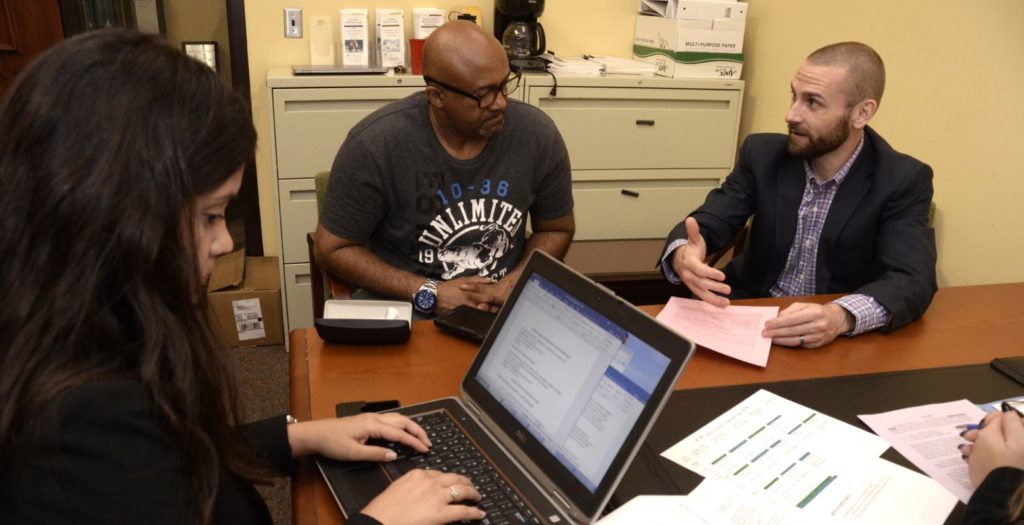
Stetson University College of Law will once again partner with the Community Law Program and the St. Petersburg Bar Foundation to prepare free simple wills and advance directives for low-income veterans and spouses over 60.
Those who qualify will receive individualized assistance from professionals who care deeply about veterans and aging individuals.
The event will take place in March. As walk-in appointments are not available, veterans or their spouses are invited to schedule appointments in advance by calling 727-562-7577 by February 23, 2024. Interested applicants are encouraged to call early, as there is a limited number of appointments available.
With support from Stetson Law’s Center for Excellence in Elder Law, the Wills for Warriors program assists eligible veterans and their spouses in the development of these essential documents. To qualify, applicants must be aged 60 or older and have low incomes and limited assets. Individuals who own real estate outside the State of Florida are not eligible to participate. Stetson Law students and volunteer attorneys from the Pinellas County Community Law Program will assist Stetson Law’s Center for Excellence in Elder Law with this program.
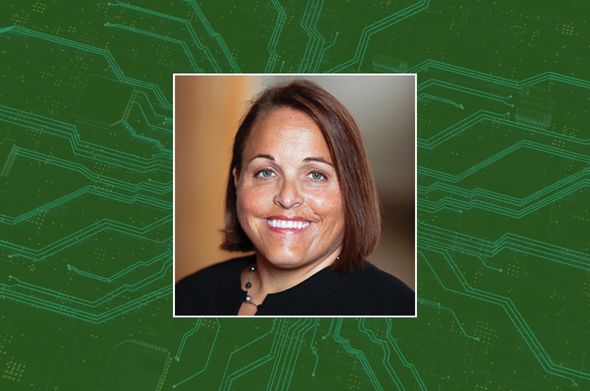
Dr. Kirsten Davis, Professor of Law and Faculty Director of Online Legal Education Strategies at Stetson.
From embracing virtual learning during the pandemic to inspiring colleagues to reimagine legal education in the age of artificial intelligence, Dr. Kirsten Davis is leading important conversations about the ways tech transforms how we teach law.
Earlier this month, Davis, a Professor of Law at Stetson and the college’s Faculty Director of Online Legal Education Strategies, was an inaugural recipient of the Association of American Law Schools Section on Technology, Law, & Legal Education Technology Mentorship Award.
The Section’s award announcement to its members described Davis a “a respected authority in legal ethics and communication” who “has made significant strides in integrating technology into legal education,” particularly with regard to the effects A.I. is having on the field.
“Through her impactful pedagogy, scholarly work, and direct mentorship, she has been a catalyst in helping students and peers understand and adapt to the rapidly evolving landscape in practice,” the Section announcement said. “Her initiatives have set a benchmark for technology mentorship within legal academia.”
Advancing the conversation
To be eligible for the award, nominees are required to have made notable efforts to help colleagues navigate the changing technology landscape, such as workshops, scholarship, or events aiming to share insights about emerging tech and offer mentees hands-on opportunities to apply what they’ve learned.
Law Professor Ashley Krenelka-Chase nominated Davis for the AALS award. She said she was motivated to do so because Davis works tirelessly to share her knowledge and understanding of emerging technologies – specifically the proliferation of Generative A.I. programs like Chat GPT.
“Her mentorship has helped people feel more comfortable with what they do and don’t know about using this technology in their classrooms and has allowed all of us to think about the use of generative A.I. and other technologies beyond the black and white in which it is often portrayed,” Krenelka-Chase said.
How it started: Adapting to The New Normal
In 2020, as education institutions everywhere grappled with how to ensure learning continued amid a global pandemic, Davis sprang into action.
She developed tutorials for colleagues who were new to virtual platforms like Zoom, created Amazon shopping lists to help them outfit their home offices with lighting and audio equipment, and more.
“From Zoom to working with Canvas to helping teaching assistants get up to speed on how to support online teaching, we were really just in survival mode in that first bit,” she said.
For that work, the university gave Davis an award for Covid-era innovation.
As the campus transitioned to the learning management software Canvas, Davis worked with Academic Technology Manager Julie Kitzmiller and faculty members Elizabeth Berenguer and Ashley Krenelka Chase on a program to train faculty and staff on the platform.
Sparking New Conversations about A.I.
As ChatGPT and other generative artificial intelligence began to grab headlines in late 2022, Davis – on sabbatical at the time – jumped at the chance to explore its implications for law schools.
“This was the moment I’ve been waiting on my whole career: the opportunity to study technology that might represent a paradigmatic shift for writing and researching the law,” Davis said.
Realizing the likely impact generative A.I. was about to have on legal education – especially legal writing – Davis reached out to colleagues on a listserv read by legal-writing experts across the country and invited them to join a national online conversation, the Generative A.I. and Legal Writing Convo Group.
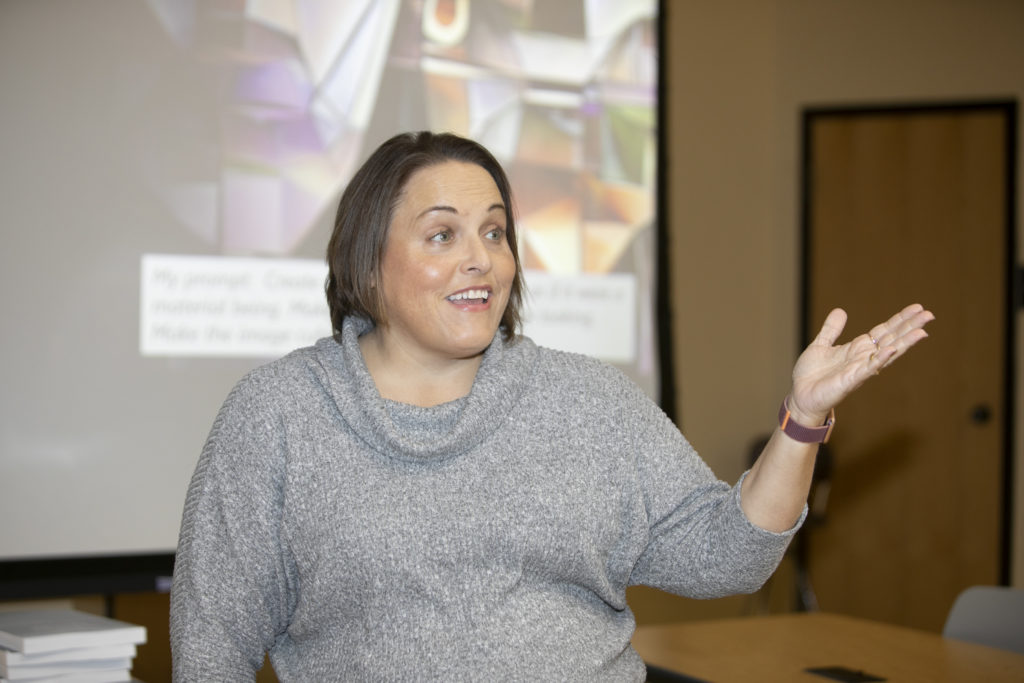
Dr. Kirsten Davis, a Professor of Law at Stetson, presented on artificial intelligence’s impact on law careers at Campus to Career 2024.
“I sent out an invitation and faculty started joining on Zoom. We talked about our concerns: Would legal writing classes need new outcomes?” Davis said. “Would faculty need new writing assessment practices? What kind of academic integrity policies should we have with generative AI in the mix? Do we need new curriculum, exercises, and assignments, and what would they look like?”
The group has grown from under 30 members in May 2023 to nearly 300 as of January 2024. Davis has since spoken on generative A.I. and legal writing at law schools at Georgetown, Rutgers, Temple, and Southwestern and will speak at the University of Baltimore in April.
Assessing A.I.’s new role in the classroom & beyond
Those conversations encouraged others to ask questions about how generative A.I. is changing legal education. Davis said developing new approaches to student assessment will be particularly important. Evaluating legal writing assignments has long been seen as a way to evaluate not only the skill of communication but also underlying lawyering skills like legal reasoning. Students’ use of generative A.I. to write papers may change that assumption, which could mean that new ways of assessing skills need to develop.
“I think from a legal education perspective, faculty have to ask, what does the world of lawyering look like for our students three, five, ten years from now?” Davis said. “How are we going to prepare them to navigate a practice world with unprecedented writing technology? Our responses to these questions are going be important.”
The future ubiquity of generative A.I. means law schools need to consider right now whether to teach students prompt engineering skills – and how to evaluate and refine the text A.I. generates, she said. The legal profession will also likely see significant impacts, such as changes to staffing models and billing practices in an environment where legal documents can be generated and refined in a fraction of the time it has historically taken, Davis said.
One question Davis is frequently asked is whether artificial intelligence will eliminate the need for lawyers.
“The discussion of the end of lawyering has been going on for decades, Davis said. “So this question is not something entirely new. Generative A.I. changes the calculus, but I think clients and the legal system will always need careful, smart, lawyers with good judgment and even better ideas who can make good use of technology.”
As the first week of the spring semester drew to a close, students were invited to take a day to reflect on their career aspirations, meet potential mentors, and explore job opportunities at the 2024 Campus to Career Experience.
A signature event at Stetson Law, Campus to Career aims to help students make concrete connections between the passion that brought them to law school and the fulfilling careers they seek.
More than a dozen presentations, workshops, and keynote addresses were led by nationally known speakers, practicing legal professionals, faculty, and staff members on everything from overcoming imposter syndrome to how to succeed as a summer associate.
An invitation to reflect
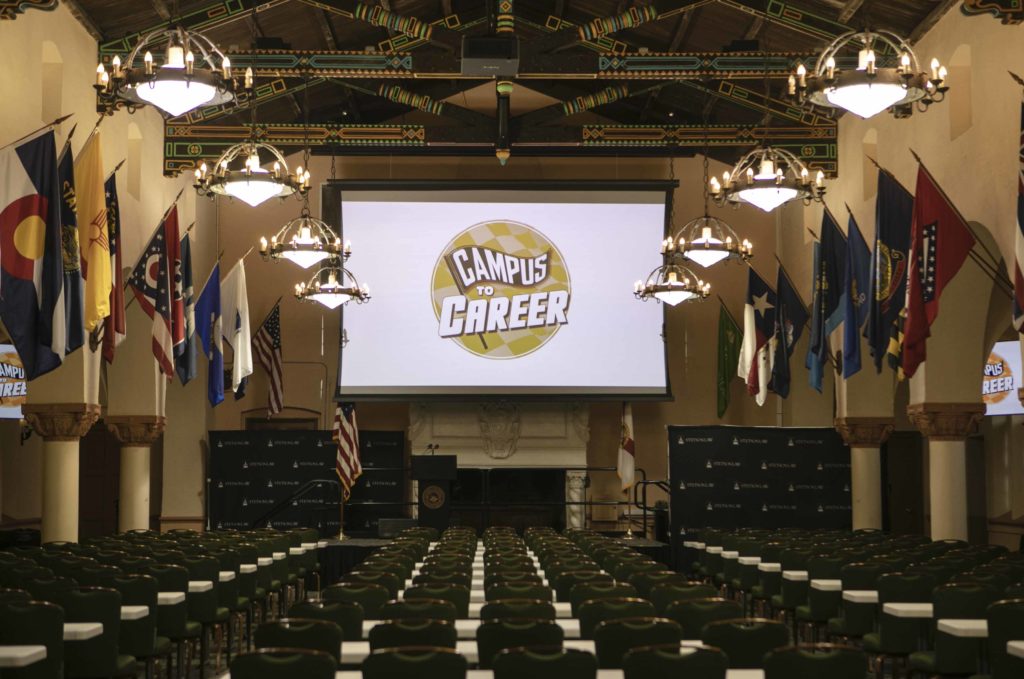
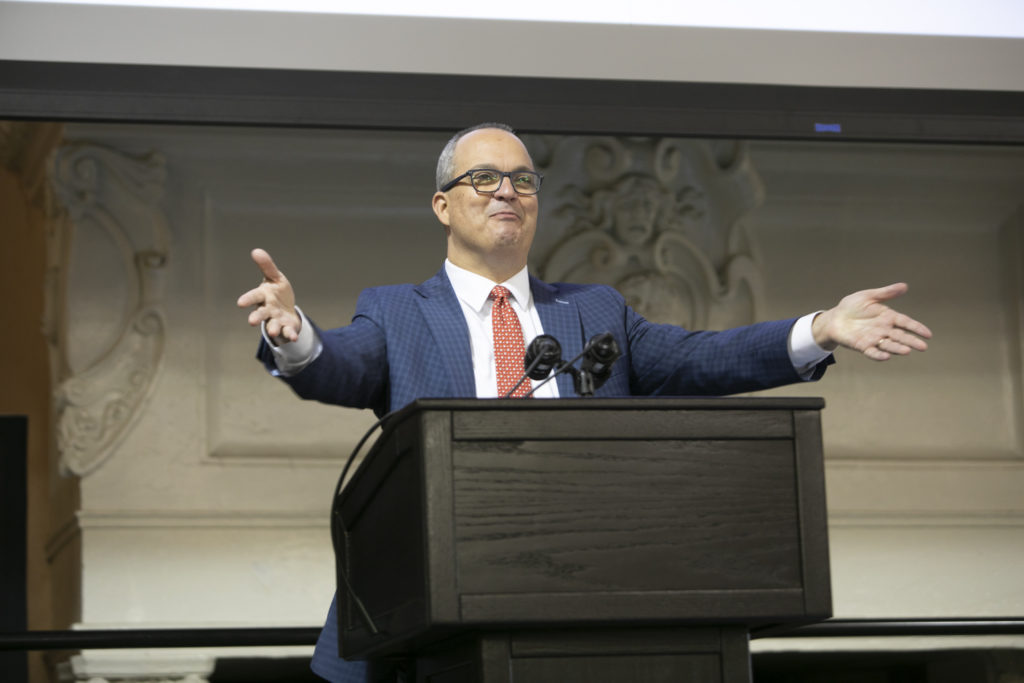
After mingling over coffee and breakfast, attendees settled into the Great Hall for opening remarks from Stetson Law Dean Benjamin Barros. While the point of law school is primarily to pass the bar and get a job, Barros said, it is important for students to take a moment to determine what excites them the most, and how to incorporate that into their professional goals via events like Campus to Career.
Stetson Law Dean Benjamin Barros addresses a Campus to Career audience in the Great Hall.
“You need to make the space to kind of step back and think about the bigger picture. And today gives you a great opportunity to do that,” he said. “You’re investing your career and your future in a really important way…I love my job and I feel lucky to go to work every day. My wish for all of you is that you find that path that you will be really happy with.”
Telling your story
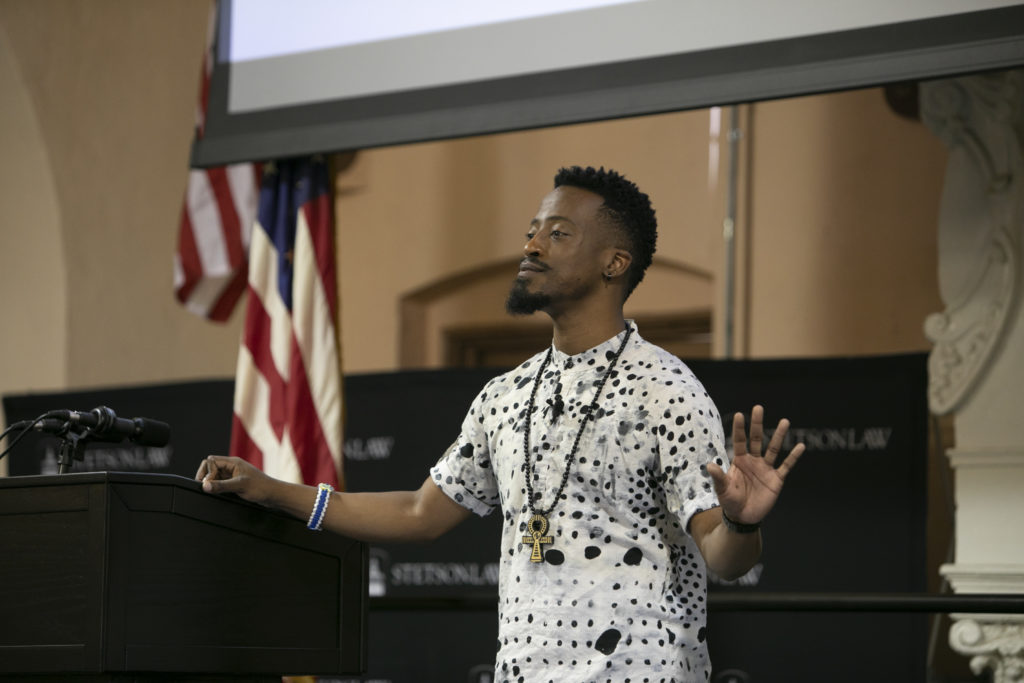
The first keynote of the day came from St. Petersburg-based actor, writer, and speaker Patrick Arthur Jackson, who led an interactive session on the importance of defining oneself through personal narrative, and letting that narrative evolve over time.
“Life is a series of stories, and each of us in this room, each of is in this state, this nation, and world, is the author of our own narrative,” Jackson told the audience. “Our stories aren’t just tales of trials and tribulations. They are testaments to the extraordinary gift of transformation that resides in each of us.”
Actor and writer Patrick Arthur Jackson speaks at Campus to Career 2024.
Through anecdotes from his own life, Jackson demonstrated how one’s story of themself can help them cultivate the confidence they need to succeed in their lives and careers.
“This is a reminder of your existence that provides full permission to live your life authentically, unapologetically, and fully,” he said.
On perfectionism & imposter syndrome
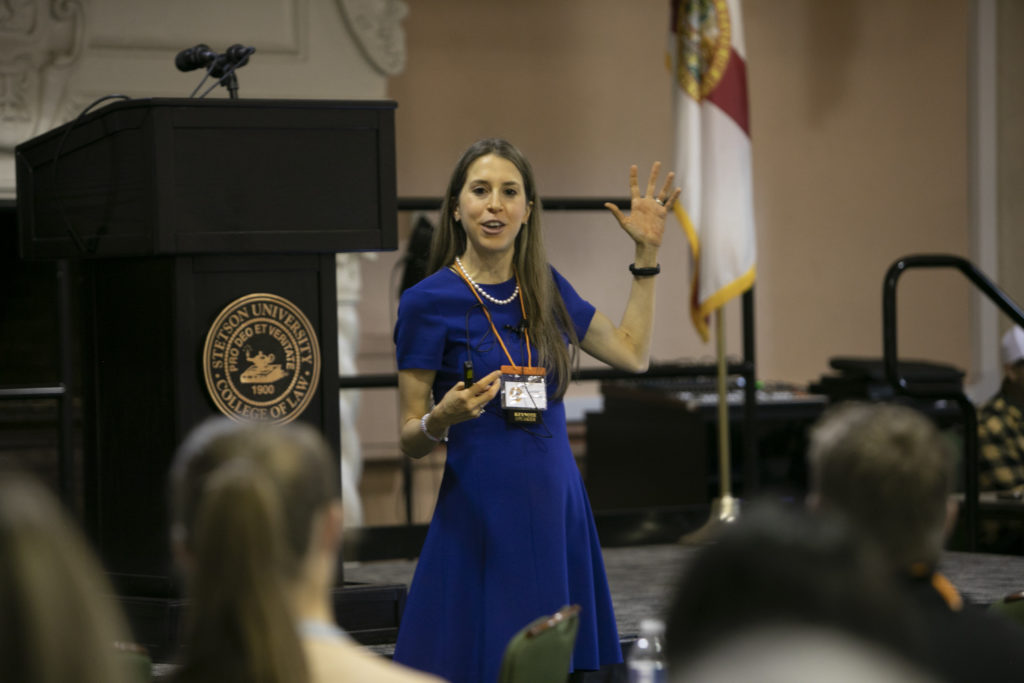
Speaking frankly on some of the attributes that can lead many law students to overwork themselves to the detriment of their physical and mental health, professor and professional coach Jordana Confino shared insights on overcoming imposter syndrome and the perfectionism it manifests.
In environments like law school, where expectations are high, perfectionism is often perceived as a positive attribute – but Confino urged the audience to see it for what it is masking: a profound underlying fear of not measuring up.
Speaker and Law Professor Jordana Confino speaks at Campus to Career 2024.
“One of the reasons it’s so hard to reign in our perfectionism is that we don’t actually want to, because we think it’s helping us,” she said.
Confino countered that perfectionism leads to setting nearly impossible goals, then setting more impossible goals once the initial goals are achieved, so a perfectionist is in a chronic state of struggle. The constant stress can affect sleep, personal relationships, and other aspects of physical and mental health.
As an alternative to perfectionism, Confino suggests becoming a “big picture perfection-seeker” who adopts a holistic view of success, responds to setbacks with self-compassion, and practices self-care techniques.
“On the other hand, the big-picture perfection seeker expects for there to be obstacles and detours and inevitable tradeoffs that they have to make as they pursue their goals, which means they can plan for them, they can navigate those tradeoffs intentionally,” Confino said. “And they can actually enjoy the process.”
From law to comedy
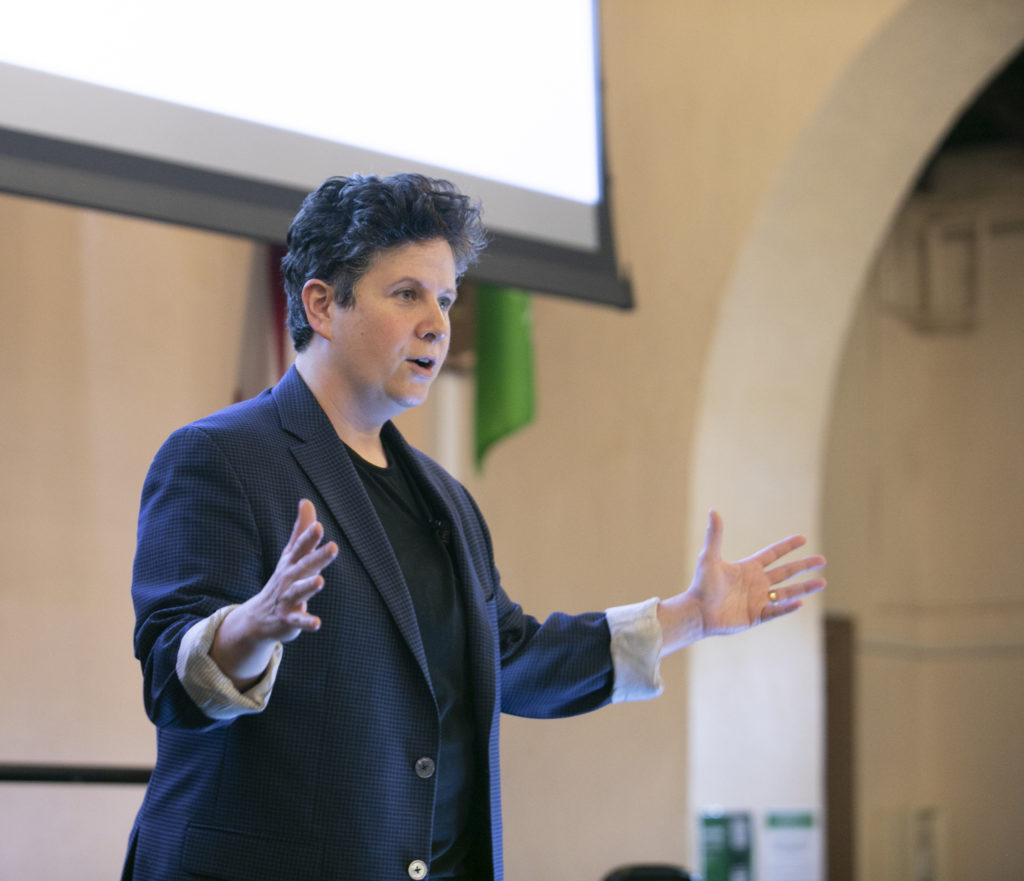
Closing out the Campus to Career programming was a keynote from lawyer-turned-comedian Liz Glazer, who joked that she is living proof that one can do anything with a law degree.
“I wasn’t always a comedian. I used to be a law professor. And that’s generally how people get started in comedy,” Glazer said.
Lawyer-turned-comedian Liz Glazer spoke at Campus to Career 2024.
She said going to law school seemed like an inevitability, even though she often didn’t love the experience as much as her classmates seemed to.
“I grew up with immigrant parents and they were like, nobody can take your education away from you,” Glazer said. “I went to law school because it made sense for me to go to law school.”
Yet she grew to appreciate it, then went on to work for a firm before being recruited to teach law. Glazer was well into her career as a law professor when she experienced the thrill of stand-up comedy. Though it took some time for her to pursue it as a career and retire from the legal profession, Glazer has since performed sold-out shows at New York Comedy Festival, appeared on network television, and won first place at the Boston Comedy Festival and Ladies of Laughter Competition.
She joked that she was invited to speak at Campus to Career as a cautionary tale.
“In all seriousness, I think that I am living proof that with a law degree, you can do absolutely everything,” Glazer said. “Literally.”
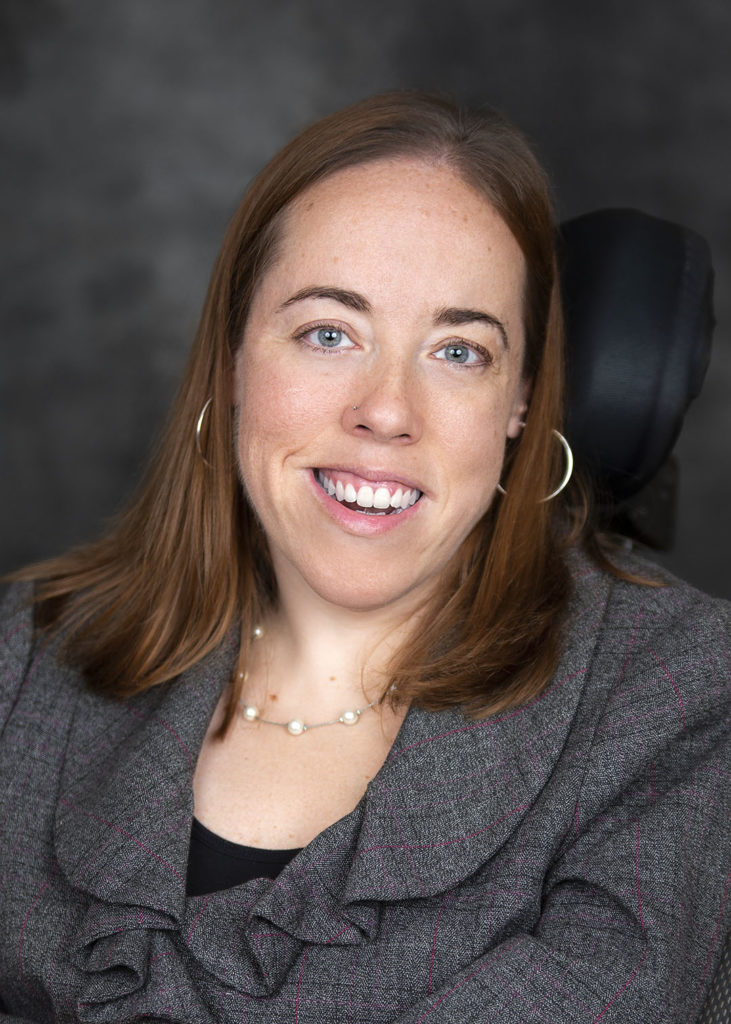
The Stetson Law community is excited to welcome Professor Robyn Powell back to campus, where she will begin as tenure-track faculty in the fall 2024 semester.
Powell, who teaches professional responsibility, disability law, public health law, and other courses, is a nationally recognized expert in disability law, particularly where it intersects parental rights. She previously served as Stetson Law’s Bruce R. Jacob Visiting Assistant Professor of Law before becoming an associate professor at University of Oklahoma College of Law. Powell said her initial time at Stetson left an enduring, positive impact on her professionally and personally and that she is eager to return to campus and the surrounding Gulfport community.
“I cannot adequately express how genuinely honored and enthusiastic I am at the opportunity to rejoin Stetson Law’s exceptional community of educators and justice-oriented students as a tenure-track professor,” Powell said. “I am beyond thrilled to contribute meaningfully to preparing practice-ready attorneys, producing impactful legal scholarship, and collaborating to empower the next generation of lawyers to drive social change.”
Exploring emerging areas of law
Powell’s work largely focuses on the intersection of disability law, family law, reproductive justice, and public health law, with a particular emphasis on how laws and policies affect disabled people’s decision-making about whether and when to have children. As a disabled woman, she said her scholarship and advocacy in this area are deeply personal.
“I have faced barriers to accessing healthcare and reproductive services,” she said. “I have seen how societal attitudes, stigma, and lack of accessibility can limit choices and agency.”
Her passion on the issue only strengthened when, through her work, she learned of the historical connections between the disability rights and reproductive justice movements, given how both have fought against coercive practices and policies targeting bodily autonomy and self-determination among certain populations. Before entering academia, she gained a crucial perspective while serving as an Attorney Advisor at the National Council on Disability and authored their report “Rocking the Cradle: Ensuring the Rights of Parents with Disabilities and Their Children.” Powell’s other professional roles advanced disability rights through government, legal, and nonprofit work.
A transformative vision
Powell said her goal is to raise awareness of and secure reproductive justice for disabled people by transforming narratives and systems she says have discounted their humanity and diversity. She plans to continue writing and advocating for greater autonomy in making informed choices about their bodies, sexuality, and reproduction.
“My vision is one of equality, autonomy, and access for all,” Powell said. “Empowerment matters, so I am committed to advancing equal rights and inclusive policies that allow each of us to make our own reproductive decisions. Securing reproductive justice and access for the disability community ultimately advances everyone’s rights and opportunities.”
Powell added that she hopes to help Stetson Law students realize their potential for advancing justice and equity, and to produce impactful legal scholarship on salient social justice issues while benefiting from Stetson’s supportive research culture. “The community’s shared commitment to developing ethical advocates and proactive contributors who shape society for the better deeply aligns with my own principles as an educator,” Powell said. “I could not be more excited to dedicate my energies toward advancing Stetson’s mission of equipping students to enact lasting justice. I eagerly look forward to formally re-joining this community I admire so greatly.”
A welcoming community
Among the college’s faculty, staff, and leadership, that admiration is mutual.
“Professor Powell’s unique experience and expertise align perfectly with our commitment to promoting justice for all through sharp scholarship and through fostering tomorrow’s best advocates,” said Stetson Law Dean Benjamin Barros. “We look forward to her contributions to this vibrant community.”
Kathryn Pelham Esq. ‘06, Stetson Law’s associate director of accessibility resources and ADA coordinator, said her presence will be an inspiration to Stetson Law’s disabled student population.
“I’m thrilled that Professor Powell is returning,” Pelham said. “Students who took her courses here at Stetson were empowered to see a person with a disability represented in such a prestigious position.”
Powell holds a Ph.D. and M.A. from Brandeis University, a J.D. from Suffolk University Law School, and a B.A. from Bridgewater State University. Her work has been published or is forthcoming in University of Pennsylvania Law Review, Michigan Law Review, California Law Review, UCLA Law Review, and Washington University Law Review, among others.
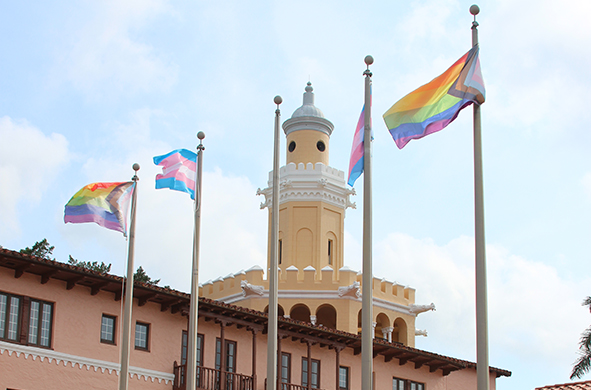
Pride flags fly on Stetson Law’s Gulfport campus every June.
Reflecting Stetson Law’s deep commitment to diversity and inclusion, the Association of American Law Schools Section on Sexual Orientation and Gender Identity Issues (SOGII) has chosen the college for its 2024 LGBTQ+ Inclusive Excellence Award.
The recognition follows years of considerable effort recruiting and enrolling LGBTQ+ students, supporting them in their law school journey and beyond, and creating opportunities for them to advocate for the LGBTQ+ community both on and off campus.
“This award is the result of a long, multifaceted campaign to invite the nation’s brightest aspiring legal professionals to build upon the successes of Florida’s First Law School,” said Admissions and Student Financial Planning Director Darren Kettles. “To call this accomplishment an honor is an understatement – we are absolutely thrilled and inspired to continue this important work.”
Building on years of success
The award follows years of measures aimed at ensuring LGBTQ+ students are not only welcome on campus, but supported and celebrated – and that they have opportunities to network and gain experience advocating on the causes that matter most to them.
Stetson Law Professor Joseph Morrissey
“This is huge,” longtime Stetson Law Professor Joe Morrissey said of the award. “We’ve made incredible progress in the last 20 or so years, culminating in Stetson being able to claim well-deserved, award-winning leadership in the LGBTQ+ inclusivity space.”
Morrissey said much of the credit goes to Kettles, whom he said “has not only communicated to future generations of Stetson lawyers about our inclusive culture, but has also shaped that culture by cultivating more and more diverse cadres of admits.”
Inviting all to study law
Under the leadership of Kettles, the College of Law has for years actively invited members of the LGBTQ+ community from around the nation to consider Stetson Law for their legal education, telling them, “You Belong Here.”
The result? A diverse, thriving community of students eager to explore the law through an LGBTQ+ lens.
Currently, LGBTQ+ students made up five percent of the fall 2023 entering class. The campus community strives to foster an inclusive, supportive environment to help them succeed in their coursework and in their career pursuits.
“We believe that creating a law school community where LGBTQ+ students feel welcome and have opportunities to thrive will have impacts beyond our campus,” Kettles said. “These students go on to cultivate meaningful careers advocating for the people and causes most important to them.”
Thoughtful community engagement
Recognizing the needs and contributions of the growing LGBTQ+ community in the greater Tampa Bay region, the college has for years engaged in community outreach efforts such as marching in and tabling at St. Pete Pride, Florida’s largest Pride parade and street fair. In fall of 2023, in partnership with Lambda Legal Society, Stetson Law’s LGBTQ+ student organization, the college hosted a fundraising event culminating in a drag show.
Stetson Law alumnus Nathan Bruemmer
In partnership with alumnus Nathan Bruemmer, the college developed a Name Change Clinic for students, employees, and local community members. Students also embarked on a collaboration with the City of Gulfport’s LGBT Resource Center, which included establishing a liaison position for a Lambda member on the LGBT Resource Center’s Executive Board.
Bruemmer, a Tampa native, recently served as Florida’s LGBTQIA+ consumer advocate with the Florida Department of Agriculture and Consumer Services, thereby making history as the first transgender statewide appointee in the U.S. He said the AALS SOGII award has been years in the making – and that it comes at a critical time.
“To protect the rule of law and ensure justice for all, it is imperative for law schools to graduate attorneys from a diverse array of backgrounds who are ready to use their skills to tackle the mounting challenges we face,” Bruemmer said. “Stetson Law didn’t just make me feel welcome – this community ensured that real-world opportunities to advocate for the LGBTQ+ community were woven into my legal education. This is a major reason that I remain connected to this community, and why I am proud to call myself a Stetson lawyer.”
Creating a home for diversity
In 2021, Stetson University created the role of Executive Officer for Diversity, Collaboration, and Inclusion to develop measurable ways of advancing leadership in diversity, equity and inclusion while building a community where members of the LGBTQ+ community feel safe and capable of thriving. Stetson Law alumna Carmen Johnson, who was hired for that role, works tirelessly to identify opportunities for fostering a diverse campus community.
“Whether it’s flying the Pride flag over the campus for the duration of Pride Month or offering courses examining LGBTQ+ issues and the law, Stetson Law is home to concrete actions that not only show students from underrepresented communities that they belong, but that they can use what they learn here to make a difference,” Johnson said. “I am proud yet humbled that we are now recognized as a national leader in this space.”
Relevant, impactful programs & course offerings
Home to leading scholars in areas pertaining to the relationship between the law and gender and sexuality, Stetson offers extensive coursework in this area, including Law and Sexual Orientation, Feminist Jurisprudence, Reproductive Technology and the Law, Employment Discrimination, Human Rights in International Family Law, and Civil Rights and the Constitution: DOMA/Marriage.
Stetson Law’s Lambda Legal Society actively provides a forum to explore legal issues related to sexual orientation and gender identity. The organization welcomes students of any sexual orientation interested in raising awareness of the issues attorneys face with the increasing number of LGBTQ+ clients who seek legal protection.
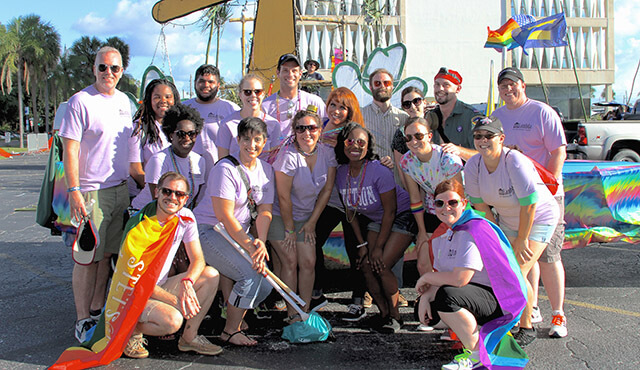
Lambda Legal Society values engaging with the greater community through events like St. Pete Pride.
In 2021, Lambda became a National Affiliate of the LGBTQ Bar, and in 2023, the organization established an endowed Pride Scholarship. Lambda hosts regular events, including displaying a National Transgender Remembrance Day Memorial, hosting important community discussions such as Intersectionality: Black and LGBTQ+ Communities with nationally renowned LGBTQ+ activist and Executive Director and Founder of Equality Florida Nadine Smith, and offering pronoun pins at tabling events like Diversity Week. In June of 2021, the organization spearheaded the raising of the Pride Flag over campus. It flew for the entire month and has done so every June since.
To help students connect their growing legal acumen in this area, Lambda also launched a Student Mentorship Program, drafted a Chosen Pronoun and Chosen Name policy for Stetson students and employees and created an “Inclusive Classroom Training” during Annual Law Faculty Orientation, a comprehensive overview of chosen pronouns and names as well as the college’s expectations towards inclusion.
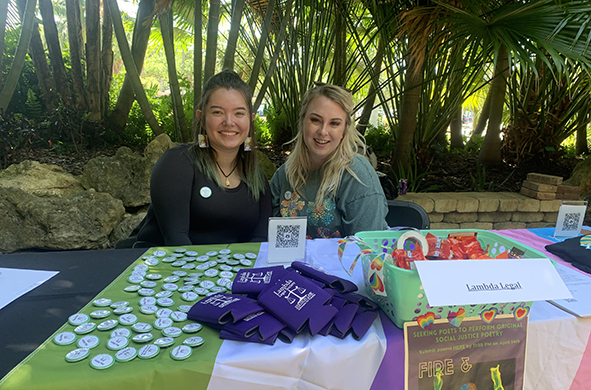
Lei-Lani Rogers, president of Stetson Law’s Lambda Legal Society (left), and Hunter Wolf, the group’s vice president, in 2022.
“There is no community like the LGBTQ+ community and it is a testament to our resilience that we are one of the largest and most active student organizations on campus,” said Hunter Wolf, vice president of Lambda. “It is incredibly special to be recognized for the work that we have put in to show that Stetson Law is not only an ally to the LGBTQ+ community, but a fierce advocate.”
Supportive faculty & campus leadership
From day one of law school, students will find professors who are members of the LGBTQ+ community or passionate allies eager to help students develop their legal skills.
Former Chair of AALS SOGII Subcommittee and longtime Law Professor Ellen Podgor launched an independent student research project highlighting and creating the Past Chairs of AALS SOGII Leadership and Initiatives Project, with plans to publish it soon.
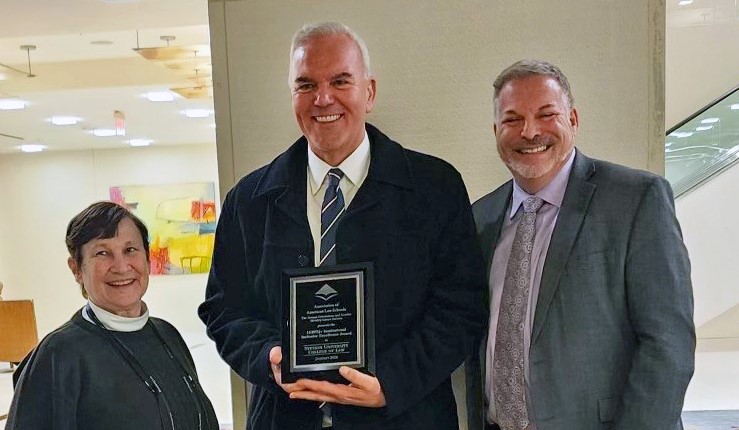
Left to right: Law Professor Ellen Podgor, Admissions & Student Financial Planning Director Darren Kettles, and Associate Dean of Academic Affairs & Professor of Law Jason Palmer celebrate Stetson Law winning an Association of American Law Schools’ LGBTQ+ Inclusive Excellence Award in January 2024.
Recently, Kettles served as a member of the Law School Admission Council Annual Meeting and Educational Conference Planning Committee, where he developed sessions aimed at assisting law school admission teams in advancing work on behalf of the LGBTQ+ community.
In fall of 2023, Professor Morrissey was a guest on an episode of the Real Cases podcast discussing attracting LGBTQ+ students to law school in states that appear hostile towards them.
With vision, collaboration, and support from executive leadership, Stetson Law will continue to thrive as a place where members of the LGBTQ+ and allies are invited to celebrate their shared passion for the law and for justice for all.
“When it comes to initiatives promoting inclusion and justice for all, we are just getting started,” said College of Law Dean Benjamin Barros. “We look forward to celebrating our diverse campus community in 2024 and beyond, starting with this award.”
Scenes from the December 2023 Graduate Celebration
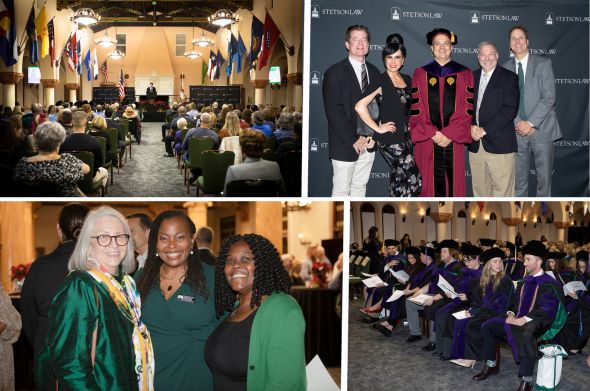
Marking the end to the fall 2023 semester, members of the Stetson Law community gathered in the Great Hall to celebrate students who successfully completed their law school journey in December. (See full event video below.)
The group of 20 graduates primarily consisted of part-time students, who have spent the last four years juggling careers, volunteer work, family, and other obligations with the rigors of their legal education.
Stetson Law Dean Benjamin Barros addresses the December 2023 graduates.
“Tonight, we celebrate the skills you have honed and the ways in which we know you will give back to the world as Stetson lawyers,” said College of Law Dean Benjamin Barros. “Tonight, we celebrate our graduates who are part of our Stetson family – today, and for a lifetime.”
Alumna Brittany Maxey-Fisher ’07, who is president of the Stetson Lawyers Alumni Association, urged the new alumni that they have earned the ability to face the new chapter of their careers with confidence.
“Today, you turn the page from being law students to law graduates,” she said. “You are joining an elite group of attorneys. You and I have been trained by the top professors in first-class facilities to sharply hone our advocacy skills.”
Faculty and university leadership remarked on the unique circumstances that shaped their law school journey: the onset of a global pandemic took hold, civil unrest, and political polarization.
Stetson University President Christopher Roellke
“Class of 2023, you are part of a unique and unshakeable cohort and have experienced more in your time in law school than most have had in their lifetime,” Barros said. “You persevered through a global pandemic, all while caring for your friends, family, and colleagues. You’ve weathered many shifts in the last few years, and remain resilient and excellent. We are so proud of you.”
Dr. Christopher Roellke, President of Stetson University, said these students faced “a once-in-a-century set of challenges for higher education and for the globe.”
“Not only have you survived the demands of an outstanding Stetson education, but you have succeeded in accomplishing something very difficult during a time of great adversity,” he said. “In my view, these challenging experiences have undoubtedly developed in you a repertoire of skills that will serve you exceptionally well as you move on to your legal careers.”
Reflecting on Stetson’s university-wide embrace of a culture of kindness, Roellke asked the graduates to “bring kindness and empathy in everything that you do.”
A celebrated professor’s keynote
After Associate Dean for Academic Affairs Jason Palmer read the names of the graduates, Professor Joseph Morrissey spoke on what it means to aspire to do great things.
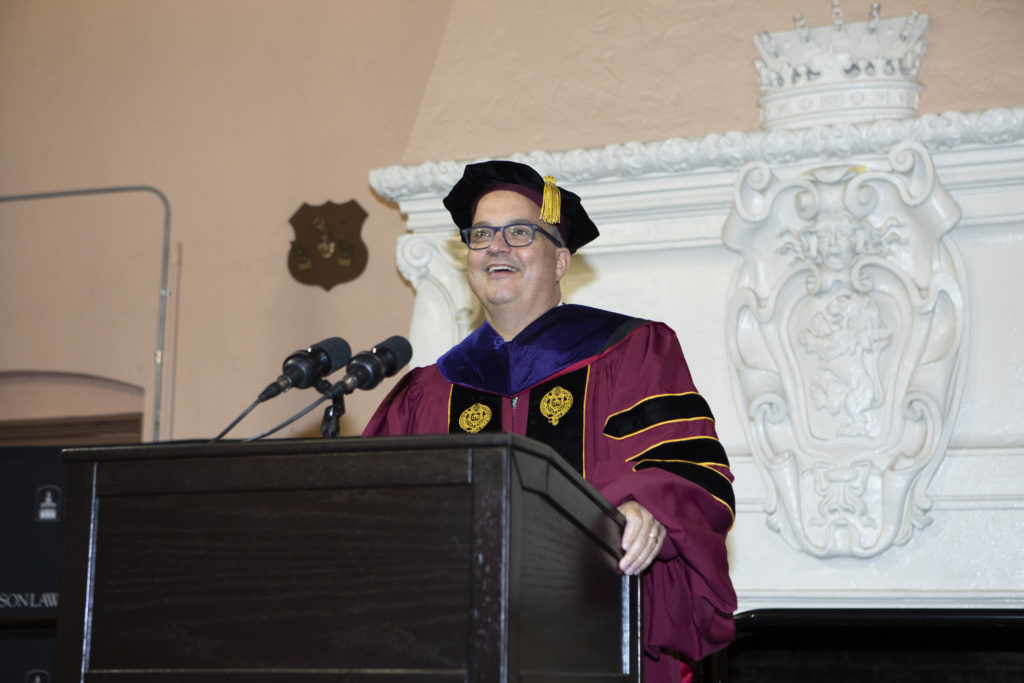
Law Professor Joseph Morrissey addresses December 2023 graduates.
“Aspire to use your advocacy powers to do more than observe and complain,” he said. “Instead, try to bring people back together. We taught you about advocacy skills. You never persuade by alienating. You persuade by finding common ground, identifying our commonalities as human beings, and building from there.”
Morrissey, to whom many students were introduced through his Contracts course, has been on faculty for nearly 20 years. He is the faculty advisor for the Stetson chapter of Lambda Legal Society, the LGBTQ+ student organization, and for years has helped coach championship-winning student advocates. The ability to advocate effectively, he said, is a power they can and should use to fight not just for their clients, but for a better world.
“One thing we know for sure is that you are going to be a Stetson lawyer, and it’s my aspiration for you that you will be a compassionate counselor for your clients, and a zealous advocate for your causes,” Morrissey said. “I’m so delighted to be able to celebrate you and all your accomplishments today. I want to once again extend my heartfelt congratulations to each of you on a job well done. You did it. You made it. And now, the future is yours.”
WATCH VIDEO: Stetson Law December ’23 Graduate Celebration
Over the past year, the Stetson Law community has had so many incredible moments, from national recognition to amazing pro bono work. Students, faculty, alumni, staff, and friends have won championships, been thought leaders in emerging areas of law, and taken pivotal steps in their career journeys – but not without a little self-care.
In no particular order, here are ten highlights from Stetson Law in 2023.
1. Serving Others Through Pro Bono Work.
Stetson Law’s inaugural members of the AALS Pro Bono Honor Roll
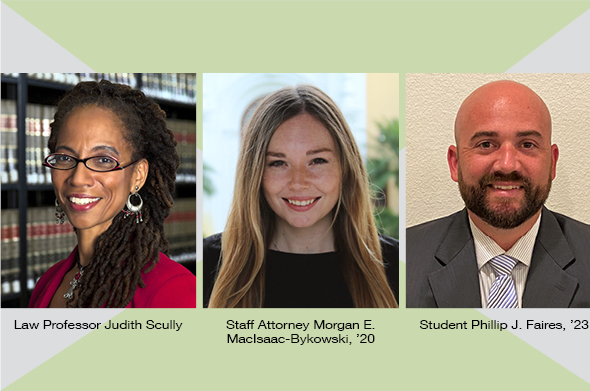
For years, Stetson Law has been committed to helping overlooked and underserved populations through a robust, pioneering program requiring students and faculty to perform pro bono work. This results in thousands of hours of legal and non-legal pro bono work performed throughout the community each year through initiatives such as Wills for Warriors, an event in which students and volunteer attorneys prepare free simple wills and advance directives for elderly veterans. In January of 2023, the AALS inducted three individuals – a faculty member, a staff member, and a student – into its inaugural Pro Bono Honor Roll: Law Professor Judith Scully, alumna and Veterans Law Institute Staff Attorney Morgan MacIsaac-Bykowski, and then-student Phillip J. Faires, who graduated in 2023.
2. The Advocacy Institute Opened.
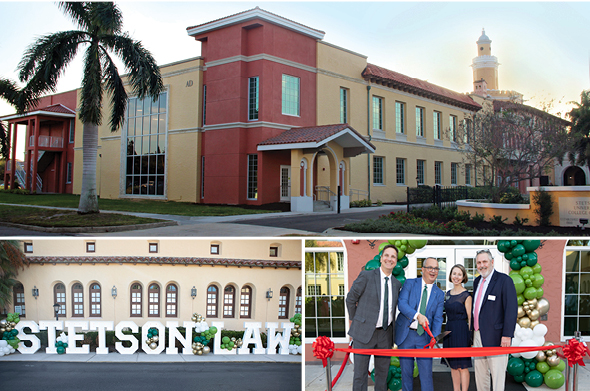
Officials celebrated the opening of the Advocacy Institute with a ribbon cutting on October 28, 2023.
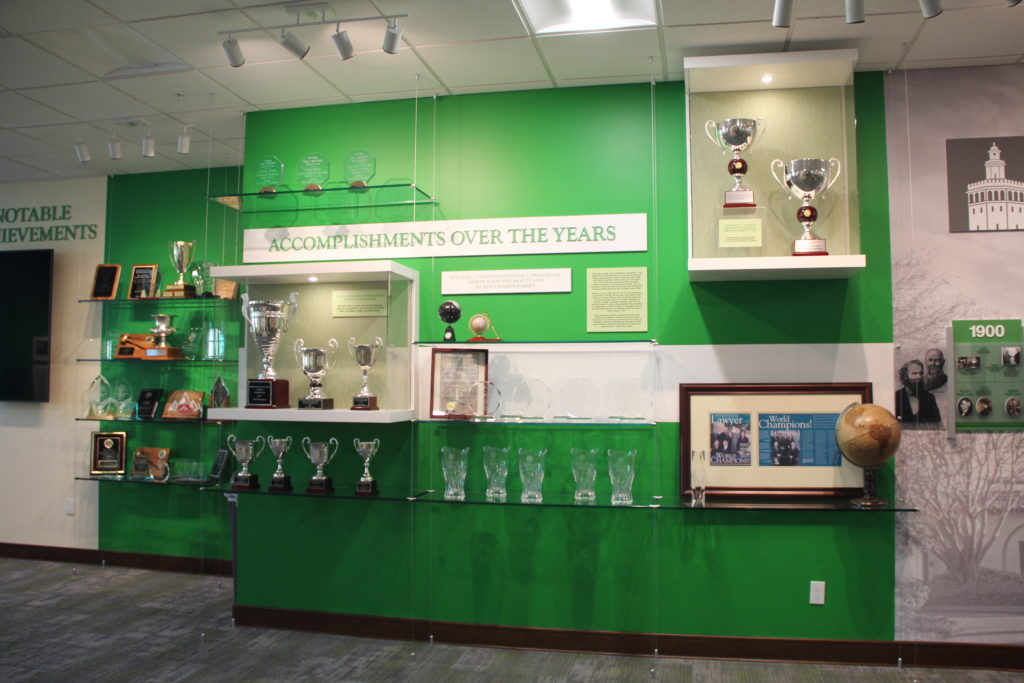
After years of planning and hard work, Stetson Law’s Advocacy Institute began welcoming the community in the fall 2023 semester. The breathtaking new facility features 16,000 square feet of space, including new conference and office space, six new courtrooms, two new jury deliberation rooms, a stunning trophy area, and more. The addition of so many new courtrooms brings the total number to 12, which means Stetson Law has the highest number of practice courtrooms of any U.S. law school.
3. Student Wellness Took Center Stage.
Students will find adjustable lighting, aromatherapy, yoga mats, and other features to help them destress in Stetson Law’s meditation rooms.
Recognizing the toll that the rigors of law school can have on one’s mental and physical health, Stetson’s Student Bar Association, with support from the Student Affairs Department and others, launched several initiatives around student health and wellness in 2023. In April, two student meditation rooms opened on campus. Student Health & Wellness Week created a sense of community around cultivating healthy habits and mindful practices to combat stress. Campus even hosted a pair of miniature therapy horses to help students take a break from their studies and make adorable new friends.
4. New Heights in Student Achievement.
Despite the rigors of law school life, Stetson Law’s students were driven to excel in their scholarly pursuits and experiential endeavors in 2023. From recent grads being two of the top bar exam scorers in the state (one of whom was Stetson Law’s spring 2023 valedictorian, Sam Ciulla) to winning a prestigious public service award from a national nonprofit, Stetson Law students shined in 2023.
5. Reclaiming the Top Spot in Advocacy.
In May, Stetson Law regained its status as U.S. News & World Report’s number-one law school for trial advocacy – and maintained its number-three rank in legal writing. These triumphs are the result of deep commitment among students, faculty, staff, and alumni. Through forward-thinking scholarship, championship-sweeping competition performance, innovative teaching methods, and more, the College of Law remains a national leader in these critical areas of legal education and practice. The advocacy and legal writing communities look forward to more success in 2024.
6. Leading Conversations About AI.
In 2023, artificial intelligence took workplaces by storm. As A.I. stood poised to transform many industries, including the legal profession, Stetson Law faculty and others seized on opportunities to share insights on how this evolving tech will transform what lawyers do. In October, Law Professor Mason Clark spoke to legal professionals at Stetson Law’s annual National Conference on Special Needs Planning and Special Needs Trusts about why they shouldn’t be afraid of A.I. and should instead harness it. A month later, Law Professor Luz Nagle hosted LexisNexis Executive Vice President and General Counsel Ian McDougall for a lecture and discussion about how closed A.I. databases will impact legal work – and why lawyers will still be needed in the future. And in December, Law Professor Kirsten Davis, PhD was recognized by the American Association of Law Schools for her “significant strides integrating technology into legal education particularly with respect to use of Generative AI,” according to a statement from the AALS Section on Technology, Law, and Legal Education.
7. Remaining a Champion of Diversity.
At a challenging time for diversity initiatives at many universities, Stetson bolstered its commitment to fostering a welcoming, inclusive campus community. Students collaborated and conversed during Diversity Week, held important discussions around culture and heritage, and marched in St. Pete Pride. In November, Lambda, Stetson Law’s LGBTQ+ student organization, hosted a fundraising event exploring Florida Law and Drag, which culminated in a series of dazzling drag performances. These initiatives aren’t going unrecognized. The college won its fourth Insight Into Diversity HEED Award in a row, and was the only School awarded the national AALS Section on Sexual Orientation and Gender Identity Issues (SOGII) LGBTQ+ Inclusive Excellence Award.
8. Major Milestones for Signature Programs.
Stetson Law’s 2023 National Conference on Special Needs Planning and Special Needs Trusts.
In July, Dean D. Benjamin Barros embarked on his new role at the helm of the College of Law. He quickly became a warm, visible presence on campus whose enthusiasm for Stetson Law’s mission is contagious. Barros came to Stetson from University of Toledo School of Law, where he also served as dean. He looks forward to spending his first full year fostering growth and student success – and even doing some teaching. Learn more about Dean Barros.
10. Alumni Achievement: From SCOTUS to SLAA.
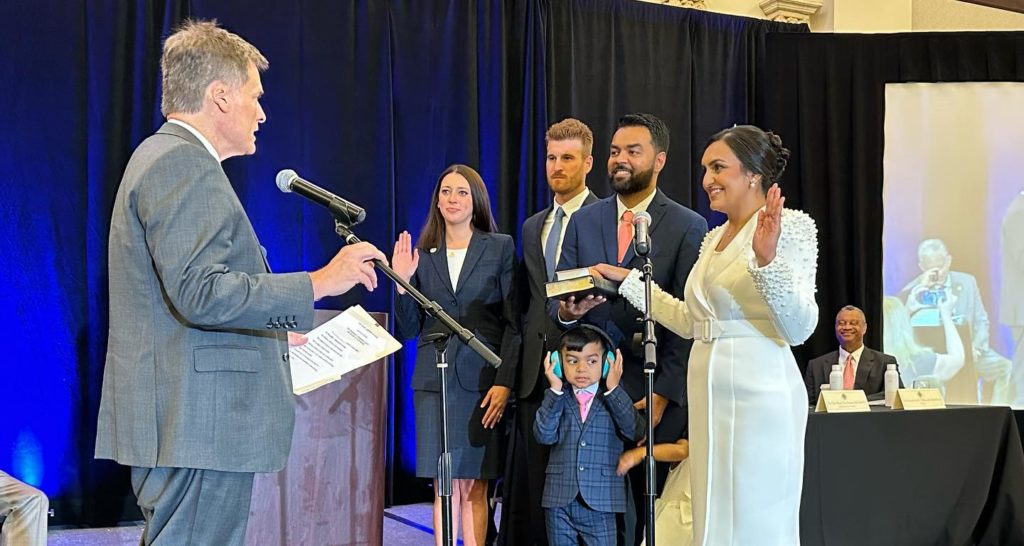
Anisha Patel ’15 was sworn into office as ’23-’24 president of the Florida Bar Young Lawyers Division in June of 2023.
It was also a huge year for Stetson Law alumni. Double Hatter Viviana Vasiu, who received her J.D. in 2018, was selected for a prestigious fellowship with the U.S. Supreme Court, a yearlong term she began in September. Over the summer, 2015 alumna Anisha Patel was sworn in as president of the Florida Bar Association Young Lawyers Division. And as mentioned above, 2018 alumna Taylor Sartor launched an app to help youth in foster care navigate the system’s legal landscape and advocate for themselves. The concept stems from her time in Stetson Law’s Social Justice Advocacy Concentration; Professor Judith Scully, who mentored Sartor at the time, won a national award for her role in the project.
BONUS: Restoring Our Historic Fountains.
Stetson Law’s beloved “wishing well” fountain was also restored in Fall of 2023.
Everyone enjoys strolling past the ornate fountains that can be found throughout campus. Thanks to a federal grant, workers are now in the middle of lovingly restoring three century-old fountains to their full glory so they can be enjoyed in perpetuity. These include the large circular South Fountain, the iconic Wishing Well, and the Granary Tower Fountain.
Artificial intelligence is poised to transform the way lawyers work. Photo courtesy of Deepak Pal/Wikimedia Commons.
Just over one year after Open AI’s ChatGPT launched, artificial intelligence is transforming workplaces everywhere – including law firms.
Ian McDougall
To London-based expert Ian McDougall, executive vice president and general counsel for LexisNexis’ Legal & Professional Division and president of its Rule of Law Foundation, artificial intelligence (A.I.) is poised to have a transformative impact on how lawyers work – but it will not likely replace them.
Law Professor Luz Nagle recently hosted McDougall for an afternoon lecture in the Florin-Roebig courtroom at Stetson Law to discuss the impact of artificial intelligence on the legal profession.
“I’m not someone usually given to hyperbole, so when I say this is an industrial revolution, on that kind of scale, it really does mean something,” he said.
Necessary, if uncomfortable
Referring to himself as a “dinosaur,” McDougall joked about how he comes from a generation for whom the term “folder” once referred to a physical item used to store paper documents. Meanwhile, generations of lawyers will join the profession never knowing a world without wifi, BlueTooth, or mobile phones. A.I. will likely join that list – even if there will be resistance at first.
“We’re talking about a profession that’s notoriously conservative and reluctant to change,” he said. “That’s been its tradition. But that’s understandable, because the legal profession is on a constant quest for certainty in an increasingly uncertain world.”
It is important, McDougall stressed, to distinguish between different types of AI: generative vs. predictive, for example, and closed systems vs. open systems.
Whereas an open system would scan the entire internet – fiction, satire, and all – to inform a legal brief it was prompted to create, a closed system would be limited to source materials contained within it. The latter could help lawyers create complex, well-sourced legal documents within seconds.
“When it comes to production efficiency, we cannot compete with computers and robots,” McDougall said. “For the legal profession, doing it the same old way is no longer an option.”
Legal strategies could become much more reliant on data and analytics – and less on a lawyer’s own subjective experience.
“I will predict that in the future, the expression ‘professional judgment’ will become a euphemism for a decision that is taken without sufficient data,” McDougall said.
Changing – not replacing – legal expertise
Citing concerns over the possibility of AI posing an existential threat, McDougall pointed to employment rates that were relatively unchanged after previous industrial upheavals.
When the internal combustion engine became ubiquitous, taxis powered by horses went away – but the job of a taxi driver never did.
“It did not replace the taxi driver, but it fundamentally altered the skills a taxi driver needs,” Mc Dougall said.
Likewise, he said, the legal profession has existed for centuries and will still play a critical role in society, but those who are a part of it may have to shift their thinking about how they work – and, importantly, how they are compensated.
“In a world where billing for time is gone because the artificial intelligence can do the same thing in a millisecond, and this is going to shock some people, billing for value will be required,” McDougall said. “Lawyers will actually have to assess how much value they contributed to people rather than just charging for time.”
Officials celebrated the opening of the Advocacy Institute with a ribbon cutting on October 28, 2023.
Stetson alumni, leadership, and friends recently gathered to celebrate the opening of a stunning new facility on the College of Law campus in Gulfport.
With support from alumni and other community leaders, the Advocacy Institute invites students, faculty, and other members of the advocacy community to learn and collaborate in its well-appointed courtrooms, study areas, and other spaces.
Officials and alumni celebrated the new facility at an event in late October.
“It has been such a joy to share our new Advocacy Institute with the community,” said Stetson Law Dean D. Benjamin Barros. “We can’t wait to see the many ways in which this dynamic new space will grow and shape our legacy as a global advocacy leader.”
In photos: Advocacy Institute opening reception
AvocacyInstituteOpening9
AvocacyInstituteOpening8
AvocacyInstituteOpening6
AvocacyInstituteOpening7
AvocacyInstituteOpening5
AvocacyInstituteOpening3
AvocacyInstituteOpening4
AvocacyInstituteOpening2
AvocacyInstituteOpening1
AvocacyInstituteOpening14
AvocacyInstituteOpening13
AvocacyInstituteOpening15
AvocacyInstituteOpening10
AvocacyInstituteOpening12
AvocacyInstituteOpening11
The facility will build on Stetson Law’s stellar reputation as a national leader in advocacy education while giving students opportunities to grow as advocates and as members of the community. Stetson Law is U.S. News & World Report’s No. 1 destination for advocacy and has been for years. The Institute will greatly enhance this incredible legacy.
More space to collaborate, practice, and celebrate
Situated on Stetson Law’s historic Gulfport campus, the 16,000-square-foot facility is emblematic and functional. It offers students a modern setting to learn without leaving the campus’s majestic grounds.
With the addition of six new courtrooms, the new facility brings the number of formal courtrooms on campus to 12. The facility also adds two new jury deliberation rooms, one new lecture classroom, two new technology-equipped conference rooms, and 16 new offices.
In photos: Stetson Law’s new Advocacy Institute
AdvocacyInstitueShots4
AdvocacyInstitueShots5
AdvocacyInstitueShots3
AdvocacyInstitueShots1
AdvocacyInstitueShots6
AdvocacyInstitueShots2
AdvocacyInstitueShots9
AdvocacyInstitueShots8
AdvocacyInstitueShots7
Extensive collaboration space invites students to study and share insights gleaned from their educational journeys. The Institute also features a history and awards hall, a renovated lobby entrance, and the campus bookstore. The new spaces will be the ideal training ground for Stetson Law’s award-winning moot court, mock trial, and dispute resolution teams – as well as the perfect backdrop for major annual events like the Educating Advocacy Teachers conference, the National Pretrial Competition, and the International Environmental Moot Court Competition.
Exploring advocacy across disciplines
Several of the College of Law’s celebrated centers and institutes have also moved here, including the Center for Excellence in Advocacy, Center for Excellence in Elder Law, and Jacobs Law Clinic for Democracy and the Environment. This invites students and mentors involved with these programs to work together, share ideas, and hone their skills across disciplines.
“An advocacy-rich education, which extends across concentrations and courses, gives students multiple opportunities to advocate for themselves as well as for positions, principles, and issues,” said Law Professor Elizabeth Boals, director of Stetson’s Center for Excellence in Advocacy. “These experiential learning spaces in our new Advocacy Institute allow for more intensive, advanced, specialized advocacy courses.”
Stetson Law believes in developing the complete advocate, and this facility represents our commitment to mastering a superior understanding of the law, the ability to persuasively present evidence, and the humanity to know when to do the right thing.
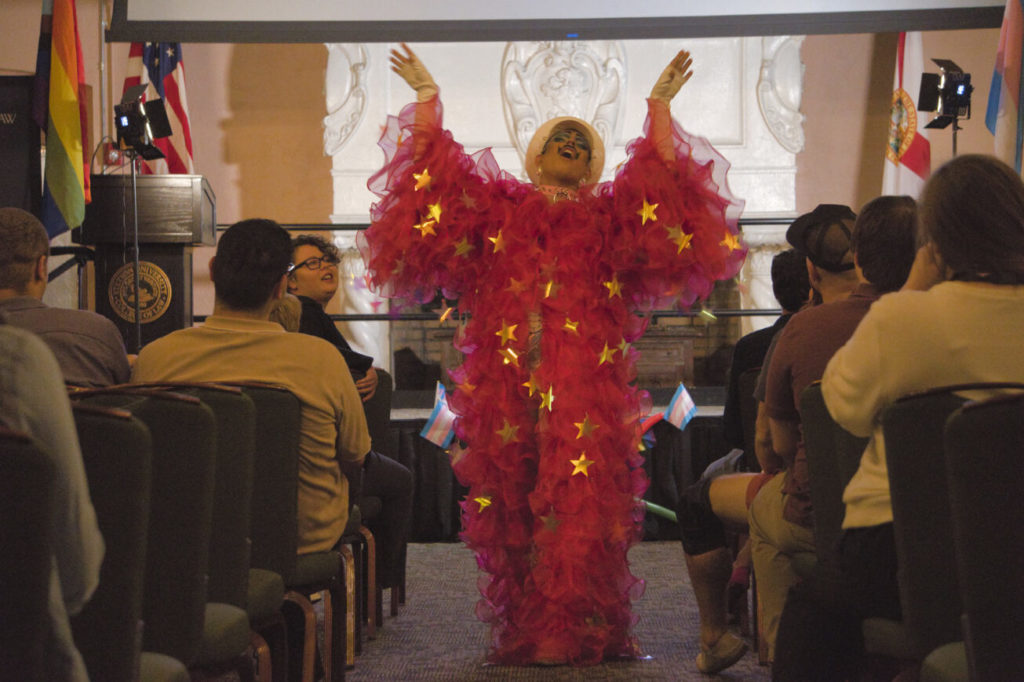
Stetson Law alumnus Edson Abadia, Jr. ’22 performs as Mr. Gripp during a Lambda Legal Society fundraiser.
Over a lively Friday evening in the Great Hall, Stetson Law students, faculty, staff, alumni, and friends celebrated the LGBTQ+ community and reflected on current challenges its members face in Florida.
The evening’s main event was a drag show featuring multiple performers, including 2022 alumnus Edson Abadia, Jr., who, in character as Mr. Gripp, opened the show with a dazzling routine set to a mashup of Queen’s “Bohemian Rhapsody,” The B-52s’ “Love Shack,” and Britney Spears’ “Toxic.”
Performances followed from Greta Gripp (Abadia’s partner, Michael Knapp), Hazel E. Genevieve, and Mr. Vun Suazion.
Organized by Stetson’s chapter of Lambda Legal Society, the event aimed to raise scholarship funds for LGBTQ students as well as awareness of current policies critics say are targeting the LGBTQ+ community on multiple fronts. Lambda played a pioneering role in bringing the first drag show to Stetson Law earlier in 2023 during Diversity Week with their annual Spelling Bee, ABCs with the LGBT.
An update & call to action
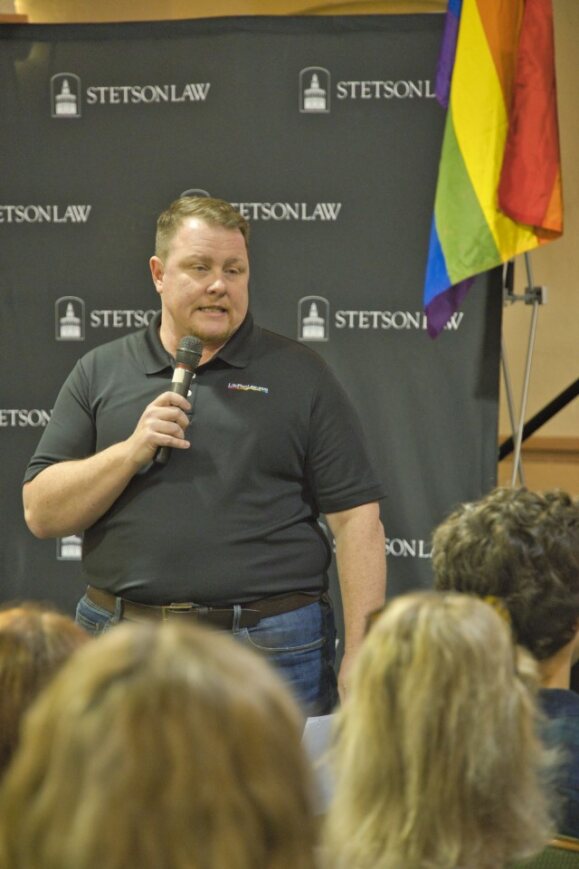
Before the performers took the stage, alumni Nathan Bruemmer offered insightful remarks on the current state of Florida law and its influence on matters related to sexual orientation as well as gender identity and expression.
Alumnus Nathan Bruemmer ’17 offers updates on laws affecting the LGBTQ+ community during a Lambda Legal Society fundraiser.
A 2017 graduate of Stetson Law, Bruemmer has held leadership roles in Equality Florida, St. Pete Pride, and other organizations. In 2021, he made history when former Agriculture Commissioner Nikki Fried appointed him to the role of LGBTQ Consumer Advocate for the Florida Department of Agriculture, which made him the first openly LGBTQ individual appointed to a statewide role in Florida – and the first openly transgender person appointed to such a role in the nation.
As he updated the audience on the latest legal efforts to fight restrictions on healthcare for transgender individuals and drag performances as well as other maneuvers targeting the LGBTQ+ community, he reflected on how his time at Stetson Law was marked by momentous events both in his life and within society at large.
He met the person who ultimately became his partner in the Dolly & Homer Hand Law Library – and was studying law at Stetson when the U.S. Supreme Court issued its decision on Obergefell, the landmark decision that legalized same-sex marriage, which he called “a really exciting and nerdy time” to be law student.
Despite it being in his hometown, he said, Stetson Law wasn’t initially on his radar as he began looking into studying law – until he got a letter from the college’s director of admissions talking about Stetson’s commitment to supporting LGBTQ+ students.
“It ended up being exactly where I needed to be, and so Stetson is home for me,” Bruemmer said.
As for facing recent setbacks for the community in Florida, he urged the audience to remain informed, engaged, and active – and to never give up.
“Never has it been clearer that the importance of developing diverse attorneys to be ready to respond to the moment we’re in, because it will take years of policy development and advocacy and litigation to get us out of this current moment,” he said. “I think Stetson’s finest will lead a lot of those efforts both here in Florida and across the country.”
Celebrating a commitment to diversity
The occasion marked a historic milestone for Lambda, serving as one of the organization’s largest networking events in its history. It also aimed to raise funds for Lambda’s PRIDE Scholarship, which Abadia initiated during his time at Stetson Law.
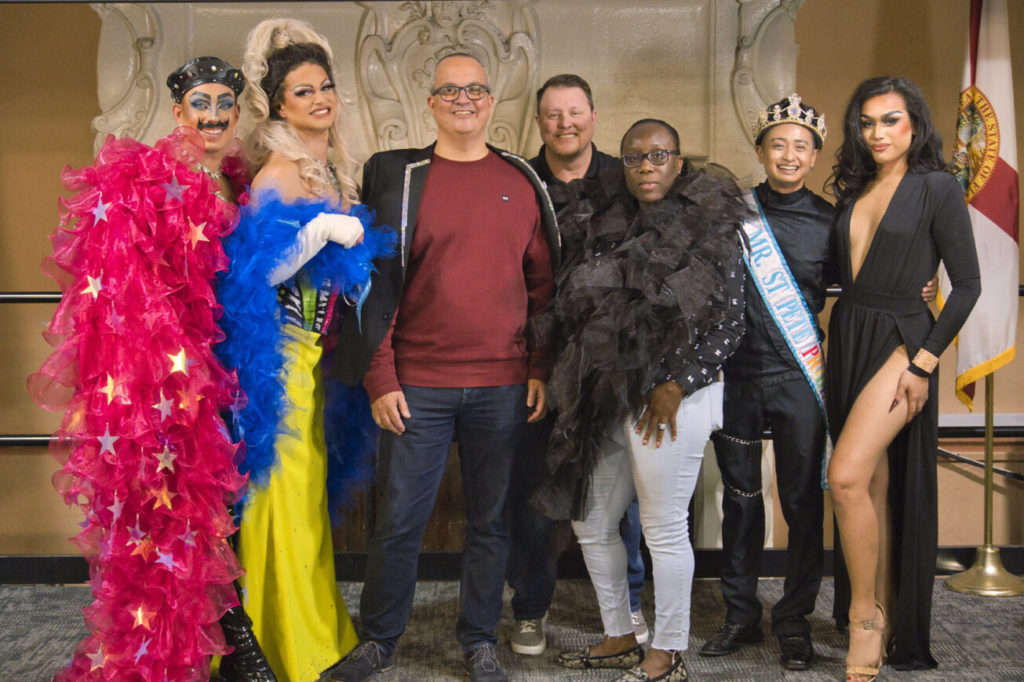
Left to right: Edson Abadia ’22 as Mr. Gripp, Michael Knapp as Greta Gripp, Dean Benjamin Barros, alumnus Nathan Bruemmer ’17, Assistant Dean for Student Affairs Latoya Edwards, Mr. Vun Suazion, and Hazel E. Genevieve.
Designed to provide financial support to LGBTQ+ community members actively engaged on campus, it thus far remains un-endowed, something Lambda’s current leadership aims to change.
In partnership with Lambda, the Student Affairs Department, Office of Diversity, Collaboration, and Inclusion (DCI), and the Department of Development and Alumni Engagement, organizers believe they are on the path to securing funding for the scholarship.
“Being able to host drag performers, hear from passionate alumni, and finally endow our PRIDE scholarship were important steps in furthering Lambda’s mission to support powerful advocates that bring diverse representation to our community,” said Hunter Wolf, president of Lambda at Stetson. “We are so lucky and honored to attend Stetson Law which both recognizes our LGBTQIA+ community and celebrates it.”
Several LGBTQ+ allied law firms, community organizations, and faculty members have already pledged their support to the scholarship – generous measures acknowledged during the event.
“Lambda Legal Society has always been my favorite part of Stetson,” Wolf said. “Law school is a difficult and demanding process, but it is the people and connections within this amazing student organization that I’m going to remember and cherish for life.”
More photos from the Florida Law & Drag fundraiser
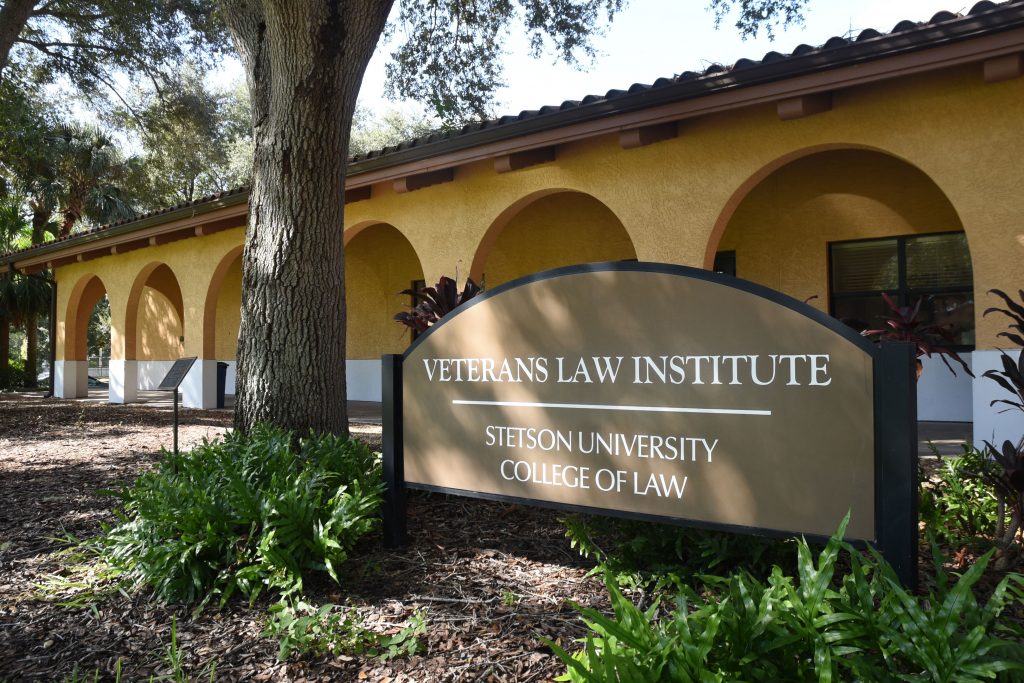
The Veterans Law Institute is on the Stetson University College of Law campus in Gulfport, Florida.
In recognition of its extensive work on behalf of veterans, The Veterans Consortium (TVC) has named Stetson’s Veterans Law Institute among seven recipients of its 2023 TVC Pro Bono Mission Partner Awards.
The awards honor active members of TVC’s National Volunteer Corps for committing their time and expertise to help further TVC’s mission of providing quality legal services to veterans in need at no charge. Award recipients will be honored Wednesday, November 15at the TVC Pro Bono Mission Partner Awards Reception, in Washington, DC.
The VLI won the consortium’s inaugural Legal Scholars Award for its extensive work on behalf of veterans. Law Professor and Veterans Law Institute Director Stacey-Rae Simcox and Adjunct Professor and VLI Associate Director Morgan MacIsaac-Bykowski will travel to Washington to accept the award.
“It is an honor to be recognized by The Veterans Consortium for the work we do on behalf of veterans,” Simcox said. “And it only inspires us to build on our successful record of advocating for veterans while giving our students a chance to do meaningful work on behalf of those who have served our nation.”
Tireless work on behalf of veterans
A founding member of the National Law School Veterans Clinic Consortium (NLSVCC), the VLI has been involved with numerous efforts to secure benefits for veterans whose claims for benefits from the U.S. Department of Veterans Affairs had been denied or inadequately compensated. These cases can take years.
In one case, a Navy veteran was hit by a car during service and suffered numerous injuries. They worsened over time; eventually requiring him to use a wheelchair. VLI students and staff took his case to court four times. After eight years, their work led to the client’s payment going from 30 percent to 100 percent due to unemployability and allowed him to receive over $70,000 in back benefits owed to him.
In another, a Navy corpsman experienced neurological damage after being tasked with spraying a pesticide to kill the fruit flies that invaded the Naval facility where he worked. He was eventually diagnosed with multiple sclerosis (MS). Receiving no benefits, he sought help from the VLI.
Professor Stacey-Rae Simcox meets with students working with the Veterans Advocacy Clinic.
Over four years, they were able to prove the connection between the pesticides he used and his MS – and the veteran received 100 percent of his claim along with Dependent and Indemnity compensation, which means his spouse would be paid monthly after he passed away. In addition, the VLI helped secure over $1 million in back pay for the client since his wife had been paying out of pocket for nursing home care, prescriptions, and medical appointments that should have been covered by the U.S. Department of Veterans Affairs.
Gaining experience, changing lives
In addition to helping veterans, the VLI gives students the opportunity to gain critical hands-on experience on U.S. Court of Appeals for Veterans Claims (CAVC) cases with potentially transformative outcomes.
For alumnus Christopher Gieger ’21, the first case he worked on was an introduction to appellate advocacy in administrative law, which became a critical first step toward his current career.
“I loved the challenges of the case and figuring out the best way to present our arguments in a brief,” he said. “The case also gave me the honor of representing a United States Veteran. We wanted to provide the best advocacy possible, and that pressure was a privilege.”
Alumnus Max Yarus ’19 said he wanted to gain experience serving vulnerable populations through public interest litigation – adding that working on veterans’ behalf was a chance to feel close to his grandfather, a World War II veteran.
“I remember writing my first memos and briefs and conducting negotiations with opposing counsel at the VLI; they were truly the foundations of my legal career and gave me the confidence to continue representing veterans in appeals to the CAVC after graduation,” he said. “I am currently clerking for Judge [Michael] Allen on the CAVC, and I’m eternally grateful for the VLI starting me down this career path.”
A former U.S. Army Airborne Infantryman who deployed as part of Operation Enduring Freedom, Vasilios Zimarakos ‘20 said many of his friends, family members, peers, and leaders who have experienced disabilities caused by and obtained during their time in service.
He said his most memorable appellate case while working in the VLI involved the widow of a veteran who had died from a disability obtained during his service in the Vietnam War. Zimarakos and his colleagues were able to secure benefits for the widow as well as back pay.
“The feeling of being able to tell ‘my’ first client about the outcome is something I’ll never forget, and my experiences at the VLI shaped my professional career in ways I still attribute to my time spent working on cases for our nation’s veterans,” Zimarakos said.
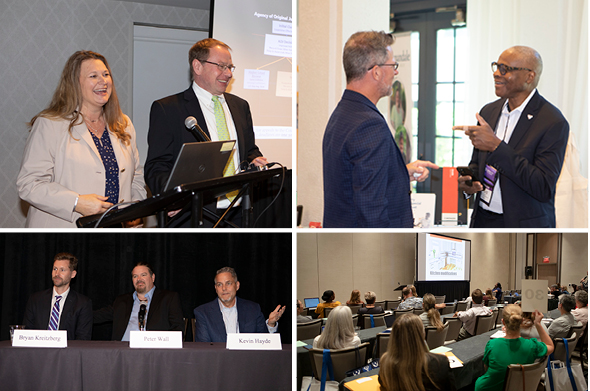
As always, the event took place at the Vinoy Result & Golf Club in downtown St. Petersburg. The programming was as enlightening and informative as ever, thanks to presenters who brought a blend of topical subject matter and expert understanding of the intricacies of public policy affecting the special needs planning and trusts space. Outside the meeting rooms, attendees mingled with a diverse array of sponsors and exhibitors.
Subject matter ranged from detailed legislative updates to ageism and its effects.
Overcoming ageism
A Thursday morning keynote by Dr. Tracey Gendron, chair and professor if gerontology at Virginia Commonwealth University and executive director of the Virgina Center on Aging, invited attendees to think differently about what it means to age.
“When we talk about aging just as a process of decline, we are missing a lot of nuance; we are missing a lot of important parts of the story that really encapsulate the whole that is aging,” Gendron said. “Aging includes decline, but aging is also about how we change and grow: psychologically, emotionally, socially, spiritually. Aging is the holistic process of change, development, growth, over time – and that is the story less told.”
Regardless of how old one is, Gendron said, they are aging. And anytime one assumes something about someone based on their age, regardless of whether someone is young or old – think generational stereotypes – it is ageism. It can also be internally directed. Ageism can have detrimental effects.
“The truth is, we are all aging. Aging is the one universal thing that connects us all,” she said. “So when we talk about the aging as others, what do you think that means? Well, any kind of othering leads to stigma, leads to discrimination, leads to marginalization, and oppression. So, aging we need to reframe as this universal experience we all share that is contextualized as growth, development, change, and adaptation over time.”
An AI primer
Stetson’s Bruce R. Jacob Visiting Professor of Law Mason Clark said he may not be a trusts expert, but he is an expert in privacy and cybersecurity law. He came to SNT to share information on a subject he knows well: artificial intelligence (AI), and how lawyers can use it.
Think of AI as an old-fashioned fold-out toolbox, he said, with implements created for different purposes. Most fall into two main categories: generative and predictive, which use machine learning and deep learning to assist users. Generative AI, he said, is currently having the biggest impact, with programs like ChatGPT and DALL-E helping firms in unprecedented ways.
“We’re seeing more productivity measurements for associates in firms, we’re seeing an increase in client-facing deliverables requiring generative AI, whether that be visualization that we’ve never had the capability to do before, sophisticated predictive analytics on how likely it is a client will succeed, how much we think you’re going to spend in fees to achieve that result,” Clark said.
Firms can use AI to model years’ worth of future revenue, thereby helping smaller firms target resources in ways that help close the gap with large firms – if done appropriately.
“I think there are a lot of wasteful ways to use AI, both generative and predictive. I think there are a lot of companies that are charging astronomical amounts to use a certain platform, a certain product, a certain application, that might not actually help your practice all that much,” Clark said, adding that resources like Consumer Reports, International Association of Privacy Professionals, podcasts and blogs like Law360 can help firms choose the right platform.
As for whether jobs in the legal profession will be replaced by AI tools en masse – a common concern for workplaces across sectors – Clark said he sees minimal impacts – as long as you’re willing to adapt.
“I don’t think AI will replace as many attorneys as you think it will… unless you’re unwilling or unable to adapt and learn how AI can help,” he said.
In photos: SNT 2023
SNT 2023 1
SNT 2023 3
SNT 2023 6
SNT 2023 8
SNT 2023 2
SNT 2023 4
SNT 2023 5
SNT 2023 7
SNT 2023 9
Frequently asked questions, answered
In an interactive, broad-reaching conversation with his audience, Los Angeles-based elder law attorney and past National Academy of Elder Law Attorneys (NAELA) president Stuart Zimring fielded questions from his audience on a range of topics during a “Top 10 Tips” session.
Among his key takeaways:
Take the time to develop the SNT to fit the beneficiary.
Have your “spidey senses” ready.
Never hesitate to say “no.”
The biggest takeaway? Make sure the beneficiary is always at the center of any conversation about a special needs trust.
“We are here to help ensure quality of life,” Zimring said, not just to grow the amount of money in a trust.
Other SNT 2023 highlights included a Veterans Benefits Intensive led by Judge Michael Allen and Law Professor Stacey-Rae Simcox, Director of Stetson’s Veterans Law Institute; “The Update,” a perennially popular SNT fixture that featured Elizabeth N.R. Friman and Robert Fechtman; and a session titled “Foxes and Henhouses – A Deep Dive Into Potential (and real) Conflicts of Interest and Other Ethical Issues for Trustees of SNTS” featuring Stetson Law alumnus Slade Dukes, Will Lucius, Briget Swartz, and Stuart Zimring.