Artificial intelligence is poised to transform the way lawyers work. Photo courtesy of Deepak Pal/Wikimedia Commons.
Just over one year after Open AI’s ChatGPT launched, artificial intelligence is transforming workplaces everywhere – including law firms.
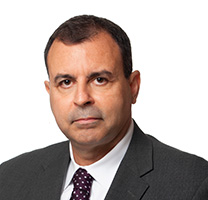
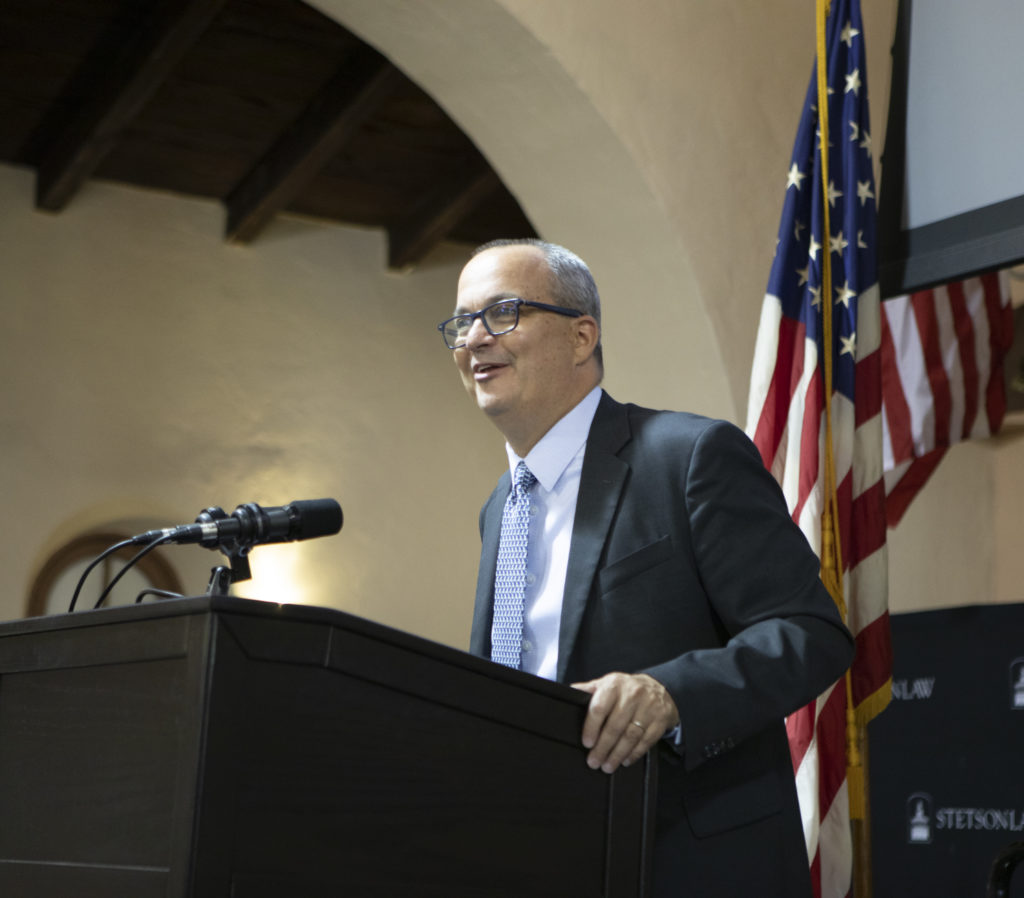
Ian McDougall
To London-based expert Ian McDougall, executive vice president and general counsel for LexisNexis’ Legal & Professional Division and president of its Rule of Law Foundation, artificial intelligence (A.I.) is poised to have a transformative impact on how lawyers work – but it will not likely replace them.
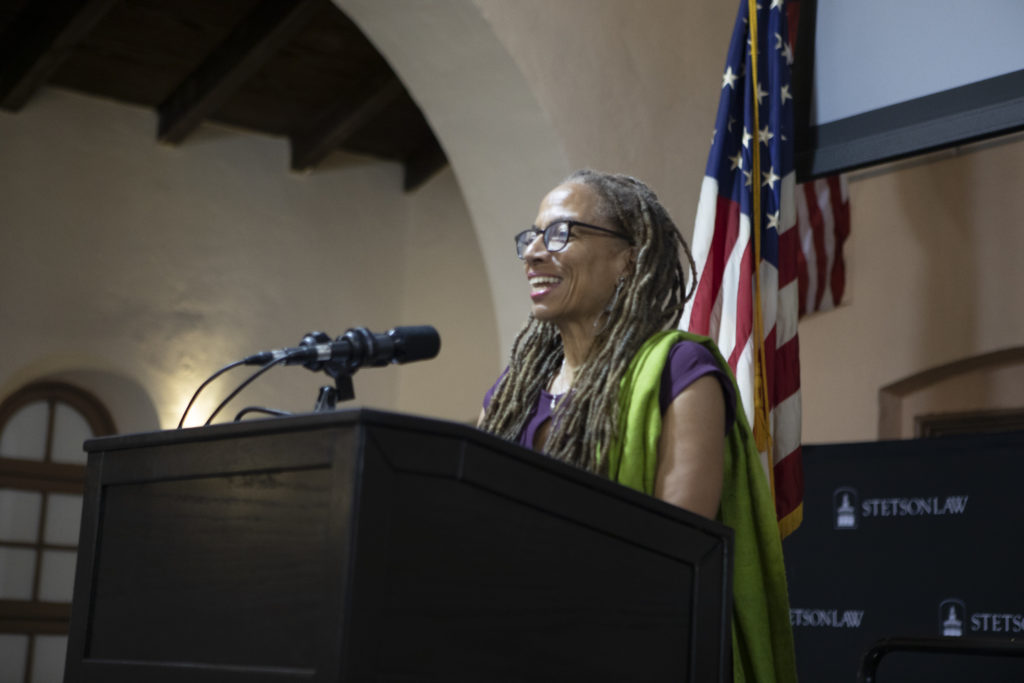
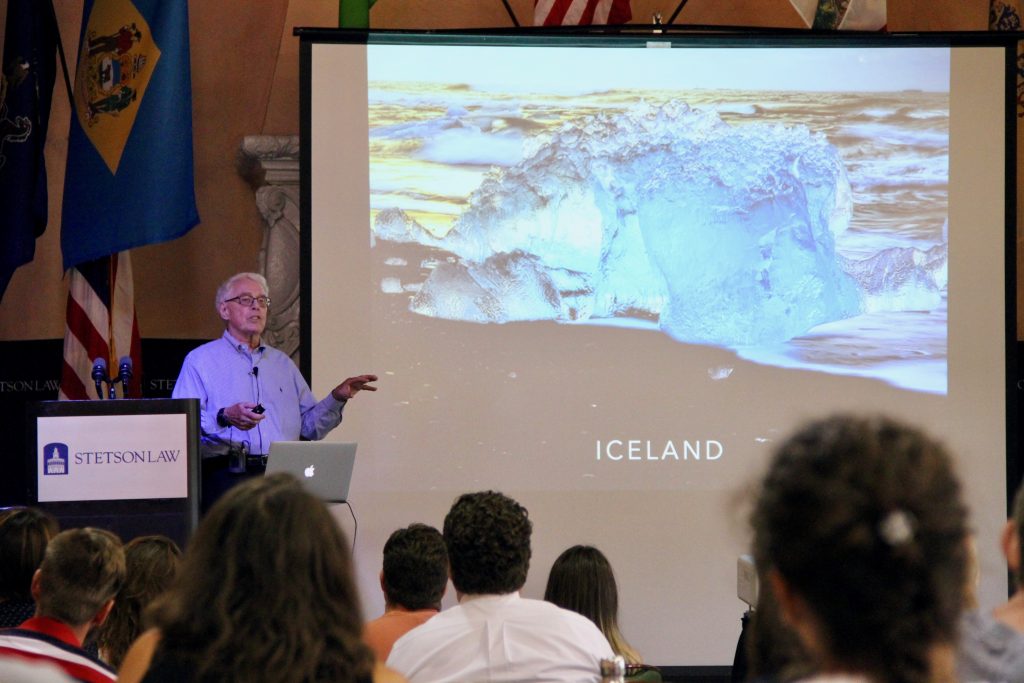
Law Professor Luz Nagle recently hosted McDougall for an afternoon lecture in the Florin-Roebig courtroom at Stetson Law to discuss the impact of artificial intelligence on the legal profession.
“I’m not someone usually given to hyperbole, so when I say this is an industrial revolution, on that kind of scale, it really does mean something,” he said.
Necessary, if uncomfortable
Referring to himself as a “dinosaur,” McDougall joked about how he comes from a generation for whom the term “folder” once referred to a physical item used to store paper documents. Meanwhile, generations of lawyers will join the profession never knowing a world without wifi, BlueTooth, or mobile phones. A.I. will likely join that list – even if there will be resistance at first.
“We’re talking about a profession that’s notoriously conservative and reluctant to change,” he said. “That’s been its tradition. But that’s understandable, because the legal profession is on a constant quest for certainty in an increasingly uncertain world.”
It is important, McDougall stressed, to distinguish between different types of AI: generative vs. predictive, for example, and closed systems vs. open systems.
Whereas an open system would scan the entire internet – fiction, satire, and all – to inform a legal brief it was prompted to create, a closed system would be limited to source materials contained within it. The latter could help lawyers create complex, well-sourced legal documents within seconds.
“When it comes to production efficiency, we cannot compete with computers and robots,” McDougall said. “For the legal profession, doing it the same old way is no longer an option.”
Legal strategies could become much more reliant on data and analytics – and less on a lawyer’s own subjective experience.
“I will predict that in the future, the expression ‘professional judgment’ will become a euphemism for a decision that is taken without sufficient data,” McDougall said.
Changing – not replacing – legal expertise
Citing concerns over the possibility of AI posing an existential threat, McDougall pointed to employment rates that were relatively unchanged after previous industrial upheavals.
When the internal combustion engine became ubiquitous, taxis powered by horses went away – but the job of a taxi driver never did.
“It did not replace the taxi driver, but it fundamentally altered the skills a taxi driver needs,” Mc Dougall said.
Likewise, he said, the legal profession has existed for centuries and will still play a critical role in society, but those who are a part of it may have to shift their thinking about how they work – and, importantly, how they are compensated.
“In a world where billing for time is gone because the artificial intelligence can do the same thing in a millisecond, and this is going to shock some people, billing for value will be required,” McDougall said. “Lawyers will actually have to assess how much value they contributed to people rather than just charging for time.”
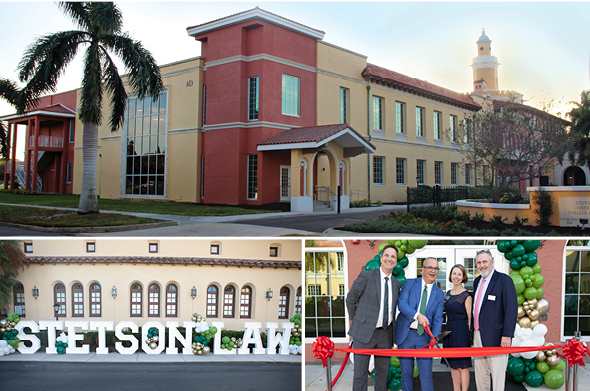
Officials celebrated the opening of the Advocacy Institute with a ribbon cutting on October 28, 2023.
Stetson alumni, leadership, and friends recently gathered to celebrate the opening of a stunning new facility on the College of Law campus in Gulfport.
With support from alumni and other community leaders, the Advocacy Institute invites students, faculty, and other members of the advocacy community to learn and collaborate in its well-appointed courtrooms, study areas, and other spaces.
Officials and alumni celebrated the new facility at an event in late October.
“It has been such a joy to share our new Advocacy Institute with the community,” said Stetson Law Dean D. Benjamin Barros. “We can’t wait to see the many ways in which this dynamic new space will grow and shape our legacy as a global advocacy leader.”
In photos: Advocacy Institute opening reception
AvocacyInstituteOpening9
AvocacyInstituteOpening8
AvocacyInstituteOpening6
AvocacyInstituteOpening7
AvocacyInstituteOpening5
AvocacyInstituteOpening3
AvocacyInstituteOpening4
AvocacyInstituteOpening2
AvocacyInstituteOpening1
AvocacyInstituteOpening14
AvocacyInstituteOpening13
AvocacyInstituteOpening15
AvocacyInstituteOpening10
AvocacyInstituteOpening12
AvocacyInstituteOpening11
The facility will build on Stetson Law’s stellar reputation as a national leader in advocacy education while giving students opportunities to grow as advocates and as members of the community. Stetson Law is U.S. News & World Report’s No. 1 destination for advocacy and has been for years. The Institute will greatly enhance this incredible legacy.
More space to collaborate, practice, and celebrate
Situated on Stetson Law’s historic Gulfport campus, the 16,000-square-foot facility is emblematic and functional. It offers students a modern setting to learn without leaving the campus’s majestic grounds.
With the addition of six new courtrooms, the new facility brings the number of formal courtrooms on campus to 12. The facility also adds two new jury deliberation rooms, one new lecture classroom, two new technology-equipped conference rooms, and 16 new offices.
In photos: Stetson Law’s new Advocacy Institute
AdvocacyInstitueShots4
AdvocacyInstitueShots5
AdvocacyInstitueShots3
AdvocacyInstitueShots1
AdvocacyInstitueShots6
AdvocacyInstitueShots2
AdvocacyInstitueShots9
AdvocacyInstitueShots8
AdvocacyInstitueShots7
Extensive collaboration space invites students to study and share insights gleaned from their educational journeys. The Institute also features a history and awards hall, a renovated lobby entrance, and the campus bookstore. The new spaces will be the ideal training ground for Stetson Law’s award-winning moot court, mock trial, and dispute resolution teams – as well as the perfect backdrop for major annual events like the Educating Advocacy Teachers conference, the National Pretrial Competition, and the International Environmental Moot Court Competition.
Exploring advocacy across disciplines
Several of the College of Law’s celebrated centers and institutes have also moved here, including the Center for Excellence in Advocacy, Center for Excellence in Elder Law, and Jacobs Law Clinic for Democracy and the Environment. This invites students and mentors involved with these programs to work together, share ideas, and hone their skills across disciplines.
“An advocacy-rich education, which extends across concentrations and courses, gives students multiple opportunities to advocate for themselves as well as for positions, principles, and issues,” said Law Professor Elizabeth Boals, director of Stetson’s Center for Excellence in Advocacy. “These experiential learning spaces in our new Advocacy Institute allow for more intensive, advanced, specialized advocacy courses.”
Stetson Law believes in developing the complete advocate, and this facility represents our commitment to mastering a superior understanding of the law, the ability to persuasively present evidence, and the humanity to know when to do the right thing.
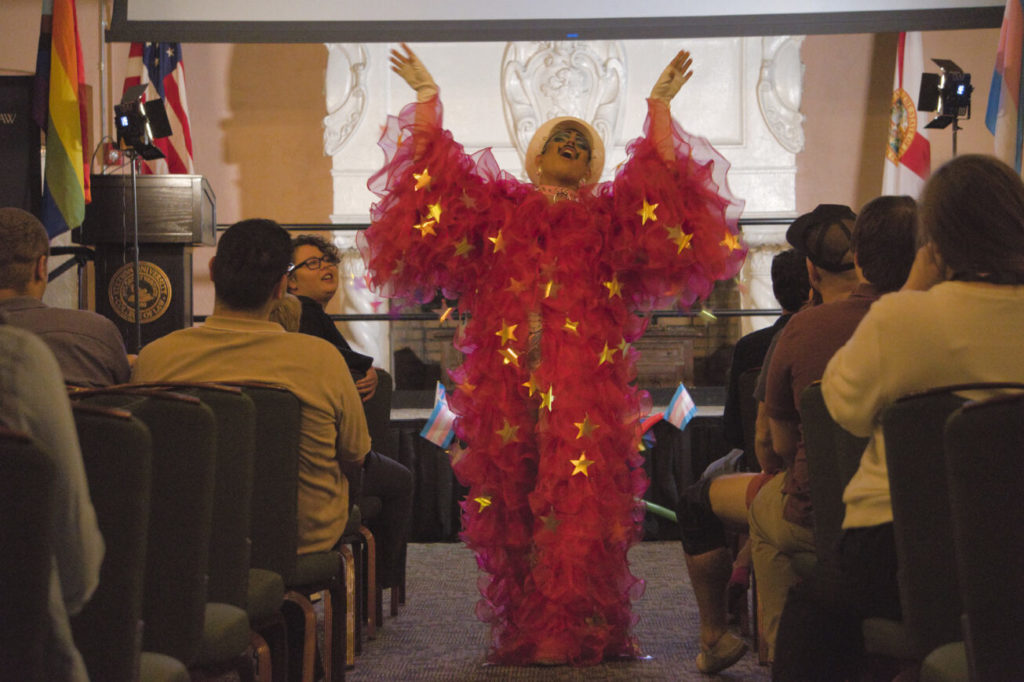
Stetson Law alumnus Edson Abadia, Jr. ’22 performs as Mr. Gripp during a Lambda Legal Society fundraiser.
Over a lively Friday evening in the Great Hall, Stetson Law students, faculty, staff, alumni, and friends celebrated the LGBTQ+ community and reflected on current challenges its members face in Florida.
The evening’s main event was a drag show featuring multiple performers, including 2022 alumnus Edson Abadia, Jr., who, in character as Mr. Gripp, opened the show with a dazzling routine set to a mashup of Queen’s “Bohemian Rhapsody,” The B-52s’ “Love Shack,” and Britney Spears’ “Toxic.”
Performances followed from Greta Gripp (Abadia’s partner, Michael Knapp), Hazel E. Genevieve, and Mr. Vun Suazion.
Organized by Stetson’s chapter of Lambda Legal Society, the event aimed to raise scholarship funds for LGBTQ students as well as awareness of current policies critics say are targeting the LGBTQ+ community on multiple fronts. Lambda played a pioneering role in bringing the first drag show to Stetson Law earlier in 2023 during Diversity Week with their annual Spelling Bee, ABCs with the LGBT.
An update & call to action
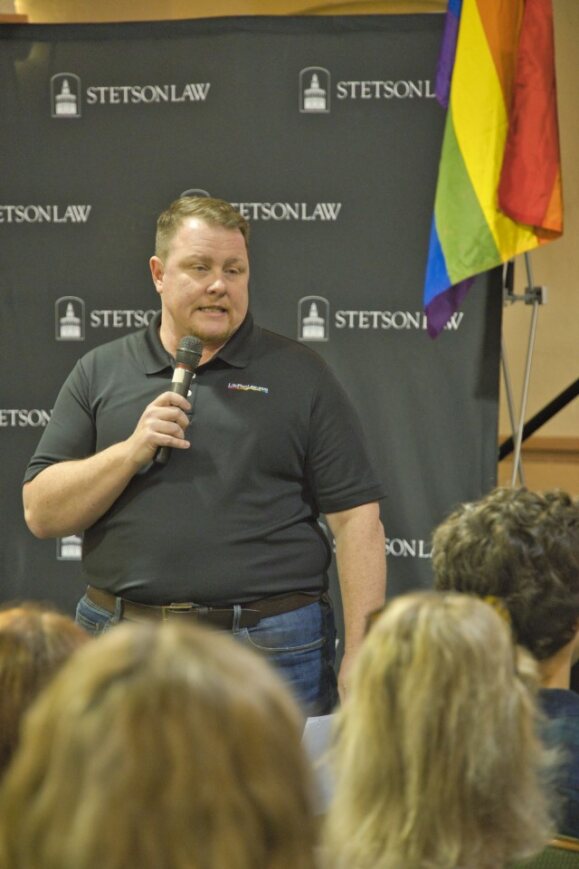
Before the performers took the stage, alumni Nathan Bruemmer offered insightful remarks on the current state of Florida law and its influence on matters related to sexual orientation as well as gender identity and expression.
Alumnus Nathan Bruemmer ’17 offers updates on laws affecting the LGBTQ+ community during a Lambda Legal Society fundraiser.
A 2017 graduate of Stetson Law, Bruemmer has held leadership roles in Equality Florida, St. Pete Pride, and other organizations. In 2021, he made history when former Agriculture Commissioner Nikki Fried appointed him to the role of LGBTQ Consumer Advocate for the Florida Department of Agriculture, which made him the first openly LGBTQ individual appointed to a statewide role in Florida – and the first openly transgender person appointed to such a role in the nation.
As he updated the audience on the latest legal efforts to fight restrictions on healthcare for transgender individuals and drag performances as well as other maneuvers targeting the LGBTQ+ community, he reflected on how his time at Stetson Law was marked by momentous events both in his life and within society at large.
He met the person who ultimately became his partner in the Dolly & Homer Hand Law Library – and was studying law at Stetson when the U.S. Supreme Court issued its decision on Obergefell, the landmark decision that legalized same-sex marriage, which he called “a really exciting and nerdy time” to be law student.
Despite it being in his hometown, he said, Stetson Law wasn’t initially on his radar as he began looking into studying law – until he got a letter from the college’s director of admissions talking about Stetson’s commitment to supporting LGBTQ+ students.
“It ended up being exactly where I needed to be, and so Stetson is home for me,” Bruemmer said.
As for facing recent setbacks for the community in Florida, he urged the audience to remain informed, engaged, and active – and to never give up.
“Never has it been clearer that the importance of developing diverse attorneys to be ready to respond to the moment we’re in, because it will take years of policy development and advocacy and litigation to get us out of this current moment,” he said. “I think Stetson’s finest will lead a lot of those efforts both here in Florida and across the country.”
Celebrating a commitment to diversity
The occasion marked a historic milestone for Lambda, serving as one of the organization’s largest networking events in its history. It also aimed to raise funds for Lambda’s PRIDE Scholarship, which Abadia initiated during his time at Stetson Law.
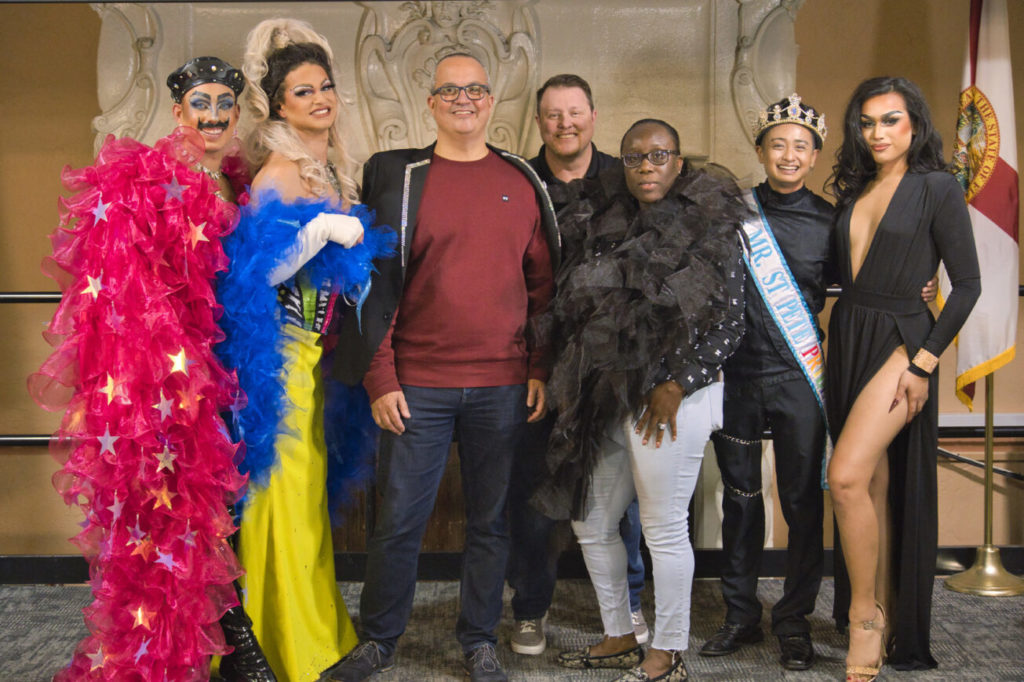
Left to right: Edson Abadia ’22 as Mr. Gripp, Michael Knapp as Greta Gripp, Dean Benjamin Barros, alumnus Nathan Bruemmer ’17, Assistant Dean for Student Affairs Latoya Edwards, Mr. Vun Suazion, and Hazel E. Genevieve.
Designed to provide financial support to LGBTQ+ community members actively engaged on campus, it thus far remains un-endowed, something Lambda’s current leadership aims to change.
In partnership with Lambda, the Student Affairs Department, Office of Diversity, Collaboration, and Inclusion (DCI), and the Department of Development and Alumni Engagement, organizers believe they are on the path to securing funding for the scholarship.
“Being able to host drag performers, hear from passionate alumni, and finally endow our PRIDE scholarship were important steps in furthering Lambda’s mission to support powerful advocates that bring diverse representation to our community,” said Hunter Wolf, president of Lambda at Stetson. “We are so lucky and honored to attend Stetson Law which both recognizes our LGBTQIA+ community and celebrates it.”
Several LGBTQ+ allied law firms, community organizations, and faculty members have already pledged their support to the scholarship – generous measures acknowledged during the event.
“Lambda Legal Society has always been my favorite part of Stetson,” Wolf said. “Law school is a difficult and demanding process, but it is the people and connections within this amazing student organization that I’m going to remember and cherish for life.”
More photos from the Florida Law & Drag fundraiser
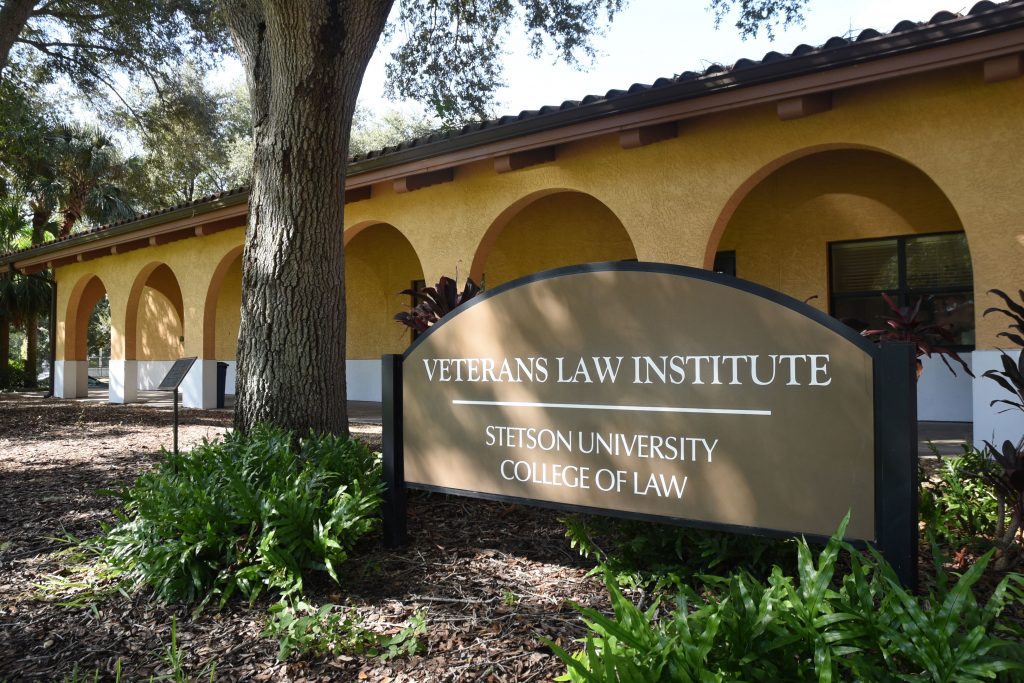
The Veterans Law Institute is on the Stetson University College of Law campus in Gulfport, Florida.
In recognition of its extensive work on behalf of veterans, The Veterans Consortium (TVC) has named Stetson’s Veterans Law Institute among seven recipients of its 2023 TVC Pro Bono Mission Partner Awards.
The awards honor active members of TVC’s National Volunteer Corps for committing their time and expertise to help further TVC’s mission of providing quality legal services to veterans in need at no charge. Award recipients will be honored Wednesday, November 15at the TVC Pro Bono Mission Partner Awards Reception, in Washington, DC.
The VLI won the consortium’s inaugural Legal Scholars Award for its extensive work on behalf of veterans. Law Professor and Veterans Law Institute Director Stacey-Rae Simcox and Adjunct Professor and VLI Associate Director Morgan MacIsaac-Bykowski will travel to Washington to accept the award.
“It is an honor to be recognized by The Veterans Consortium for the work we do on behalf of veterans,” Simcox said. “And it only inspires us to build on our successful record of advocating for veterans while giving our students a chance to do meaningful work on behalf of those who have served our nation.”
Tireless work on behalf of veterans
A founding member of the National Law School Veterans Clinic Consortium (NLSVCC), the VLI has been involved with numerous efforts to secure benefits for veterans whose claims for benefits from the U.S. Department of Veterans Affairs had been denied or inadequately compensated. These cases can take years.
In one case, a Navy veteran was hit by a car during service and suffered numerous injuries. They worsened over time; eventually requiring him to use a wheelchair. VLI students and staff took his case to court four times. After eight years, their work led to the client’s payment going from 30 percent to 100 percent due to unemployability and allowed him to receive over $70,000 in back benefits owed to him.
In another, a Navy corpsman experienced neurological damage after being tasked with spraying a pesticide to kill the fruit flies that invaded the Naval facility where he worked. He was eventually diagnosed with multiple sclerosis (MS). Receiving no benefits, he sought help from the VLI.
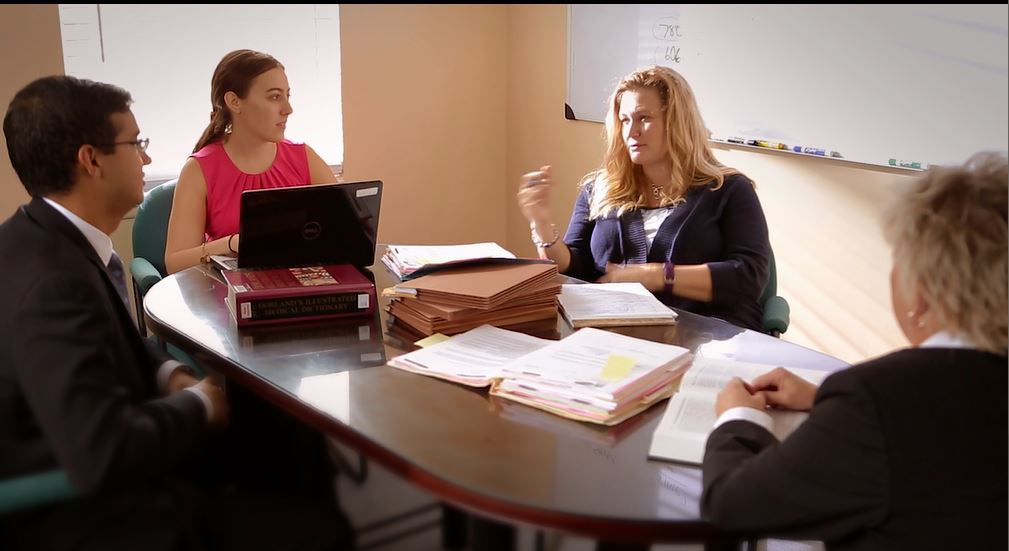
Professor Stacey-Rae Simcox meets with students working with the Veterans Advocacy Clinic.
Over four years, they were able to prove the connection between the pesticides he used and his MS – and the veteran received 100 percent of his claim along with Dependent and Indemnity compensation, which means his spouse would be paid monthly after he passed away. In addition, the VLI helped secure over $1 million in back pay for the client since his wife had been paying out of pocket for nursing home care, prescriptions, and medical appointments that should have been covered by the U.S. Department of Veterans Affairs.
Gaining experience, changing lives
In addition to helping veterans, the VLI gives students the opportunity to gain critical hands-on experience on U.S. Court of Appeals for Veterans Claims (CAVC) cases with potentially transformative outcomes.
For alumnus Christopher Gieger ’21, the first case he worked on was an introduction to appellate advocacy in administrative law, which became a critical first step toward his current career.
“I loved the challenges of the case and figuring out the best way to present our arguments in a brief,” he said. “The case also gave me the honor of representing a United States Veteran. We wanted to provide the best advocacy possible, and that pressure was a privilege.”
Alumnus Max Yarus ’19 said he wanted to gain experience serving vulnerable populations through public interest litigation – adding that working on veterans’ behalf was a chance to feel close to his grandfather, a World War II veteran.
“I remember writing my first memos and briefs and conducting negotiations with opposing counsel at the VLI; they were truly the foundations of my legal career and gave me the confidence to continue representing veterans in appeals to the CAVC after graduation,” he said. “I am currently clerking for Judge [Michael] Allen on the CAVC, and I’m eternally grateful for the VLI starting me down this career path.”
A former U.S. Army Airborne Infantryman who deployed as part of Operation Enduring Freedom, Vasilios Zimarakos ‘20 said many of his friends, family members, peers, and leaders who have experienced disabilities caused by and obtained during their time in service.
He said his most memorable appellate case while working in the VLI involved the widow of a veteran who had died from a disability obtained during his service in the Vietnam War. Zimarakos and his colleagues were able to secure benefits for the widow as well as back pay.
“The feeling of being able to tell ‘my’ first client about the outcome is something I’ll never forget, and my experiences at the VLI shaped my professional career in ways I still attribute to my time spent working on cases for our nation’s veterans,” Zimarakos said.
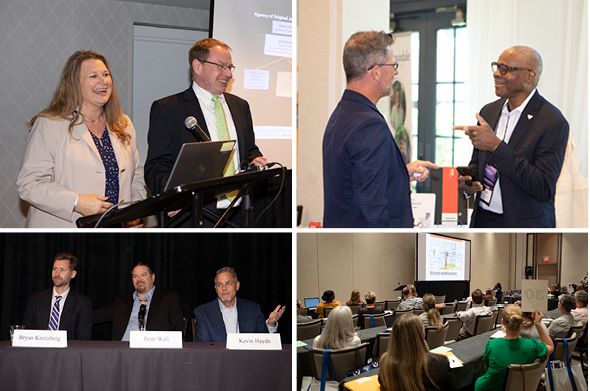
As always, the event took place at the Vinoy Result & Golf Club in downtown St. Petersburg. The programming was as enlightening and informative as ever, thanks to presenters who brought a blend of topical subject matter and expert understanding of the intricacies of public policy affecting the special needs planning and trusts space. Outside the meeting rooms, attendees mingled with a diverse array of sponsors and exhibitors.
Subject matter ranged from detailed legislative updates to ageism and its effects.
Overcoming ageism
A Thursday morning keynote by Dr. Tracey Gendron, chair and professor if gerontology at Virginia Commonwealth University and executive director of the Virgina Center on Aging, invited attendees to think differently about what it means to age.
“When we talk about aging just as a process of decline, we are missing a lot of nuance; we are missing a lot of important parts of the story that really encapsulate the whole that is aging,” Gendron said. “Aging includes decline, but aging is also about how we change and grow: psychologically, emotionally, socially, spiritually. Aging is the holistic process of change, development, growth, over time – and that is the story less told.”
Regardless of how old one is, Gendron said, they are aging. And anytime one assumes something about someone based on their age, regardless of whether someone is young or old – think generational stereotypes – it is ageism. It can also be internally directed. Ageism can have detrimental effects.
“The truth is, we are all aging. Aging is the one universal thing that connects us all,” she said. “So when we talk about the aging as others, what do you think that means? Well, any kind of othering leads to stigma, leads to discrimination, leads to marginalization, and oppression. So, aging we need to reframe as this universal experience we all share that is contextualized as growth, development, change, and adaptation over time.”
An AI primer
Stetson’s Bruce R. Jacob Visiting Professor of Law Mason Clark said he may not be a trusts expert, but he is an expert in privacy and cybersecurity law. He came to SNT to share information on a subject he knows well: artificial intelligence (AI), and how lawyers can use it.
Think of AI as an old-fashioned fold-out toolbox, he said, with implements created for different purposes. Most fall into two main categories: generative and predictive, which use machine learning and deep learning to assist users. Generative AI, he said, is currently having the biggest impact, with programs like ChatGPT and DALL-E helping firms in unprecedented ways.
“We’re seeing more productivity measurements for associates in firms, we’re seeing an increase in client-facing deliverables requiring generative AI, whether that be visualization that we’ve never had the capability to do before, sophisticated predictive analytics on how likely it is a client will succeed, how much we think you’re going to spend in fees to achieve that result,” Clark said.
Firms can use AI to model years’ worth of future revenue, thereby helping smaller firms target resources in ways that help close the gap with large firms – if done appropriately.
“I think there are a lot of wasteful ways to use AI, both generative and predictive. I think there are a lot of companies that are charging astronomical amounts to use a certain platform, a certain product, a certain application, that might not actually help your practice all that much,” Clark said, adding that resources like Consumer Reports, International Association of Privacy Professionals, podcasts and blogs like Law360 can help firms choose the right platform.
As for whether jobs in the legal profession will be replaced by AI tools en masse – a common concern for workplaces across sectors – Clark said he sees minimal impacts – as long as you’re willing to adapt.
“I don’t think AI will replace as many attorneys as you think it will… unless you’re unwilling or unable to adapt and learn how AI can help,” he said.
In photos: SNT 2023
SNT 2023 1
SNT 2023 3
SNT 2023 6
SNT 2023 8
SNT 2023 2
SNT 2023 4
SNT 2023 5
SNT 2023 7
SNT 2023 9
Frequently asked questions, answered
In an interactive, broad-reaching conversation with his audience, Los Angeles-based elder law attorney and past National Academy of Elder Law Attorneys (NAELA) president Stuart Zimring fielded questions from his audience on a range of topics during a “Top 10 Tips” session.
Among his key takeaways:
Take the time to develop the SNT to fit the beneficiary.
Have your “spidey senses” ready.
Never hesitate to say “no.”
The biggest takeaway? Make sure the beneficiary is always at the center of any conversation about a special needs trust.
“We are here to help ensure quality of life,” Zimring said, not just to grow the amount of money in a trust.
Other SNT 2023 highlights included a Veterans Benefits Intensive led by Judge Michael Allen and Law Professor Stacey-Rae Simcox, Director of Stetson’s Veterans Law Institute; “The Update,” a perennially popular SNT fixture that featured Elizabeth N.R. Friman and Robert Fechtman; and a session titled “Foxes and Henhouses – A Deep Dive Into Potential (and real) Conflicts of Interest and Other Ethical Issues for Trustees of SNTS” featuring Stetson Law alumnus Slade Dukes, Will Lucius, Briget Swartz, and Stuart Zimring.
Spring ’23 alumni Sean Caulfield (left) and Samuel Ciulla (right) had two of the highest July 2023 Florida Bar Exam scores.
Like many of his classmates, Spring 2023 Stetson Law graduate Sean Caulfield was in the library nearly seven days a week following commencement.
Though grueling, studying for the July Florida Bar exam got a little easier as the summer went on – especially with support from Stetson Law’s extensive bar prep resources, Professor Ellen Podgor (his bar coach), and Professor Stacey-Rae Simcox (his mentor).
“It was a long and hard process, but as the summer goes on you get into a routine and it becomes a bit more bearable,” Caulfield said.
All that work paid off – and then some. Not only did he pass, but he and classmate Samuel Ciulla were among the top bar exam scorers in the state.
“We are incredibly proud of Samuel and Sean,” said Law Professor Alicia Jackson, Director of Academic Success and Bar Preparation at Stetson Law. “They are a testament to hard work and dedication to their law studies and preparing for the bar exam. Great things are destined for them as we welcome them to the legal profession.”
A rare honor for a job well done
That designation comes with the opportunity to speak at a Florida Bar Association swearing-in ceremony for new members. Caulfield spoke in front of the Florida Supreme Court on behalf of the newly admitted attorneys while Ciulla spoke at Florida’s 2nd District Court of Appeals induction ceremony in Tampa.
“It was truly an honor to address my peers at the induction ceremony, as these new attorneys are all incredibly bright individuals who passed one of the hardest exams in the country, so being able to celebrate this momentous occasion with them was certainly rewarding,” Ciulla said.
Caulfield said it was an honor to celebrate the milestone with his peers and his family, who made the trip to Tallahassee for the occasion.
“Everyone who was sworn in that day put in an enormous amount of work over their law school careers to get to that point, and it was an honor to represent Stetson, speak before the justices, and celebrate the accomplishments of his new class of attorneys,” Caulfield said.
Exam day nerves
The day they walked into the exam room in July, both were already accomplished Stetson Law alumni.
Caulfield participated in the Honors Program and Stetson Law Review, graduated with honors, and received Stetson Law’s 2023 Elizabeth M. Leeman Award. Ciulla participated in the Stetson Law Review, graduated with honors, and was Stetson Law’s Spring 2023 valedictorian.
Even so, neither saw passing the bar as a sure thing – let alone being a top scorer.
Caulfield said when he got a phone call regarding his score, he immediately thought there had been a mistake and that his passing score had been rescinded.
“I wanted to hang the phone up right then and there,” he said. “But thankfully I didn’t.”
For Ciulla, who began studying full-time three weeks early so he could take weekends off (thus avoiding burnout), it took a few moments to sink in.
“Getting the call from Chief Judge Daniel Sleet that I achieved one of the higher bar exam scores was unfathomable at the time, but after processing the news, I reflected on all the hard work, dedication, and sacrifice I put in over the summer – it was all worth it,” he said.
Investing in success
College of Law leadership places particular emphasis on equipping students with everything they need to pass the Florida Bar Exam on the first attempt.
Stetson Law Dean D. Benjamin Barros
Stetson Law Dean D. Benjamin Barros, who started in his role in July of 2023, views improving first-time bar exam passage rates as a key priority.
“As an institution, we are committed to doing everything we can to help prepare our graduates for the bar,” Barros said. “At the end of the day, though, passing the bar takes a great deal of diligence from each graduate. We are incredibly proud of Mr. Caulfield, Mr. Ciulla, and all of their peers for doing the hard work necessary to pass the bar.”
Stetson Law had one of the top first-time bar passage rates for the July 2023 exam. This is also not the first time a recent College of Law graduate has achieved one of the highest scores on the exam.
A vibrant reef ecosystem off the coast of Puerto Rico. Photo courtesy of NOAA.
Last week, Stetson’s Jacobs Public Interest Law Clinic for Democracy and the Environment submitted an amicus brief to the D.C. Circuit Court of Appeals calling on federal officials to halt a project that could be detrimental to a coral reef system off Puerto Rico’s coast.
Filed on behalf of two Ph.D. scientists criticizing the U.S. Army Corps of Engineers’ approval of a dredge project that the scientists fear will harm coral in San Juan Bay, the brief and declaration from Dr. Rachel Silverstein of Miami Waterkeeper documents the federal government’s failure to learn lessons from dredge projects in South Florida that damaged coral.
“The Corps’ failure to learn lessons from the PortMiami dredge is egregious,” said Dr. Rachel Silverstein of Miami Waterkeeper. “In the PortMiami project, dredging likely killed millions of corals and destroyed over 278 acres of reef. Now, the Corps is once again failing to protect corals in Puerto Rico. With devastating coral losses incurred in recent years, it’s an absolute imperative to prevent more damage to corals in San Juan.”
An ecosystem in peril
The proposed project coincides with catastrophic events like coral bleaching, brought on by pollution and a warming climate. The importance of protecting vibrant coral reef ecosystems like that which lies off San Juan Bay goes beyond the intrinsic value of good environmental stewardship. This complex, enchanting seascape is critical to the island’s economy through sustaining countless aquatic species.
“We are hopeful that the information we’re submitting to the court will help it understand just how wrong the federal government is on this one,” said Professor Jaclyn Lopez, the director of Stetson’s Jacobs Law Clinic. “These coral are already under so much strain from climate change, we should be doing all we can to protect them from easily preventable harm.”
The scientists brought the amicus brief with community-based environmental groups in Puerto Rico who oppose the project. Those groups are represented by the Vermont Law’s Environmental Justice Clinic.
For the fourth consecutive year, Stetson University College of Law has won INSIGHT Into Diversity‘s Higher Education Excellence in Diversity (HEED) Award, a national honor recognizing U.S. colleges and universities that demonstrate an outstanding commitment to diversity and inclusion.
The 2023 HEED Award recognizes Stetson University as a whole for its diversity initiatives as well as those specific to Stetson Law. This is the first time Stetson University, which is headquartered in DeLand, Florida, has won this award.
A Civil Rights and the Constitution travel course is an immersive experience at Stetson Law.
The winners, announced Oct. 11, underwent a rigorous application process that examined recruitment and retention of students and employees at their institution, as well as supportive leadership for diversity in campus culture.
“Our standards are high, and we look for institutions where diversity and inclusion are woven into the work being done every day across their campus,” said Lenore Pearlstein, publisher of INSIGHT Into Diversity, the oldest and largest diversity-focused publication in higher education.
Years of fostering diversity & inclusion
Stetson Law was recognized for co-founding and co-leading the St. Petersburg Truth, Racial Healing, and Transformation Center in partnership with Eckerd College, the only entity of its kind in Florida. Stetson Law continues to reinvest in the effort by sharing expertise and resources beyond its Gulfport campus, exploring ways to bring communities together, and training lawyers and future leaders to be part of the work.
Law Professor Judith Scully speaks to students who completed the 2023 Youth Civic Engagement Program.
“The TRHT Center’s ultimate goal is to build the bridges necessary to connect our college campuses to community activists, government officials, and other individuals who are working on making our communities stronger, healthier, and more equitable,” said Law Professor Judith Scully, who led efforts to establish the program. “To be involved in organizing around racial healing and transformation at this moment in time in Florida is a challenging opportunity that the St. Pete TRHT Center is perfectly poised to meet.”
Stetson Law Professor Jaclyn Lopez, Director of the Jacobs Law Clinic
Stetson Law has received the HEED Award every year since 2020 for a range of diversity-related initiatives, including an enlightening Civil Rights & the Law travel course and integrating the role of race in the legal system into course materials for required Criminal Law and Legal Writing & Research courses. This year, it received an honorable mention for creating the Dick & Joan Jacobs Public Interest Law Clinic for Democracy and the Environment.
“The Jacobs Law Clinic prioritizes ensuring our next generation of lawyers has practical opportunities to develop leadership skills like empathy and cultural humility,” said Law Professor Jaclyn Lopez, director of the Jacobs Clinic. “Our law students represent diverse clients with challenging legal issues and leave the clinic prepared to bring change to their communities.”
A unique & welcoming environment
Stetson was one of 108 colleges and universities across America selected for the award, joining Columbia University, Cornell, Johns Hopkins and UC Berkeley. Each school will be featured in the November / December issue of the magazine.
Dean Benjamin Barros commends students who took part in the 2023 Youth Civic Engagement Program.
“Cultivating a law school environment that is welcoming to all is a critical part of our efforts to equip our students to advocate for a more just future,” said College of Law Dean D. Benjamin Barros. “It is an honor to be recognized for the investment – of time, energy, and dollars – in meaningful diversity initiatives. Winning our fourth HEED Award in a row speaks to the wonderfully vibrant community of faculty members, staff, students, and alumni we have at Stetson Law.”
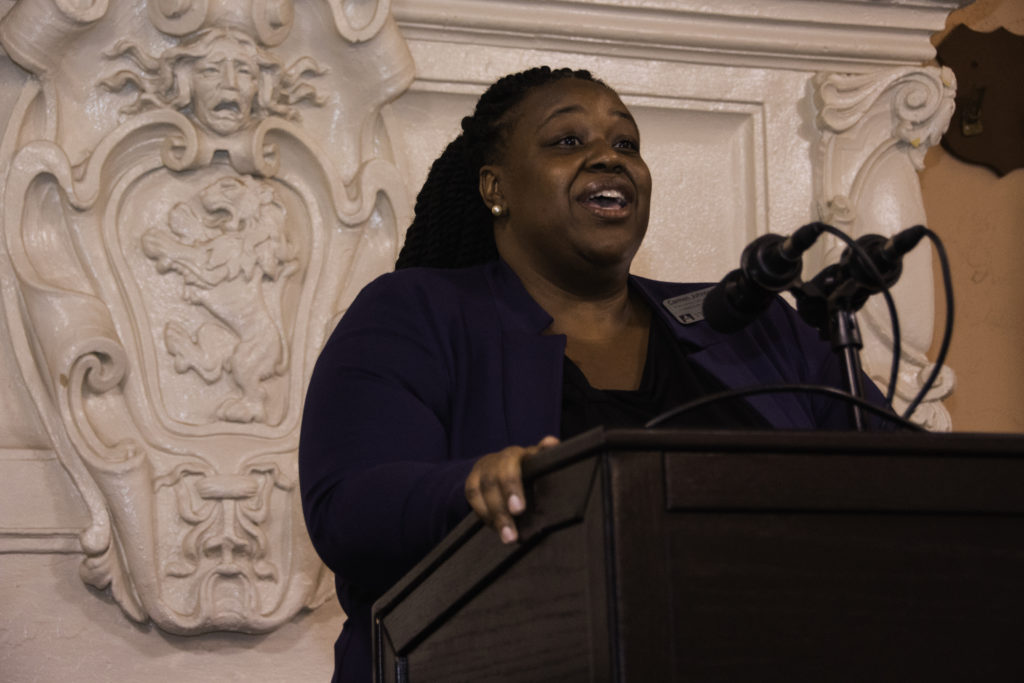
“We are elated to receive the HEED Award, which is a wonderful affirmation of our efforts throughout the university to provide an academic and professional experience that is personable and authentic for community members of all backgrounds and identities,” said Carmen Johnson, JD, Stetson’s Executive Officer for Diversity, Collaboration, and Inclusion and a Stetson Law alumna.
Carmen Johnson, Stetson University’s Executive Officer for Diversity, Collaboration, and Inclusion.
“Stetson provides such a unique and welcoming environment, and this is the result of dedicated administrative, academic, and student leadership throughout our campuses. We celebrate our community and this ongoing work and consider the HEED Award as welcomed motivation to keep going and to keep innovating,” Johnson added.
Progress on the main campus
The publication praised Stetson University for its notable investment in a new Cross-Cultural Center on the DeLand campus for underrepresented students and multicultural student groups. At a time when some colleges are facing challenges in investing in diversity and inclusion programs, Stetson renovated a historic home to create this unique, welcoming space.
“This is an incredible honor for Stetson to receive the national HEED Award and for our College of Law to receive it for the fourth consecutive year,” said Stetson President Christopher F. Roellke, PhD. “It is a reflection of the deep commitment and dedicated work of our students, faculty and staff to create inclusive and vibrant campuses that promote a sense of belonging for all our students.”
The DeLand campus also was recognized for its “Be Seen” marketing campaign that amplifies concepts of student belonging and students’ need to be their authentic selves as well as efforts on the DeLand campus to support first-generation college students, who made up a quarter of the student body in the Spring 2023 semester.
Stetson Law’s Fall 2023 fountain restoration project.
With help from a Historic Preservation Grant, Stetson Law is in the process of restoring three ornate fountains crafted over a century ago and installed in the Plaza Mayor and the Granary Tower.
Guided by National Park Service Preservation Briefs and the U.S. Department of the Interior’s Standards for the Treatment of Historic Properties, the process involves, cleaning, documenting, removing, restoring, and re-installing the ornate tiles that constitute the fountains. In the event a tile cannot be preserved, contractor Mizner Industries will replicate it with utmost precision.
The project will also include replacing aging hardware beneath the fountains.
Fountains of Historic Significance
Stetson Law’s beloved “wishing well” fountain was also restored in Fall of 2023.
Designed in the Mediterranean Revival style by architect Richard Kiehnel, the Stetson Law campus was constructed by the George A. Fuller Company of New York City, which also built Manhattan’s Flatiron Building and the Lincoln Memorial.
Prior to serving as the main Stetson Law campus, it was the site of the Florida Military Academy from 1932 to 1951 and the grand Rolyat Hotel prior to that.
Significant people associated with property include sports legends Walter Hagen and “Babe” Ruth; producer Sam Spiegel and actor George Peppard; Florida State Supreme Court Justice and Stetson Law Dean Harold Sebring; William Reece Smith, Jr.; and presidents of three Florida collegiate institutions: Doak Campbell (Florida State University), J. Ollie Edmunds (Stetson), and Hamilton Holt (Rollins).
A beneficial endeavor
The project will initially create about 20 jobs and spur economic development through heritage tourism.
The fountain in Granary Tower, which was restored in 2023, in a photo taken in 1927.
Restoring them to a fully functioning state will enhance the sense of place on campus, which is often cited among the reasons prospective students choose Stetson Law – and is the reason so many choose Stetson Law as a venue for weddings and other milestone events.
The value extends to our classrooms. In Land Use Law courses, faculty discuss the growing importance of historic preservation laws. Like Stetson Law – which was the site of events such as a famous contract signing between Babe Ruth and the New York Yankees during its days as a luxury hotel, many of Florida’s historic structures were built in the 1920s.
The campus, fountains and all, is a striking example of adaptive re-use of old buildings.
When the project is complete, they will add to the beautiful, relaxing atmosphere on the Stetson Law Gulfport campus.
The latest of multiple restorations
The current projects aren’t the first fountain restorations to take place. In 2020, it all began with the fountain in center of the Plaza Mayor courtyard. This seven-month endeavor, an official historic restoration, was no small task.
After months of work, the fountain in the heart of Plaza Mayor was restored to its full glory in 2021.
The images in each quadrant of the fountain were cut out, tiles removed from slab, cleaned, and restored. Other tiles could not to salvaged, so, bisque was imported from Italy and hand painted to match the original tile, baked, and then waterproofed. All the painting was done by the same woman, meaning no two tiles are exactly alike, just as was true of the originals. RLA Conservation of Art & Architecture in Miami, Fla., a state certified tile restoration company, oversaw the work.
The result?
A fully functioning, delightfully ornate centerpiece for all to enjoy.
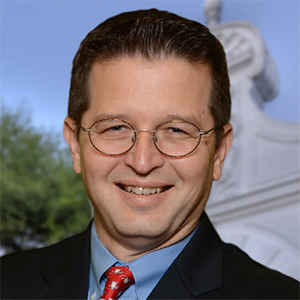
Clay Henderson is a celebrated environmental advocate who writes extensively about protecting Florida’s wild lands.
In keeping with its tradition of bringing Florida’s best-known environmentalists to campus for enlightening conversations, the first Foreman Biodiversity Lecture of the Fall 2023 semester featured pioneering environmental lawyer Clay Henderson.
On the heels of his 2022 book, Forces of Nature: A History of Florida Land Conservation, Henderson has been touring the state to talk about a cause about which he is most passionate: public policy’s critical role in protecting Florida’s vulnerable natural ecosystems.
Over the decades, Henderson has held various influential positions. He served on the Florida Constitution Revision Commission, the Florida Community Trust, and the Volusia County Council, on which he was elected to serve two terms. An early advocate for land conservation, he has been recognized with multiple awards, including the Nature Conservancy’s National Public Service Award and the Marine Resources Council Florida Trust’s Lifetime Achievement Award.
Thinking differently about environmental regulation
Henderson said he considers the genesis of modern environmental regulation in Florida to be the Land and Water Conservation Act of 1971. Advocating for policies that were effective in protecting critical natural lands from overdevelopment – ones developers could not easily outmaneuver – required a lot of trial and error – and a lot of improvisation, he said.
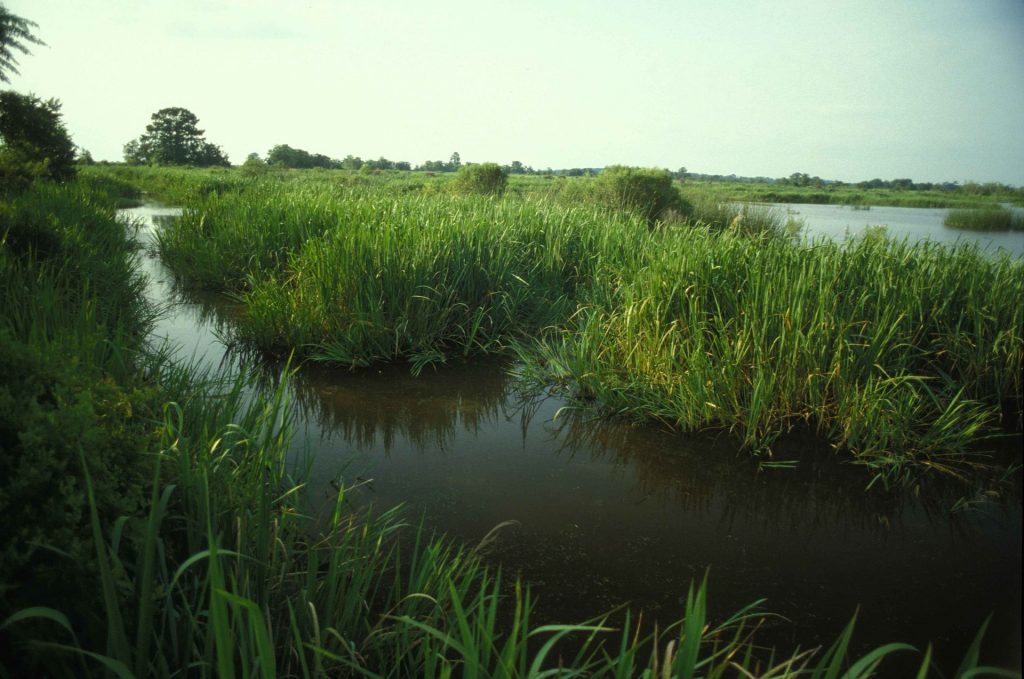
Florida’s critical wetlands cover millions of acres throughout the state.
“We didn’t know what we were doing,” Henderson said of the early years. “We had to make up the rules, make up the procedures, however we were going to do it. So, when the state started embarking on these larger, billion-dollar efforts, (it was) the same thing, we kind of had to make it up along the way.”
One innovative approach that proved effective was using public funds to buy up private land that would be preserved and protected in perpetuity.
“What was critical at the very beginning of Florida’s environmental movement was this recognition… that, if you’re going to regulate people, the concern was that you’re going to take their property,” Henderson said. “Therefore, we needed to have some funds available – so if you really want to conserve that person’s land, you don’t take it, you buy it.”
Inspired by history
For more than a century, advocates for protecting Florida’s natural spaces and the wildlife that inhabits them have included prominent lawyers, writers, and even a president – something Henderson’s book thoughtfully examines.
Among the earliest champions for Florida’s wildlife and their habitat was President Theodore Roosevelt, who, prior to the Spanish-American War (and thus his presidency) visited the Sunshine State as a birder. He was reportedly devastated upon seeing mounds and mounds of dead birds on Florida’s docks being prepared for shipment to New York, where their feathers would be turned into ladies’ hats.
It is estimated that as much as 95 percent of Florida’s wading birds were killed for this purpose at the time, Henderson said.
Years later, as president, Roosevelt signed 10 executive orders conserving over one million acres in Florida, starting with Pelican Island National Wildlife Refuge.
At the state level, Florida established its first park, Royal Park Hammock State Park, in 1915; it is now part of Everglades National Park.
Another famous advocate, Marjorie Harris Carr, fought against construction of the Cross Florida Barge Canal – a centuries-old idea for bisecting the state via an artificial east-to-west canal, which critics derided as a boondoggle that would be detrimental to surrounding ecosystems. The project was ultimately abandoned and its intended area became the Marjorie Harris Carr Cross Florida Greenway.
Henderson offered a litany of more recent examples of meaningful land protections in Florida, including Amendment 1 (supported land-acquisition supported by the document stamp tax, which voters overwhelmingly passed in 2014), the successful completion of the Florida Wildlife Corridor, and the popular Florida Forever program.
Deep Stetson ties
Law Professor Royal Gardner
Though his work sees national recognition, Henderson has long been a member of the Stetson community.
Law Professor Royal Gardner, director of Stetson’s Institute for Biodiversity Law and Policy, said he hopes stories like Henderson’s will inspire nascent legal professionals to consider running for office.
“Government service is so important, and we need good people to run for office. So, follow his example, please,” Gardner said. “Think about that. It’s a hard ask, but we need good people running for office.”
It is no secret that Stetson Law is home to a pioneering elder law program that invites students to be a part of a growing area of practice through a certificate of concentration, an LL.M., and pro bono opportunities.
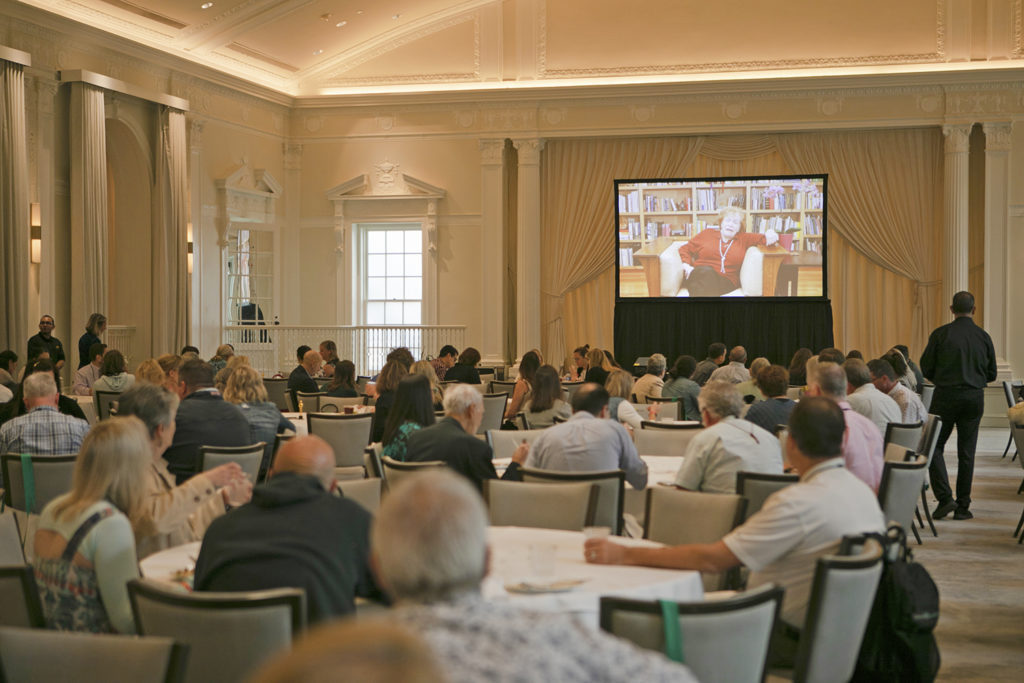
The Center for Elder Justice (formerly the Center for Excellence in Elder Law) is so highly regarded that the annual event it organizes and hosts, the National Conference on Special Needs Planning and Special Needs Trusts (SNT) is poised to celebrate 25 years of inspiring community and collaboration among professionals in the elder and special needs spaces. Taking place every year in the beautiful Vinoy Resort & Golf Club, Autograph Collection in downtown St. Petersburg, it is an event that leaders in the field look forward to every October. (See the SNT 2022 recap.)
Stetson Law’s 24th Annual National Conference on Special Needs Planning and Special Needs Trusts at the Vinoy Resort in downtown St. Petersburg
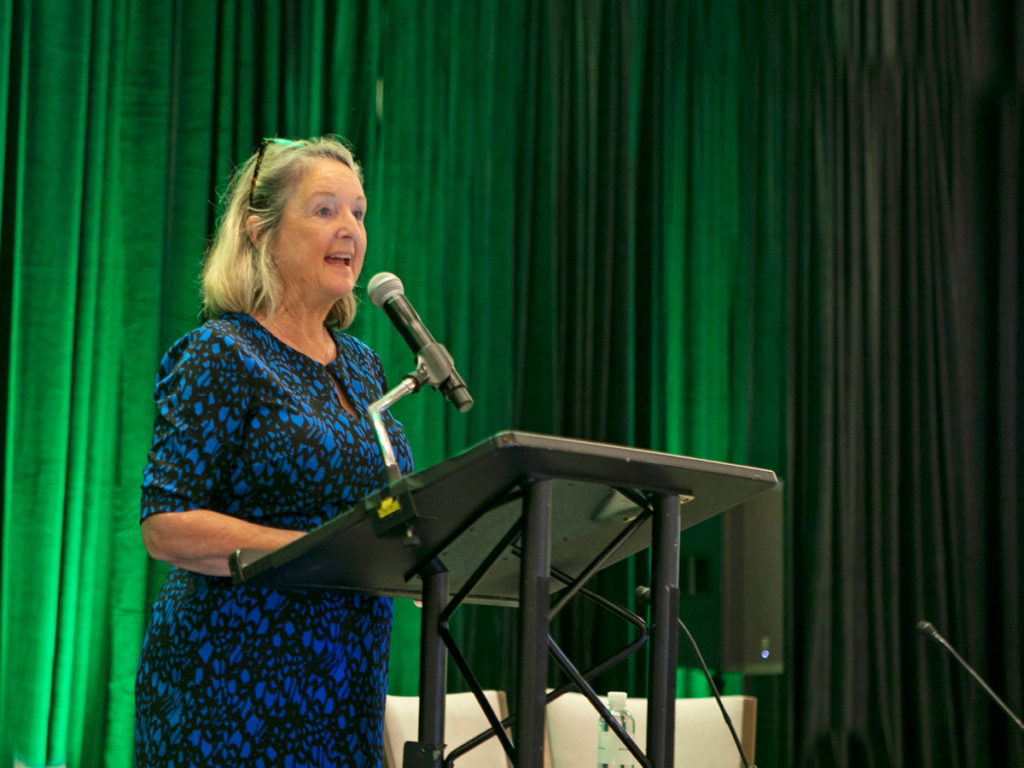
Stetson Law Professor Rebecca Morgan, Director of the M.J. in Healthcare Compliance law, said she owes the event’s success to a fellow pioneer in the field.
Professor Rebecca Morgan, director of the Center for Excellence in Elder Justice, speaks at SNT in 2015.
“Twenty-six years ago, a friend and leading elder law attorney, Julie Osterhout told me Stetson needed to offer a conference on Special Needs Trusts,” Morgan said. “Twenty-five years later, I’m still grateful for Julie’s suggestion.”
Morgan ran the event for its first 20 years; Law Professor and Director of Stetson Law’s Center for Elder Justice Roberta Flowers took the reins in year 21.
Law Professor Roberta Flowers, Director of the Center for Excellence in Elder Justice
A national professional gathering
Over the decades, SNT has become a premier national event drawing prominent speakers from law firms, academia, government, nonprofits, and beyond – all of whom share their unique insights on special needs trusts and how they are created, planned, administered, and monitored.
Topics range from detailed examinations of changes to federal regulations to managing the rigors of a career that often involves trauma and grief.
As always, dozens of sponsors and vendors line the hall outside of the meeting rooms, and networking over happy hour creates meaningful connections and memories that inspire attendees to return year after year.
What to expect at SNT 2023
Attendees will be wowed by the newly renovated Vinoy Resort (last year’s attendees may recall some construction), which offers new restaurants, a glamorously revamped pool terrace, a new spa, and much more.
Ret. Maj. Gen. Michael Astrue (L) speaks on Social Security Disability at the 2013 Special Needs Trusts-The National Conference.
More excitement awaits inside the ballrooms and breakout spaces.
Stetson’s Special Needs Trusts Conference brought hundreds to the Vinoy.
The National Conference programming begins Thursday, October 19. Presentations include a discussion about confronting ablism and ageism with Dr. Tracey Gendron; one exploring the effects of artificial intelligence on trust planning and special needs trusts with Stetson Bruce R. Jacob Visiting Professor of Law Mason Clark and Janet Lowder; and another navigating potential conflicts of interest with Slade Dukes, Will Lucius, Bridget Swartz, and moderator Stuart Zimring.
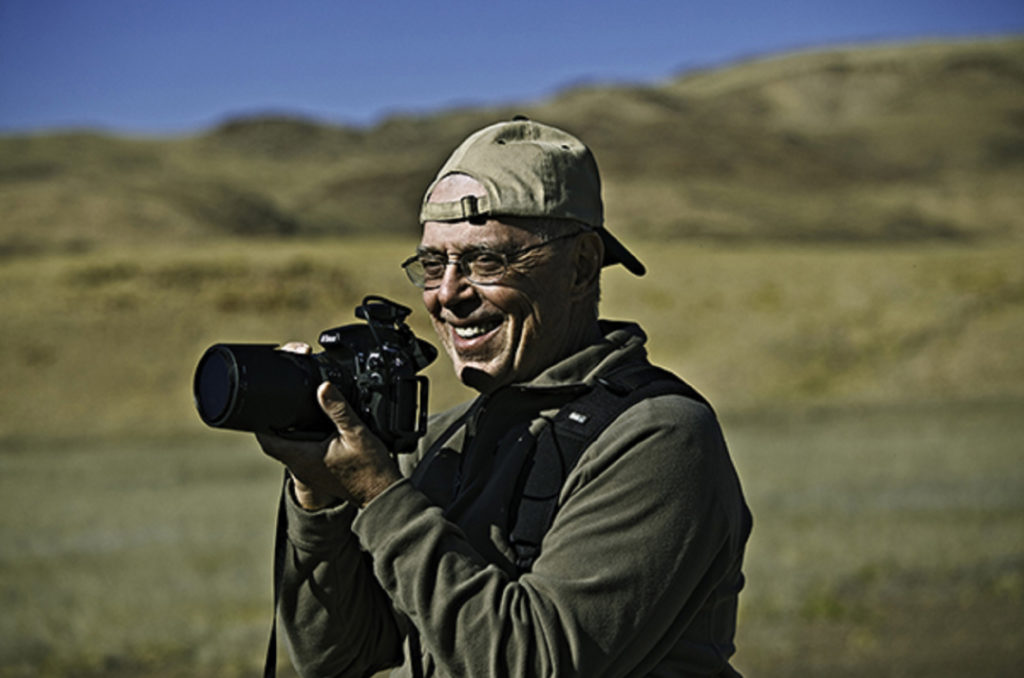
Dick Jacobs ’67 looks for the perfect shot in Namibia.
The Stetson Law community mourns the passing of alumnus Richard O. “Dick” Jacobs ’67, a champion of the College of Law – and the legal profession itself – whose legacy will not be forgotten.
Driven to succeed and inspire others in his work, Jacobs was generous with his time and support of initiatives that proved transformative at Stetson Law. As a Stetson Law Board of Overseers member, he helped with the land-planning process for the Dolly & Homer Hand Law Library.
“Dick was truly exceptional. He cared deeply about our country and the world that we are leaving for future generations,” said Law Professor Royal Gardner, who is co-director of the Institute for Biodiversity Law and Policy. “His drive, enthusiasm, and energy to fight for democracy and the environment – into his nineties – was inspiring.”
“Many of our students are here because they want to make a difference. It’s a noble but often challenging path,” said Law Professor Lance Long. “Through helping create opportunities for students to use their legal education to work for a better future, Dick has inspired them to put their passion to work within organizations that advocate on critical environmental and social causes. The future is brighter because of Dick and Joan Jacobs.”
An early love of nature and adventure
Born in Wisconsin in 1931, Jacobs’ upbringing was filled with adventure, conquering adversity, and seeing dreams come true.
When he was eight years old, his mother hung a sign from his neck and put him on a train alone to visit his grandfather in Montana, where he encountered the Blackfoot tribe and fished in the Yellowstone River.
Dick & Joan Jacobs in 2020
Jacobs attended the University of Wisconsin, earning a Bachelor of Business Administration in January 1954, graduating Phi Beta Kappa. While a student manager of the snack bar at the university, the Rathskeller, he met his wife-to-be, Joanie Swanson. The two were together ever since and married for 70 years. Dick says she raised not only their two children, but him as well – and credits her with helping him realize his dream of going to law school.
After graduation, Jacobs joined the military before building a highly successful career in the life insurance industry. Despite much success and recognition, law school called.
Coming to Stetson Law
Though he was 33, married with two children, and paying a mortgage, Joan insisted he pursue his dream of becoming a lawyer. He enrolled at Stetson Law – and graduated magna cum laude in 1967, the first in his class, and earning the top score on the Florida Bar Exam.
Jacobs’ early legal career leveraged his insurance business acumen. He worked with Florida Governor Lawton Chiles, then a young lawyer and a member of the Florida Legislature, on a law allowing professionals to incorporate and have retirement plans, which the IRS did not permit at to the time. Dick’s early legal career was as a tax attorney, specializing in organizing professionals’ corporations and retirement plans. He co-founded a law firm that grew to about 100 lawyers, with offices in Tampa, St. Pete and Clearwater, and a satellite office in London. He was Chair of the Tax Section of The Florida Bar.
Facing setbacks, sharing lessons
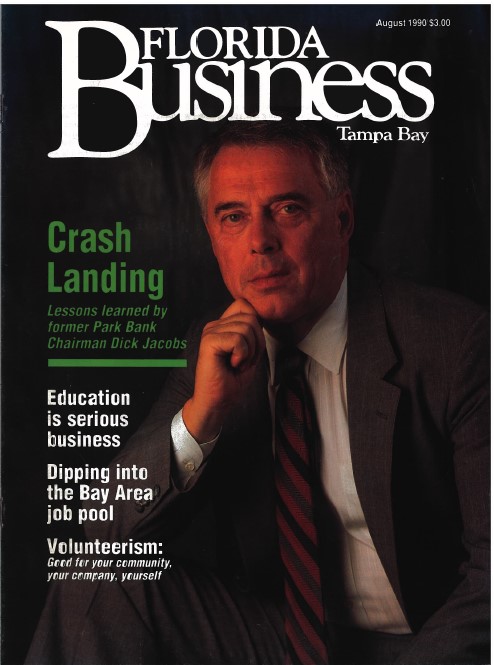
Dick Jacobs ’67 earned acclaim for a book he wrote on lessons learned from failure.
In the late 1970s, he joined with clients to form Park Bank of Florida. It went public and quickly grew to comprise eight offices and hundreds of employees. When it began to flounder, Dick took a leave of absence from his law firm to help save the bank – but to no avail. In 1986, the bank failed.
Though a crushing blow to him professionally and personally, Jacobs came to see the period as the biggest learning experience of his life, one that made him a stronger lawyer – so much so that it inspired his book Crash Landing: How to Survive a Business Crisis. From the ashes of the experience rose a new passion for life outside the office. At 55 years old, he had a chance to reinvent himself through channeling his energy into passion projects such as venture travel and environmental conservation efforts.
“Wet hands, dirty feet”
His travels began with a trek through the Serengeti with Joan. They carried their own backpacks and slept in tents – a rustic departure from the luxe trappings of travel during his big-law days.
Jacobs would later refer to these adventures as “dirty hands, wet feet” experiences offering profound insights into how other populations live. After trekking all seven continents, he developed a deep appreciation for and understanding of our connectivity with – and responsibility to care for – the Earth.
His 2015 book Wonderlust featured his photography and lessons learned from crisscrossing the globe. He gifted proceeds from the project to charity. He closed Wonderlust with a challenge: that we take responsibility for the wellbeing of the Earth and each other. It led him to call Our Children’s Trust, a public interest law firm that provides legal services helping youth secure legal rights to a sustainable future. He was instrumental in that organization’s 2018 lawsuit on behalf of eight youth plaintiffs arguing the state of Florida is violating their constitutional rights to a healthy environment.
Reconnecting with his alma mater
Through his work on that suit, he began collaborating with Stetson Law Professor Lance Long on a number of meaningful initiatives aimed at inspiring pursuit of careers in environmental law. In 2016, he and Joan created the Dick and Joan Jacobs’ Environmental Law Externship Fund to provide financial assistance for students enrolled in the Environmental Law concentration to pursue experiential opportunities – the dirty hands, wet feet experiences he deemed essential for good lawyering.
Staying involved: Dick Jacobs delivers the Foreman Biodiversity Lecture in 2018. Photo by Sy-Woei Hao.
In 2020, Jacobs helped launch The Stetson Environmental Tax Policy Writing Competition: Tax Policy Solutions to Address Sea Level Rise. He believed Stetson Law students could develop innovative tax law policies to fund solutions for sea-level rise – a pressing issue for Florida.
Back into practice
Amid his travel and philanthropy, Jacobs returned to practicing law with Holland & Knight in St. Petersburg, then Trenam Kemker, focusing on health care law. He was editor and prime author of Health Care Law – Mergers and Acquisitions of Physician Practices, a 1,000-page treatise that was core to his new practice. He was named to Best Lawyers in America, as well as a Florida Super Lawyer, in health care law.
In 2011, Jacobs went Of Counsel at Trenam Kemker at the age of 80 before retiring in 2013. At the retirement ceremony, Dick’s son dubbed him a “doer if I ever saw one” who “redefined the word ‘Now.’” Characteristically, Dick’s retirement lasted only two years. In 2015, he reunited with several attorneys from his original firm at Johnson Pope Bokor Ruppel & Burns, LLP, where he remained on staff for several years as Senior Counsel.
His vision for Stetson Law endures with the Dick and Joan Jacobs Clinic for Democracy and the Environment, which gives students opportunities to work on environmental policy and other valuable hands-on experiences.
“The kids have got to become the difference makers,” Dick said of the initiative at the time of its launching. “We just can’t keep repeating the past. That’s why you go to law school – to be a difference maker.”
Those who have worked with him say his legacy will live on through the students whose work he inspired and supported.
“Dick was a force of nature. From his ‘dirty hands, wet feet’ philosophy, to the sense of urgency he brought to all his projects, aspiring lawyers should seek inspiration from his life and deeds,” said Law Professor Jaclyn Lopez. “Dick created opportunities for Stetson’s students to channel their passion into meaningful work and through the creation of the Jacobs Law Clinic, helped ensure that the important work of environmental conservation and the preservation of democracy itself – will endure. We mourn his loss and share our deepest sympathies with his family and close friends, but are energized by and committed to honoring his legacy.”