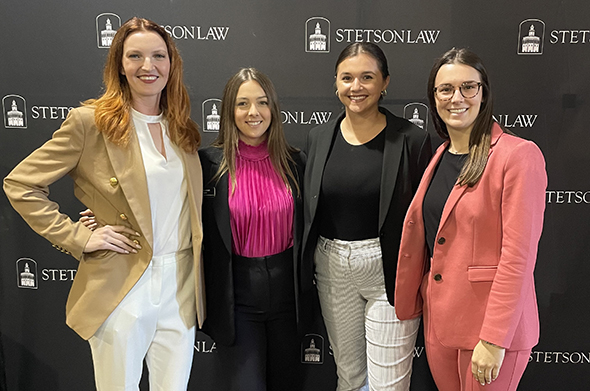
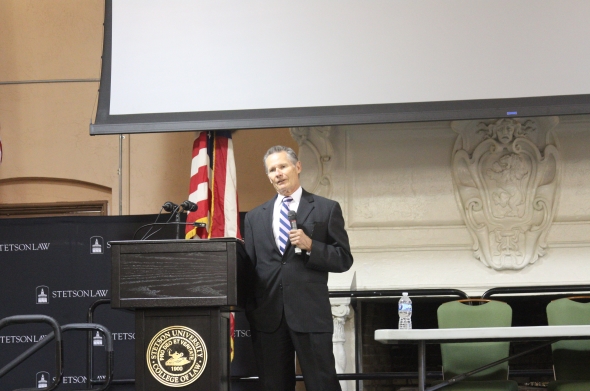
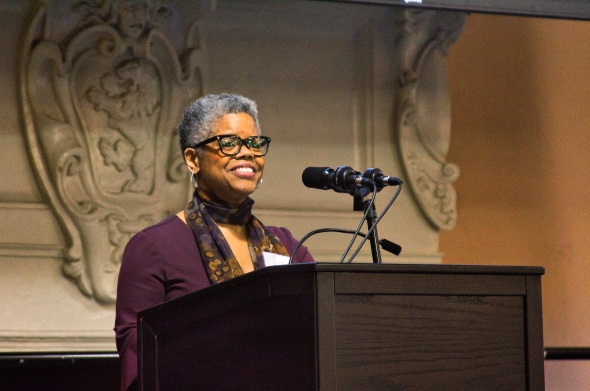
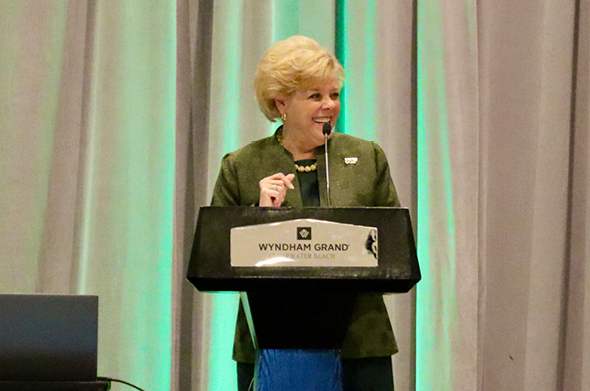
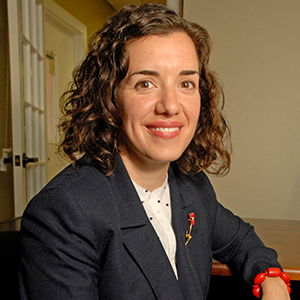
Left to right: Avery Sherrer, Savannah Green, Madison Hanna, Lauren Johansen
Over the last year, there’s been a lot of activity within the Florida Association for Women Lawyers at Stetson (FAWLS), the college of law’s chapter of the Florida Association of Women Lawyers (FAWL). Organization leadership at the state level have taken notice.
Citing the chapter’s effective strategies for growing and engaging membership, encouraging members to become leaders, and involvement with the surrounding community, FAWL has recognized its Stetson Law chapter with the 2023 Outstanding Student Chapter Award.
The Outstanding Student Chapter Award aims to recognize a Student Chapter that has been particularly active both in its local community and in the state FAWL organization.
“Your Chapter has developed innovative ways to build its membership, including by providing programs and services which specifically encourage and assist members to become leaders in the profession and in the community,” said FAWL President Donna Eng, Esq. in a letter congratulating the group. “We recognize how much work chapter leadership has put into these efforts, and we thank you for the investment you have made in the organization.”
Sustained efforts to promote women in law
This award focused on FAWLS’ extensive events, membership, and pro bono activities from the past year, including the group’s annual Women’s Week programming.
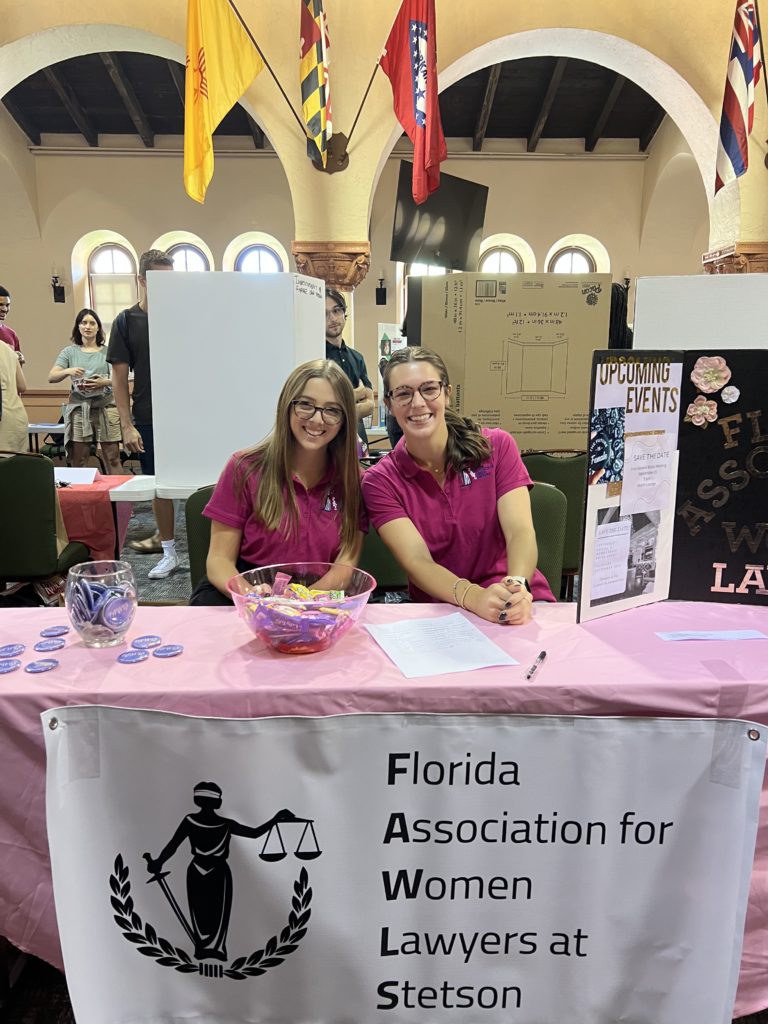
FAWLS President Savannah Green and Pro Bono Chair Lauren Johnson tabling at an event.
Other activities involve partnering with the Pinellas Florida Association for Women Lawyers, Southeastern Women in Financial Services, the Office of Diversity, Collaboration and Inclusion at Stetson, and multiple Stetson Law student organizations to hold events for our members. These collaborations have helped FAWLS’ actively promote gender equality and leadership roles in the legal profession through networking events, informative panels, professional development opportunities, and empowerment activities for students at Stetson.
“Coming in as FAWLS President, I had a focus on increasing membership and expanding our collaboration both on and off campus,” said FAWLS President Savannah Green. “I am so proud that FAWLS has successfully done both over the past year! I am very grateful to have an incredible executive board and passionate members who support one another and exemplify what it means to be strong women leaders.”
FAWLS’ executive board consists of: Green (president), Vice President/Treasurer Cara Zimmerman, Secretary Madison Hanna, Chapter Representative Avery Sherrer, and Pro Bono Chair: Lauren Johansen.
Recognition at the Florida Bar convention
As a recipient the award, the chapter will receive a $250 prize. The check, along with a certificate recognizing the achievement, will be presented at FAWL’s Awards & Installation Celebration in June during The Florida Bar’s annual convention.
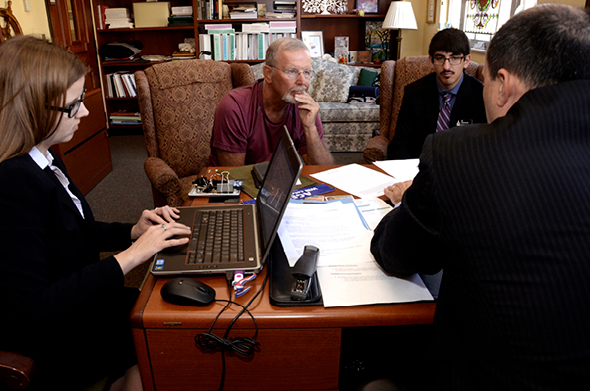
For the first time since before the Covid-19 pandemic, Stetson Law invited elder veterans to campus for assistance creating simple wills and other important documents.
The free, confidential Wills for Warriors program is available to U.S. military veterans over 60 and their spouses. The event brought seven local attorneys and 13 student volunteers to Stetson Law’s Center for Excellence in Elder Law for a day of pro bono legal work.
In all, they helped 12 people – eight veterans and four spouses – in creating simple wills and advance directives.
Giving back through volunteering & mentorship
Alumna Jenna Jordan, who participated in the program over all three years as a student at Stetson Law, said taking part in Wills for Warriors as a 1L was her first experience in a real-life client-attorney setting. It’s a fond memory for her, she said, one that solidified her decision to go into elder law.
Participating as a volunteer practitioner this time, she let the students work through the process with the clients. “As an attorney participating in this event, I tried to take a back seat and let the students ask the clients the questions, and only fill in where needed to provide the legal advice,” she said. “I also took the time to explain to the students why I asked certain questions along the way. I wanted to make sure this was a learning experience for the students as much as it had been for me.”
Making a difference through hands-on experience
To Stetson Law student Victoria Benson, it was an incredible opportunity to help veterans from the local community – and a unique way to have an impact.
“It’s not every day students have the opportunity to put pen to paper and show the skills we’ve learned during law school, but Wills for Warriors allowed us to do just that while also giving back,” Benson said. “It was so rewarding to use our skills to benefit our local veterans who have given so much, and hearing the relief we granted them was extremely motivating.”
She added that she would encourage any law student to participate in the program.
The 12 other 2023 student volunteers were Lauren Armstrong, Brenton Avery, Mason Bo, Sophia Bond, Sierra Fackler, Brianna Faenza, Erin Hinsberg, Meagan Lynch, Lisa Mueller, Rachel Propper, Richard Shockley, and Natalie Taylor.
Serving those who have served
Now elder law attorneys, the Stetson Law alumni who returned to assist veterans during Wills for Warriors say they are all too familiar with what can happen when someone goes without critical documents – and the thought of a veteran not having access to legal services is particularly heartbreaking.
“As a practicing elder law attorney, I see what can happen when someone doesn’t have an estate plan or when it’s done incorrectly, and participating in events like this can really make a difference to veterans and to their families one estate plan at a time,” Jordan said.
Through lending a small amount of time and expertise, they can give aging and elder veterans peace of mind by assisting them as they review, plan, and complete their advance directive as well as estate legacy planning such as a health care surrogate designation, a living will designation, and a simple last will and testament.
“Warriors have given, served, and sacrificed so much, with many if not most having extremely modest but no less meaningful lives and legacies,” said alumnus Slade Dukes. Each of those lives and legacies are so deserving, and it is great that we can be part of a program that gives back, easing their concerns about understanding and completing necessary and appropriate advance directive and estate legacy planning documents.
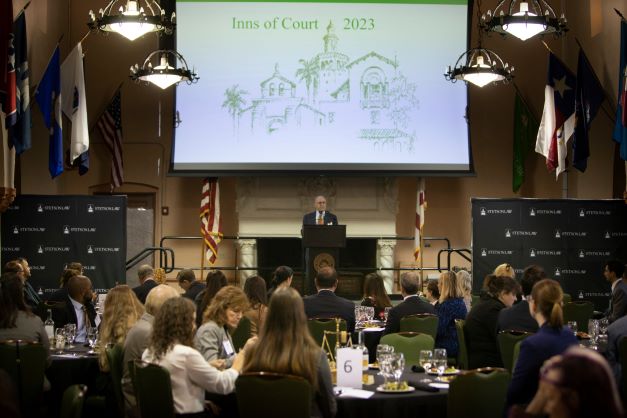
Steve Binder, creator of the Homeless Court Program, spoke at the 2023 Inns of Court banquet.
Speaking to members of the Stetson Law community gathered in the Great Hall, Steve Binder reflected on the transformative potential of a career in law – especially in helping society’s most vulnerable.
Known for developing the Homeless Court Program in San Diego, which dozens of other communities have since adopted, Binder was the Wm. Reece Smith, Jr. Distinguished Lecturer at the 2023 edition of Stetson Law’s Annual Inns of Court banquet.
“Many law students seek to use their skills to one day change the world – and Steve Binder, indeed, has,” said Stetson Law’s Wm. Reece Smith, Jr. Distinguished Professor of Law Kristen Adams said as she introduced him to the audience. “He developed an alternative court system that considers the unique challenges of being unhoused in determining the outcome in each case.”
A lifelong passion for helping the unhoused
Born in Flint, Michigan, he was in junior high when he discovered the cause to which he would ultimately dedicate his career when a class visit to a homeless shelter brought him face to face with the economic and legal toll homelessness can have on those lacking a support system.
As a young lawyer in San Diego County in the late 1980s, Binder saw how unfair the criminal justice system was to homeless people with substance abuse, mental health challenges, and a lack of financial resources – and how focusing on punishment over rehabilitation can push vulnerable individuals further from society. Many were cited for sleeping in public, and were either given a fine they couldn’t pay or arrested with less than a fighting chance of beating the charges in court.
“When a homeless case did come to court, I heard tales of hardship and renewal,” Binder said. Some came to court telling me they had recently found a place to live. Many asked, Where am I supposed to go? Homeless shelters are full.”
Some came to court carrying all of their worldly belongings. Some hadn’t showered. Others spouted FBI and CIA conspiracy theories. All, he said, struggled with problems the criminal justice system ignored.
“Invariably, a judge would take the plea and sentence them to an array of fines that they couldn’t afford, and terms and conditions that frustrated their continued participation in society,” Binder said. “More often than not, homeless defendants failed to appear in court – not because of a disregard of the court system, but due to their status and condition.”
Pervasive problem, creative solutions
The experience inspired him to create the Homeless Court Program, a local court system model that takes into consideration the needs and limitations associated with poverty and homelessness. Such entities now operate in dozens of jurisdictions throughout the U.S.
They build on partnerships between courts, homeless services organizations, and other entities and substitute participation in services and activities for fines and custody. To help offset the challenge of getting to the courthouse for multiple hearings, the programs try to resolve cases in one hearing.
Binder said there are four basic principles of a Homeless Court Program: Participation is voluntary, there’s a progressive disposition of cases, a non-traditional sentencing structure, and the assurance that no one goes into custody.
Individuals are invited – but not forced – to participate in programs and services to help them avoid further legal troubles, such as life skills courses, substance abuse treatment, literacy classes, or counseling.
“The homeless court reinforces this work and the work of participants with a sentencing structure that is not coercive or punitive in nature, but rather designed to assist participants with reintegration into the community,” Binder said. “It gives credit for time served for participation in program activities.”
Now in place at dozens of jurisdictions throughout the U.S., these programs have helped countless individuals experiencing homelessness find more positive life paths. And though it doesn’t address the underlying reasons homelessness is so widespread or eliminate its associated challenges, Binder said it’s important to not lose hope. “While the continued problems homelessness represents are discouraging and frustrating, it’s important to remember it’s the condition homelessness represents that’s undesirable, not the people.” “The criminal justice system will not solve homelessness. Treatment, service, community, and trust are needed if we are serious about addressing the myriad of problems homelessness represents.”
Honoring a public service titan
The event is one way Stetson Law continues to honor the legacy of the late, legendary Florida lawyer William Reece Smith Jr. Inducted into Stetson Law’s Hall of Fame in 2004, he served Stetson for decades as a distinguished professorial lecturer, Board of Overseers member, and university trustee.
“For those of you who did not have the pleasure of knowing Reece, he was a legal icon, a mentor, an advisor, a teacher, a champion of civil rights, and a consummate professional who upheld the highest of ethical standards,” said Stetson Law Interim Dean TheresaPulley Radwan at the start of the event.
The Inns of Court banquet was inspired by an English mentoring program for barristers dating back centuries. A reflection of the profound value the Stetson Law community places on mentorship, the program gives Stetson Law students an opportunity to connect with prominent lawyers on current topics concerning law and ethics.
Trial lawyer Guy Burns, Stetson Law’s 2023 Distinguished Nichols Lecturer.
If there’s anything that can keep one’s legal career on a meaningful, decades-long trajectory, said trial lawyer Guy Burns, it’s the ability to set concrete goals – but only if you leave a little room for serendipity.
Burns was speaking as the 2023 Nichols Foundation Prominent Speaker Lecture on his chosen topic, “Where Will You Be in 50 Years?” Often referred to as the Nichols Lecture, the series is named for Perry Nichols, a 1937 Stetson Law alumnus who is considered a trial-law pioneer. Burns, who was admitted to the Florida Bar in 1973 and subsequently built a successful career that has spanned decades, reflected on his years as a prominent trial attorney – but not without a little humility.
“Really, perhaps the reason I’ve been asked to be here is that I’ve been around a long time,” Burns, who is now partner at Tampa-based firm Johnson Pope Bokor Ruppel & Burns, said. “And it pains me to say that, but this is my 50th year practicing law.”
Knowing he’d be speaking to a room full of law students in Stetson Law’s Great Hall that afternoon, he decided his topic would cover the attributes and practices that helped him grow as a lawyer.
A big factor, he said, was regularly stopping to look down the road.
“I have always during my career thought a bit about what’s next,” he said. “And I think regularly about what’s next year, and what’s in five years.”
The importance of setting goals
Hired out fresh out of law school, Burns said he had a rather lucrative starting salary – for the time.
“They offered me $12,000 a year,” he said, as the audience chuckled. “And that was big money.”
He then set a goal to make $30,000 by age 30. As a civil trial lawyer who got his start defending clients in complex commercial matters, he achieved that. He said law students are uniquely equipped to accomplish whatever they set their minds to.
“Your legal education here is a great foundation for whatever you decide to do,” Burns said. “You’re a group of people that sets goals. You wouldn’t be here if you hadn’t set goals already, and you wouldn’t be here if you if you weren’t willing to have some delayed gratification.”
Yet one should also be open to the opportunities that come along with life’s twists and turns.
“With any plan you make, leave room for serendipity, fate, and unexpected things to come into play,” he said.
Following one’s conscience
Though he started out defending companies against accusations of fraud and other legal matters, Burns said he ultimately realized he wanted to use his skills and talents to help those being defrauded and otherwise taken advantage of by large companies with seemingly infinite means. So he set the goal of moving into representing plaintiffs.
“It was a conscious decision to move in that direction,” Burns said. “If you want to spread your wings and you’ve been the best widget lawyer in the world and you think you might want to get into something else, make a plan.”
Now, he primarily represents litigants in cases involving consumer fraud, financial malpractice, and securities, among other matters. Over the years, he has helped clients win record-setting awards as well as settlements totaling well into nine figures.
Burns is also a cofounder of Crypto Lawyers, which helps clients recover lost investments in cryptocurrency and has amassed a long history of representing clients pro bono in cases involving discrimination over race, gender, and sexual orientation.
Telling your story
Fielding questions from students in the audience, Burns turned from the philosophical to the practical at times. Asked what made him excel at persuading jurors to favor his clients, he said the most effective tool he has is storytelling. “Number one is develop a theme,” Burns said. “I’d lay out a theme… and I would try to work that consistently into the case. If it’s a theme I think I can sell, I want to ride that as far as I can.”
Verna Williams, CEO of Equal Justice Works, speaks at the 2023 Disaster Resilience Symposium.
Over a two-day workshop on the Stetson Law campus, legal professionals, local and state officials, nonprofit organizations, and thought leaders gathered to explore strategies to more effectively meet the needs of individuals and communities as they prepare for, experience, and recover from disasters.
Led by nonprofit Equal Justice Works and cohosted by the American Bar Association and American Bar Association Young Lawyers Division Disaster Legal Services, “Building Community Resilience Through Advocacy and Systemic Change” was the immersive event’s theme.
There was a long list of recent disasters from which they drew insights – Hurricane Ian, the global Covid-19 pandemic, the earthquake in Turkey, and even the onslaught of climate change. They shared their own experiences with these disasters and how they can inform strategies for building a stronger approach to disaster resiliency and recovery, especially for society’s most vulnerable.
An unexpected octopus’s climate connection
The first keynote speaker was Robert R.M. Verchick, Gauthier-St.Martin Chair in Environmental Law and Professor at Loyola University New Orleans and Senior Fellow at the Tulane University Disaster Resilience Leadership Academy.
He began his speech with a story of an octopus that went viral on social media in 2016 after a combination of factors – including a Super Moon, the King Tide, and storm surge, resulted in an octopus splashing into the parking garage of a Miami condominium tower.
It inspired him to coauthor a Miami Herald column titled “The Octopus in the Parking Garage.” Later, he wrote a full-length book of the same name.
To Verchick, the octopus incident is a less intimidating way to talk about climate change.
“This was a story that wasn’t so scary, and that was good. Because I want to make sure that people face the scary and important parts of climate change without freezing up,” Verchick said. “Because when we freeze up, nothing happens.”
Humanity is facing a “no-analog future,” he said, one in which a fossil fuel-reliant power grid will repeatedly fail due to extreme weather, the economy will lose trillions over time, and communities of color will bear the brunt of it all. With no precedent, there’s no telling how it will all unfold.
“We don’t know how fast the changes are going to be, we do know that they’re going to happen,” he said.
Verchick said while it’s impossible to stop at least some of the impacts of decades of CO2 emissions, taking action now can at least reduce future impacts. It’s not a pass-fail exam, he said, but a matter of reducing harm; curbing fuel emissions and building resilient infrastructure can earn us a B or C – and both are better than an F.
Disaster Response & Recovery at the local level
With Hurricane Ian and other major events in recent memory, a panel of local leaders held an in-depth discussion on the roles local emergency management agencies and community partners play as a disaster looms and after it passes.
Speakers discussed disaster response mechanisms and the importance of collaboration among private and public organizations – and how critical it is to be nimble.
The panel consisted of Joe Barrios of Pinellas County’s Emergency Management department, Michelle Luckett, CEO of the BeReady Alliance, Bay Area Legal Services staff attorney John Lawless, Florida Division of Emergency Management general counsel Stephanie Stachowicz-Twomey, and Jason Susalla, Grant Project Manager for the Disaster Relief Team at Bay Area Legal Services.
It is often on local agencies to accurately assess the extent of damage, Barrios said, so state and federal authorities can offer the correct amount of support.
To correctly assess a community’s need, the panel agreed, it’s important to make survivors feel as comfortable as possible. This could mean helping them navigate a Federal Emergency Management Agency assistance application – which, Luckett noted, is written at the 13th grade level – or, simply, listening.
“It takes a survivor at least five times to tell their story before they can start moving ahead,” Luckett said.
Putting it all together with Equal Justice Works’ Verna Williams
The conference culminated with remarks from Verna Williams, CEO of Equal Justice Works, a nonprofit that connects aspiring public interest lawyers to opportunities in the field.
Disaster recovery – especially for people and families unable to afford legal representation but don’t qualify for legal aid – is extremely complex and requires collaboration across organizations and sectors.
“They require us to act creatively and collaboratively to do what we couldn’t possibly do alone,” she said of disasters. “If the recent past is any indication, working across borders, organizations, and even disciplines will be essential to weather the storms that keep on coming.”
Williams’ background includes teaching and practicing law, researching civil and women’s rights, and serving as the dean of the University of Cincinnati College of Law. She noted that the World Justice Project ranks the U.S. 114th out of 140 nations in terms of accessibility and affordability of civil legal justice. Of the richest countries in the world, she added, the U.S. ranked 32nd out of 43. It is, she said, an “abysmal and untenable state of affairs” that makes disaster recovery significantly more challenging – from FEMA claims to insurance issues.
“These are all complex and difficult matters to navigate alone,” Williams said. “With disasters becoming more severe and causing greater destruction, there is overwhelming need for lawyers who can help individuals and families navigate these challenges and take the necessary steps toward some degree of normalcy.”
Mobilizing public assistance lawyers to help achieve this is the core of her organization’s work, she said, and a major motivation for launching the conference. Investing in long-term resilience involves cross-sector planning and partnership-building among agencies, nonprofits, faith-based organizations and other groups, Williams added.
“Doing so means impacted communities will have the necessary resources to recover more quickly and effectively,” she said.
University of South Florida President Rhea Law, a Stetson Law alumna
The state of higher education may be in flux, but industry leaders say there will always be a constant: the vital role colleges and universities play in their communities.
That was a key takeaway from the 44th Annual National Conference on Higher Education, which took place March 1-6 at the Wyndham Grand Clearwater Beach. This year’s theme was “Rewriting the Ground Rules of Higher Education Law and Policy for the 21st Century.” Leaders from nearly every aspect of campus life – Title IX officials, mental health experts, public safety officers, general counsel, and more – spoke passionately about how they are adapting as a shifting higher education landscape changes how they serve students and other critical constituencies.
Though the focus was often on subjects like political polarization, student health and wellness challenges that were exacerbated by Covid-19, and a looming enrollment cliff, the conference atmosphere was one of camaraderie and optimism as higher education workers reflected on their work and why they do it. “This year’s empowering interdisciplinary event, featuring exceptional access to leading subject matter experts, gave participants many tools to return to campus to meet the challenges that lie ahead for higher education,” said Conference Chair Peter Lake, Charles A. Dana Chair, Professor of Law, and Director of the Center for Excellence in Higher Education Law and Policy at Stetson Law.
A sunny keynote from USF President Rhea Law
Higher education may be in turmoil, but this year’s keynote speaker, University of South Florida President Rhea Law, a Stetson Law alumna, focused on the strategies, mindsets, and actions that have helped USF face the most pressing challenges.
One big component: cutting through the noise by telling the right story about how the institution’s value extends well beyond the four-year degrees it issues.
“We give students background and thought processes so that they can solve the problems of the future, and we give them that connection to us so that they continue to be educated and skilled on things that they need,” Law said.
Then, there’s a college or university’s role as a community cornerstone for constituencies of all ages. Law spoke about USF’s Lifelong Affinity Model, which engages groups of every age. This includes everything from summer programming for k-12 students, pre-college programs, professional education, and courses for older adults who want to keep learning and stay connected.
Also critical: creating a sense of belonging for everyone on campus – and supporting students who are experiencing mental health challenges.
“There are so many students now who are wrestling with mental health,” Law said. “They clearly can’t be successful when they go out about the business of life if they don’t have support for them; if they don’t have the mental health and a wellness component. So we’ve been prioritizing our work around that.”
The first USF graduate to ascend to the university’s presidency, Law’s community involvement is incredibly far-reaching. She served on the Stetson Law Board of Overseers, led a law firm, and served on a seemingly countless array of boards of important nonprofits and companies.
At an interactive Friday afternoon panel, moderator David Rowe, President of the higher-education consulting firm Windermere Group, LLC asked the panelists what keeps them up at night.
The question launched the panel, consisting of four higher ed leaders, into a frank discussion of how the Covid-19 pandemic, a polarized political climate, and public perception of higher education.
“I think right now we’re at a crisis point at how higher education is perceived,” said Frederick Lawrence, who is secretary and CEO of Phi Beta Kappa Society.
That perception is in stark contrast to reality, the panelists agreed, given the role colleges and universities play in their communities.
“That image of the isolated ivory tower is very outdated,” said panelist Jonathan R. Alger, President of James Madison University. “During Covid, where did people go in the Shenandoah Valley when they needed Covid testing? They came to our campus. Where did people go when they needed vaccines? They came to our campus.”
Rowe closed with a question that paralleled his first question to the panel: what gets them out of bed in the morning. They all agreed: it’s the students.
“It’s just a rush,” Law, who participated in the panel following her keynote address, said. “It’s all about the students. And it’s all about the research that our faculty does.”
Alger agreed.
“We talk about it all the time on our leadership team – if you’re having a bad day, go out and spend some time with the students,” he said. “And I would say particularly, our students that come from a less privileged background who are so grateful for the opportunity to be in a university setting.”
Working to further the mission of higher education is also a key motivator.
“I believe in higher education as a public good. I think, as a sector, getting to wake up and live and breathe in a place of constant lifelong learning is a real gift for all of us,” said Jacob Rooksby, Dean of Gonzaga University School of Law. “These are great jobs to have, but we’re all working together for the students and in service to the mission.”
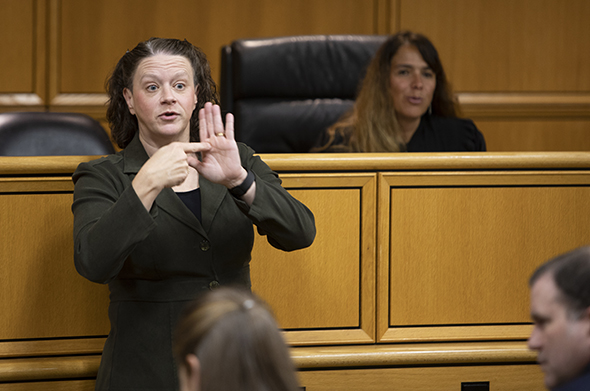
Interpreters were able to experience signing in a courtroom setting.
For the sixth year in a row, Stetson Law was the site of an innovative, intensive workshop for sign language interpreters to learn how to conduct their work in a courtroom setting.
The three-day Sign Language Interpreter Legal Training Workshop featured faculty and staff from Stetson Law’s Center for Excellence in Advocacy and the Center for Excellence in Elder Law as well as students from Stetson Law’s mock trial teams. They collaborated with professionals from Tampa-based Absolute Quality Interpreting Services as well as Columbus, Ohio-based Hallenross and Associates – two American Sign Language (ASL) interpreter services – and all of the attendees came away from the workshop with important new insights about their work in court and other legal settings.
The training was a unique opportunity for interpreters to hone their skills in a realistic, unscripted setting – and for students to experience what it is like to work on a case involving deaf or hard of hearing clients, jurors, and other trial participants, said Stetson Law Professor Jason Palmer, who helped facilitate the workshop.
“Stetson is very proud of its role as a sponsor of the Sign Language Interpreter Legal Training Workshop,” he said. “Each year, the workshop has grown in size and scope, with many interpreters returning to continue their training on legal interpreting in the courtroom. Our students also greatly benefit from the opportunity to conduct a trial with interpreters, a skill that is not readily available prior to actual practice.”
According to the Bureau of Labor statistics, there are about 11 million Americans in the U.S. who have a hearing disability – but there are less than 20,000 interpreters certified by the Registry of Interpreters for the Deaf.
Understanding the challenges of interpreting in court
Interpreters – many with decades of experience – and students alike got to see firsthand the potential issues that may arise when sign language interpretation is required in a court hearing. Participants learned how to sign legal and law-enforcement terms and how to avoid potential ambiguities. They also got to observe how a courtroom layout can affect the line of vision between an interpreter and a deaf or hard of hearing party or witness – and how to prevent visual obstruction.
“One of the significant values that our workshop provides to interpreters is the chance to learn legal terminology and courtroom dynamics in a risk-free environment,” Palmer said. “As sign language is not a word-for-word interpretation, having lawyers and interpreters talk about the objectives each have in the courtroom allows all the participants to realize the ways in which testimony can be accurately interpreted and communicated.”
One example: When a deaf or hard of hearing person on the witness stand signed in response to a question, then corrected himself with a different sign (“no,” then “yes”), some interpreters asked whether they should sign the intended answer, or sign both the incorrect and the self-corrected response.
The answer? The latter.
This way the record reflects potential uncertainty on the part of the witness.
Inviting community connections
It was also an opportunity for members of the legal community to participate in a meaningful learning experience.
Volunteers included judges who presided over the mock trials. One judge recently moved to the area from Washington State, where she had worked as a Spanish language courtroom interpreter, and then was a prosecutor and subsequently became a judge. She served on the Washington State Supreme Court Interpreter Commission, which she chaired in her final year there. Her insights into courtroom interpreting were particularly valuable to both the interpreters and the students, given her background and training.
Leaders from the ASL interpretation community said attendees once again came away from the experience with a deep understanding of their unique role in helping ensure our legal system truly ensures justice for all.
“Even though it’s been six years since the inaugural workshop, the amount of curiosity, learning and collaboration among all parties involved never ceases to amaze me,” said David Scott, co-owner of Absolute Quality Interpreting Services. “We are so thrilled that we can help empower these dedicated professionals to be the absolute best they can be when it comes to serving hearing-impaired individuals in even the most complex of circumstances.”
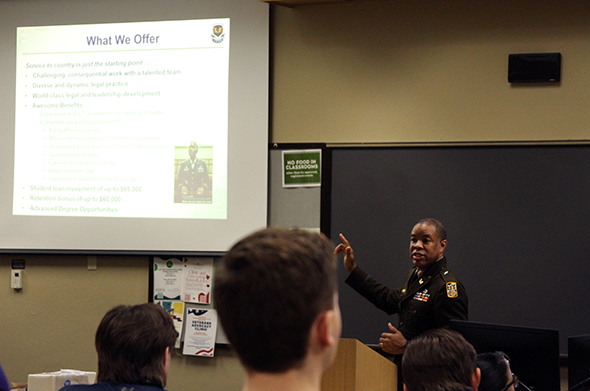
Over the course of a candid lunchtime conversation, U.S. Army Brigadier General Ronald Sullivan shared insights on what it is like to pursue a legal career in the military – and tips on how to launch a successful legal career regardless of one’s chosen sector.
His remarks were part of Campus to Career, a multi-month experience that brings law students an up-close look at the many ways one can successfully transition from law student life to a successful career. Speakers come from a wide range of backgrounds, each sharing insights and tips with anecdotes and humor. While Sullivan offered perspective on life as a military lawyer, much of his wisdom applied to all professional pursuits – and life in general.
Key themes were the value of mentorship, the importance of teamwork, and the difference having the right mindset can make. “Keep perspective. Be honest with yourself,” he said when asked what 3Ls should do as they look for their first job out of law school. “Know why you’re going into the office every day.”
Pursuing a legal career in military
Sullivan, who is Chief Judge of the U.S. Army Court of Appeals, gave an extensive overview of the Army Judge Advocate General’s (JAG) Corps – “the greatest and oldest law firm in the world,” a presentation slide boasted.
Consisting of thousands of judge advocates, paralegals, and other professionals, the JAG handles cases related to military justice, national security law, administrative and civil law, and contract and fiscal law. They also support soldiers and their families through trial defense and other legal services.
Sullivan touted the benefits of a military career: the challenging work, diverse and dynamic environment, generous benefits, and opportunities for advancement – as well as the intangibles that would benefit anyone’s career.
It was, for example, Sullivan’s military background that helped him cultivate a collaborative mindset that suited him well as he advanced in his career.
“We start in uniforms with no rank on them… with no names on them,” Sullivan said. “And we work together…. We run together. We get to know each other. We push each other. We compete. And no one’s bigger than someone else. And we take that to our area of practice.”
Optimizing one’s time
It was his father, also a veteran, who taught Sullivan the importance of getting a job done right over focusing on an allotted timeframe.
“My dad would tell me that we work to task, not to time,” Sullivan said.
He asked the students how long it takes to study for an exam.
“It depends,” said two students, nearly in unison, which elicited laughter from the room – given how often the phrase is uttered on campus.
“It might take ten hours, it might take two,” Sullivan continued. “But it takes as much time as it takes for you to get the information down. That’s the task. But if I told you it will take ten hours to study for your next midterm, and you do everything in six hours, I hope that you stop at six hours.”
But it can also work the other way; if it takes more than ten hours, you do what it takes to get the material down. In a military context, working to task and not to time can mean the difference between life and death.
“I don’t think any of you who paid your taxes this year want us to stop training before we’re ready to actually go out there and do our job,” Sullivan said. “And that’s what I’ll ask each of you to do in your practice of law.”
Stetson Law Professor Jason Palmer spoke at The Florida Holocaust Museum as part of the museum’s Lawyers of Conscience series.
Before a packed room at The Florida Holocaust Museum, Stetson Law Professor Jason Palmer gave a compelling talk on the process of helping families of Holocaust victims reclaim assets from Swiss banks.
Palmer, who teaches international litigation and arbitration, legal writing, civil procedure, and law and sexuality – among other courses – wove together strands of history, collaboration, and heart-wrenching stories of families seeking justice in the wake of unprecedented atrocity as part of the museum’s Lawyers of Conscience lecture series.
“Not only did I spend five years of my life in Zurich, Switzerland, working on these matters and working on international mass claims processes, but I also have a personal connection, with a family member who was a Holocaust survivor and very close friends whose parents were Holocaust survivors,” Palmer said. “So the work that the museum does is very important and the topic is personal.”
An international collaboration
As a claims judge for the Claims Resolution Tribunal (CRT) for Dormant Accounts in Switzerland, Palmer adjudicated claims for dormant Swiss bank accounts of victims of Nazi persecution. The process was the result of legal challenges to Swiss banks that had accumulated great wealth in part from assets deposited there by individuals who later became victims of the Holocaust or were separated from their wealth when the Iron Curtain was established.
Relatives of Holocaust victims were asked to submit claims if they believed a loved one had deposited assets in a Swiss bank prior to the war. If they could prove their relation to the person who established a now-dormant account, tribunal officials awarded them with an amount of money comparable to the original deposit, with appropriate interest and fees added as of the date of the award.
Thousands of people from around the world had legitimate claims – all of which were investigated by a team of about 100 young legal professionals – lawyers, paralegals, translators – committed to doling out justice.
“Over the course of both CRTs, over $720 million was distributed to victims of the Holocaust,” Palmer said. “It was really an amazing enterprise made up of people basically in their late twenties to late thirties.”
A challenging legal landscape
Determining whether a claim should be paid required claimants to provide documentation to justify their claims – but since adjudicators could not rely on documents like death certificates (given there often wasn’t one), they had to get creative.
In one case, a claimant whose grandparents had made a deposit had only one way to demonstrate the validity of her claim: describing the place her grandparents lived, from her memories of visiting them as a little girl. The adjudicators used old maps to determine that her description of the town – the church down the street, a nearby playground – matched the layout of the town listed in the address used to open the account.
There were also challenges with multiple account holders sharing a name, and with determining which nation’s laws applied at a time when shifting borders kept an account holder’s citizenship in flux.
In some cases, the process helped reunite families whose connections had been lost to the war.
When an account was awarded that was determined to be owned by a victim of Nazi persecution, a computer model subsequently helped Palmer and his team to determine an equitable adjustment to the account amount which was also awarded to the claimant. While they couldn’t guarantee the claimants were being given the exact amount that was deposited, the CRT did its best. “It wasn’t perfect justice,” Palmer said. “It wasn’t the exact amount, but it was to right a historical wrong.”
An enduring Stetson Law connection
The event was not just the first edition of Lawyers of Conscience since before the start of the COVID-19 pandemic; it also marks the tenth anniversary of the series. Museum board member Rachael Worthington noted that the inaugural speaker of the series in 2013 was former Stetson Law Dean Bruce Jacob.
Jacob, who spent 13 years as Stetson Law dean (1981-1994), focused on the Nuremberg medical trials, which prosecuted Nazi doctors who carried out cruel experiments on Holocaust victims.
Palmer’s evening lecture was open to the general public, but the professor also led a CLE seminar on the same topic for legal professionals earlier in the day.
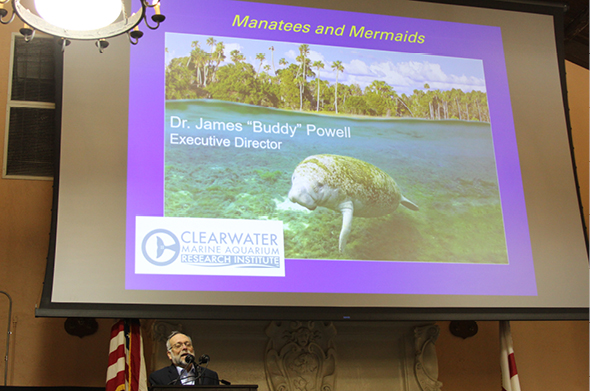
Clearwater Marine Aquarium’s Buddy Powell addressed a room full of students curious about Florida’s manatees and threats to their habitat.
A majestic sight in Florida’s rivers and coastal waters, manatees are as beloved as they are emblematic of the Sunshine State. Yet the large aquatic mammals – who may have inspired the myth of mermaids – might be more threatened than ever in Florida and other places they dwell.
That’s why, for its first Foreman Biodiversity Lecture of 2023, Stetson Law hosted Dr. James “Buddy” Powell, one of the world’s leading experts on manatees, for a compelling talk about these lovable sea creatures and how to protect them.
President of Clearwater Marine Aquarium (CMA) and director of the facility’s Research Institute, Powell has contributed to humanity’s understanding of manatees, also known as sea cows, for decades.
From Cousteau to Clearwater
Powell’s interest in manatees dates back to the 1960s. Growing up in Crystal River, Florida, a waterfront town about 100 miles north of Stetson Law’s main campus in Gulfport, he spent extensive time navigating the pristine springs that feed the river, springs with 72-degree water year-round, which attracts manatees in search of warmth when Gulf and Atlantic temperatures plummet.
Jacques Cousteau himself hired Powell, then a high-school student, as a guide to find manatees in Crystal River.
He even has a near-photographic memory of manatees he has studied and can identify them by the unique scarring patterns on their thick skin, which are often caused by boat propellers.
An iconic species in the Sunshine State, Florida manatees face unprecedented threats to their health and habitats.
A truly fascinating species
Powell spoke passionately about the Florida manatee and its counterparts around the globe, including the Amazonian manatee, the African manatee and the dugong – the manatee’s fork-tailed relative in the Indo-West Pacific.
Though they dwell in waterways, he said, manatees are more closely related to elephants than whales or dolphins. In addition to elephants, they share a common ancestor with aardvarks and hyraxes. Like elephants, they have an exceptional memory – which helps them maintain consistent food sources and get to warm-water sanctuaries when temperatures drop.
Also, they may have inspired maritime lore for cultures the world over. “No matter where you go – Africa, South America, Central America – there is this reference and legacy to a water deity like a mermaid,” Powell said.
An inspiration for future environmental lawyers
As law students, those present at the lecture were curious about how they can use their skills to help manatees thrive despite numerous factors depleting their habitat and food supply. Powell, who has advocated for protections for manatees and their habitats in Florida, West Africa, Central America, and Cuba, had some insights.
He recalled his early efforts to get protections in Citrus County, where Crystal River is located, in 1969. Time was of the essence, he said, given how development and other factors posed a threat to their habitat.
“We realized in time that it was a really special place,” he said.
Powell and other environmental advocates proposed that Crystal River become a manatee sanctuary. Officials initially denied the request, but ultimately came around – to everyone’s benefit; manatee-spotting is now a major tourism draw during the winter months.
“I can say ‘I told you so,’” he said.
A complicated threat
The U.S. Fish and Wildlife Service downlisted manatees from endangered to threatened in 2017. The designation comes as a mortality trend on the Atlantic Coast has led to record manatee deaths. Nutrient loading in the Indian River Lagoon – fertilizer, agricultural runoff, septic tank leakage – is feeding algae blooms that affect manatees’ main food source.
“What’s happening is, this algae has decreased the water clarity, which seagrass – being grass – needs clear water and light through to the bottom to grow,” Powell said. “Now, we’ve seen a dramatic decrease in vegetation. So they’re getting there and they’re finding, well, ‘where’s the buffet?’”
Environmental lawyers can help, he said, by using their legal expertise to push for science-backed clean water protections.
“It’s about environmental regulation and environmental laws – so that we can remove those threats to manatees,” Powell said. “What’s good for manatees is good for everything else.”
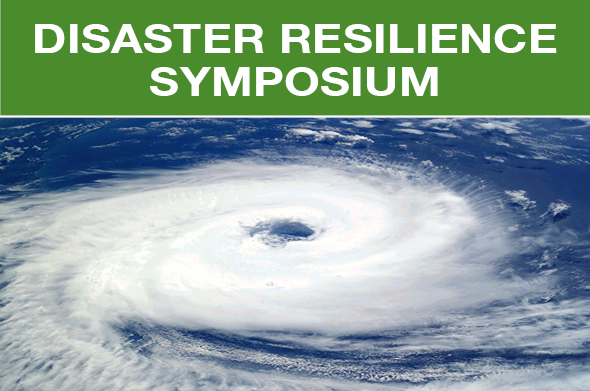
Whether it’s the COVID-19 pandemic or Hurricane Ian, major disasters can dramatically disrupt society on multiple levels. Yet it is often the poorest and most underserved communities that are most hurt in their aftermath.
This is why Stetson Law looks forward to hosting the Disaster Resilience Symposium, which takes place March 15-16. A collaborative effort led by nonprofit Equal Justice Works and cohosted by the American Bar Association and American Bar Association Young Lawyers Division Disaster Legal Services, the event’s theme is “Building Community Resilience Through Advocacy and Systemic Change.”
Important policy discussions
The event will bring together legal, academic, and community voices instrumental in disaster law and the resilience movement for keynote presentations on current and emerging issues in disaster response and preparedness. Organizers plan to examine the question of how to build more equitable disaster resiliency and recovery strategies through the lens of law and policy.
Law Professor Christine Cerniglia
“As we see on the news, disasters are occurring at an alarming rate across the globe,” said Law Professor Christine E. Cerniglia, who is Stetson Law’s Director of Clinical and Experiential Education. “How communities prepare to become more resilient will define our future – most importantly, how communities respond to ensure all members in the community are resilient – will further define us. This symposium hopes to provide a space to think about how to bolster preparedness for all, including the most vulnerable, in order to create equality in disaster response.”
Disaster resilience through a legal lens
Over the symposium’s duration, panelists and speakers will discuss the recent changes in disaster law, systemic challenges, and how disaster and preparedness, response, and recovery may evolve in the future. Attendees can also learn about legal resources and tools they can use to advocate for greater resiliency in the communities they serve.
“This conference brings together leading advocates and thinkers to share best practices and resources for increasing and improving community response and resilience to all types of disasters,” said Equal Justice Works CEO Verna Williams, “Lawyers play a critical role in disaster preparedness and recovery, and to build disaster resilience in communities, we know having a sustained presence of lawyers on the ground is crucial. We’re thrilled to work in partnership with groups that are on the frontlines of this important issue.”
Attendees can expect highly substantive sessions discussing timely topics like climate justice, how disaster effects migrants, advocacy through organizing, and more. Immersive workshop experiences, meanwhile, aim to broaden their perspectives on the critical role legal and government professionals play in helping low-income families recover in the aftermath of a disaster.
The Disaster Resilience Symposium is free to attend. Those who do so in person are eligible to earn CLE credit. Registration closes February 14. Learn more and register.
At a Friday lunch event, Stetson Law students got a candid look at the incredible career path of one of Stetson Law’s most distinguished alumni.
Double Hatter Lila Jaber, who graduated from Stetson University in 1988 before earning her J.D. from the College of Law in 1990, was speaking as part of Stetson Law’s 2023 Campus to Career experience. A prominent Florida energy lawyer, she has held numerous leadership roles within her area of practice. Recently, she served on the board of Chesapeake Utilities, was a regional managing shareholder at the firm Gunster Yoakley & Stewart, P.A., and is a member of Stetson University’s Board of Trustees. In 1999, Jaber was appointed by then-Governor Jeb Bush to serve on the Florida Public Service Commission, an entity that regulates the state’s public utilities. She was later appointed to a second term and ultimately served as commission chair. She currently runs her own consulting firm.
Emphasizing the importance of characteristics like patience, integrity, compassion, and humility, Jaber recounted how her strategy for building a successful career went from a plan to reality – even when life’s unpredictable nature made things look a little different than what she might have expected.
A clear but flexible vision
She told the students that not knowing precisely what role to which they aspire isn’t a bad thing.
“It’s true I planned a future, I didn’t necessarily plan exactly where I was going to be,” Jaber said. “And that’s why when I was speaking with some of you who said to me, ‘I’m not quite sure,’ my reaction was ‘that’s okay.’ Because sometimes, exactly what you’re going to do finds you.”
As a first-generation Palestinian American Muslim, Jaber said she applied to Stetson University without telling her parents until nearly the deadline for confirming her attendance with the school. When she finally told them, they were staunchly supportive.
Seeking mentorship, knowing the material
Early on, she sought mentorship from the likes of beloved Stetson University Professor of Political Science T. Wayne Bailey, who not only encouraged her to attend law school, but was a champion of the ambitious student.
Years later, when then-Governor Jeb Bush named Jaber to the Public Services Committee shortlist, her competition consisted of two well-known state lawmakers. At the time, she was bureau chief for the agency’s water and wastewater division and used her working knowledge to advocate for herself. She knew the work well, and it won her the appointment.
“Because when you do your homework and know everything better than the next person, you’re actually empowering the decisionmakers to make the right decision,” Jaber said. “How could they not, right?”
Suited for leadership
Other things she stressed to attendees: familiarize yourself with decisionmakers, develop and effectively communicate your message, be prepared for negative feedback, be gracious and leave the door open.
Lawyers, she said, must also recognize how their work equips them to be powerful community leaders.
“I think of the practice of law as a leadership opportunity,” Jaber said. “Because lawyers are the leaders of the community. They certainly can be – and you should be.