(L-R): Clare McQueen (standing), Brittany Maxey-Fischer (local patent attorney), Katherine Pill (the curator of contemporary art at the Museum of Fine Arts), and Jennifer Kosharek (local street artist). Photo by Austin Sigl.
By Taylor Allyn
On March 26, Clare McQueen presented her paper, “The Visual Artists Rights Act: Why Graffiti Art Merits Protection,” at the Stetson Law Review spring scholarship luncheon. A panel comprised of Stetson Law Associate Dean Darryl Wilson, local patent attorney Brittany Maxey-Fischer, St. Petersburg Museum of Fine Arts curator of contemporary art Katherine Pill, and local artist Jennifer Kosharek provided specialized insights into copyright law and the preservation and protection of art.
McQueen began by giving a brief history of graffiti and street art, noting the general shift in public attitudes to this art form. Street art can encourage rehabilitation of communities, beautify public spaces, and stimulate economic development, although it has historically been classified as vandalism instead of art.
The Visual Artists Rights Act (VARA), enacted in 1990, protects the moral rights of artists and provides a national standard for visual art protection. McQueen expressed concern that the recognized stature test for whether art merits protection under VARA has been too narrowly applied, excluding peculiar or atypical works of art. Even the works of Picasso, the panel noted, were considered experimental in his day.
McQueen proposed a new six-factor balancing test to determine whether visual art, specifically graffiti art, merits protection. These factors include the status of the artist, the time, effort, and creativity that was used, and the property owner’s interest, among others, to ensure fairness and protect beautiful art.
(L-R): Students Marcus Scott, Christopher Odgers, Blaze M. Bowers, and Alicia Roddenberg, alumnae Kaitlyn Dugas and Theresa Jean-Pierre Coy, students Jacob Delorme, Noel Gonzalez, Brooke Pearson, and Magner Tiuso. Photo by Brielle Tucker.
By Brielle Tucker
The team of 1L students Blaze M. Bowers, Christopher Odgers, Alicia Roddenberg and Marcus Scott was awarded first place and the team of Jacob Delorme, Noel Gonzalez, Brooke Pearson, and Magner Tiuso was named finalist in Stetson’s annual Intramural Mock Trial Competition. Roddenberg was also named the final round’s Best Advocate. Fifty-two first-year students competed in the two-day competition, presenting students unfamiliar with trial advocacy and evidence with an opportunity to try a mock case and learn trial advocacy techniques. Students were coached by Stetson Trial Team members and competed on Saturday, March 30, and Sunday, March 31. The fact pattern involved a negligence case arising out of a plane crash on the defendant’s property.
The Intramural Mock Trial Competition was sponsored by the Stetson Student Bar Association with the support of the Center for Excellence in Advocacy. Third-year student advocate Brielle Tucker was the director of this year’s competition with the assistance of second-year student Olivia Bergert, who will take over as director next year. Attorney alumni Theresa Jean-Pierre Coy J.D. ’05, Kaitlyn Dugas J.D./M.B.A. ’17, Julie Ann Embler J.D. ’15 and David E. Little J.D./M.B.A. ’10 served as final round judges.
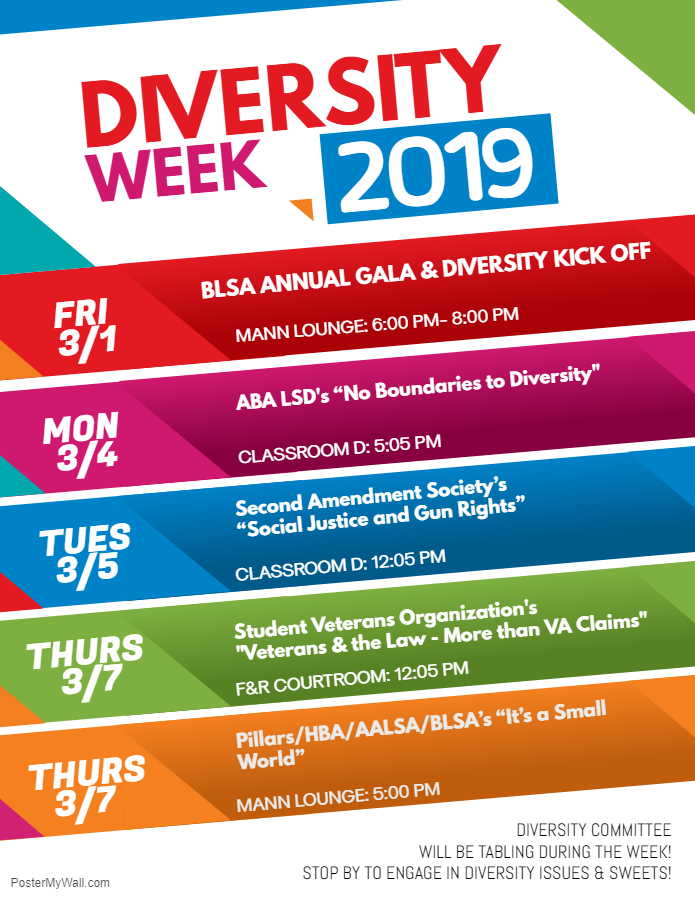
Stetson Law celebrated Diversity Week with a series of special events on the Gulfport campus March 1-7. Diversity Week is organized by the Student Bar Association Diversity Committee and coincides with the ABA Diversity Day initiatives. The Diversity Committee coordinates and assists student organizations who wish to host a diversity-related event during Diversity Week and furthers the conversation about what diversity means to the Stetson Law community.
“It is our goal during Diversity Week to facilitate conversations and thought-provoking programming between students,” said Mary Samarkos of Stetson’s Student Bar Association Diversity Committee. “Something unique about Diversity Week is that it is organized by students and it is intended for the benefit of students.”
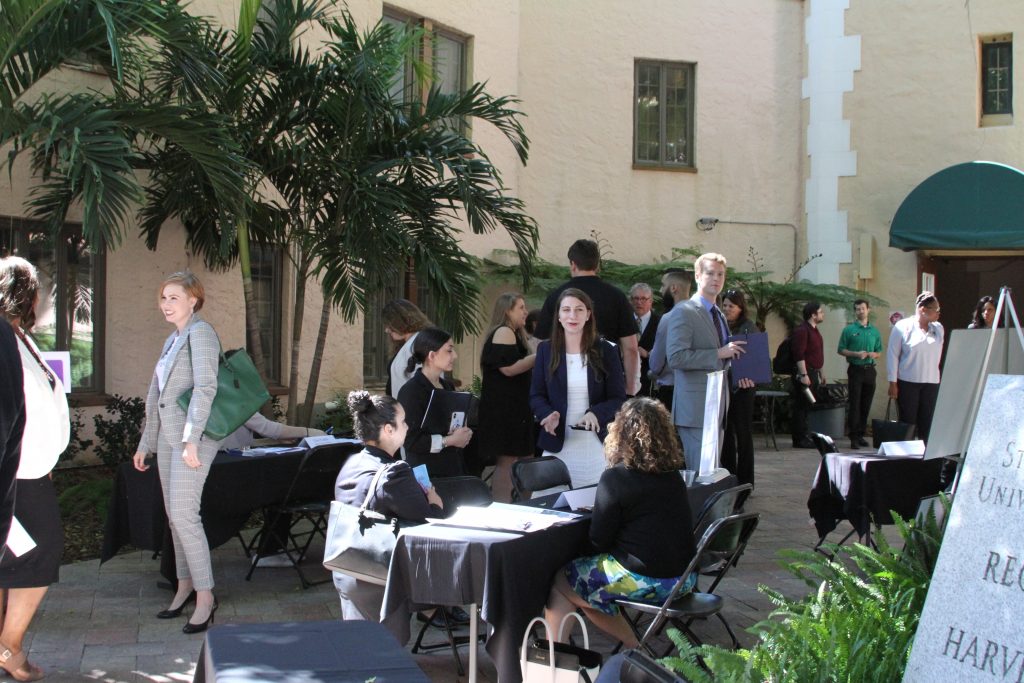
Diversity Committee tables are generally located outside within Stetson’s common area during the week to survey the student population on four different aspects of diversity-related ideas. Samarkos encouraged students to keep an eye out for upcoming events from the Diversity Committee.
Stetson hosts Social Justice Opportunity Forum for students. Photo by Eileen McGarry.
By Julie McHaffie
Stetson University College of Law held its first Social Justice Opportunity Forum on March 22. The Forum provided presentations from a variety of social justice practitioners and an opportunity for students to network, interact and ask questions.
Professor Judith Scully delivered the opening address about access to justice and what it means, emphasizing the great need in the civil system where there is no guarantee of representation.
“The need of low-income people is much greater than the availability of service,” said Professor Scully.
Other speakers included Claire Cusella with Equal Justice Works, Bay Area Legal Services attorney Cherilyn Hansen, civil rights attorney Michele Rayner-Goolsby, Juvenile Justice Policy Coordinator with the ACLU of Florida Michelle Morron, and Shutts & Bowen LLP attorney Ella Shenhav.
After the presentations, law firms and organizations were available to meet with students for one-on-one information sessions with professionals working in the field. Firms and organizations included Bay Area Legal Services, Catholic Immigration Network, Suncoast Voices for Children, Equal Justice Works, and Gulfcoast Legal Services.
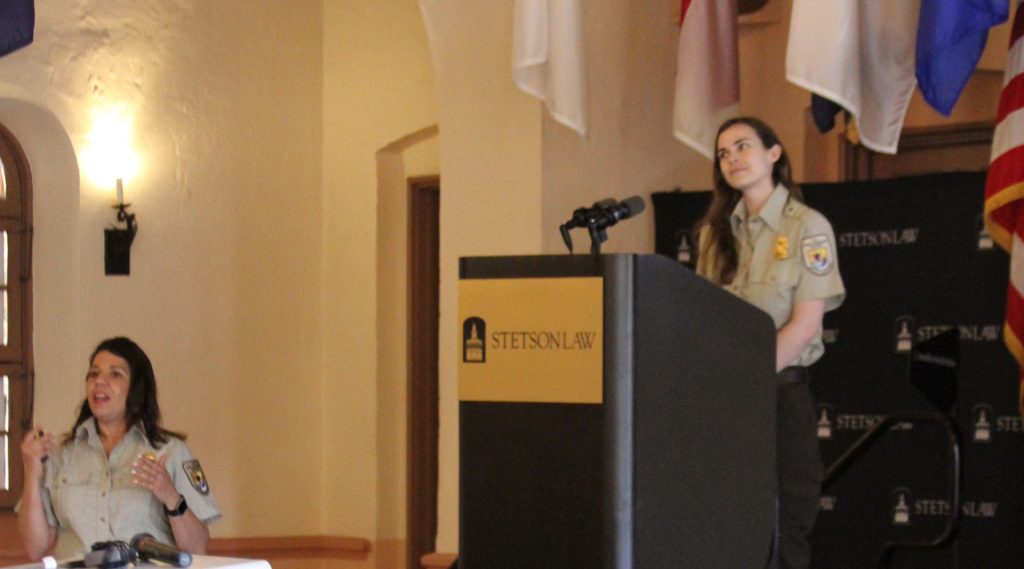
Rhyan Tompkins and Cindy Mercado presented the Foreman Biodiversity Lecture on March 5. Photo by Austin Sigl.
By Sarah Shirley
Rhyan Tompkins and Cindy Mercado, wildlife inspectors with the U.S. Fish and Wildlife Service, presented the Foreman Bioversity Lecture on “The Black Market for Wildlife and America’s Front-line Defense” on March 5 at Stetson Law’s Gulfport campus.
“Our job is to capture the illicit trade and facilitate the legal movement of certain animals,” said U.S. Fish and Wildlife Inspector Cindy Mercado. People smuggle animals into the United States daily through a means of many creative ways.
“I never thought that people would go to such extreme measures to get animals into the United States,” said Mercado. “Smuggling illegal wildlife into our nation is a crime.”
The Fish and Wildlife inspectors work with approximately 140 inspectors nationally, in effort to enforce the federal wildlife laws. Mercado emphasized the need for change to our legal system so that the punishment is suitable for the crime, and hopes that people begin to better understand the effect of illegal wildlife in on our nation.
Wildlife inspectors of the U.S. Fish & Wildlife Service are the nation’s front-line defense against illegal wildlife trade, a criminal enterprise that threatens species worldwide. The presenters led a talk on global wildlife trafficking and transnational organized crime and provided an in-depth look into federal wildlife investigations and smuggling activity.
Tompkins and Mercado have more than two decades of combined wildlife inspector experience.
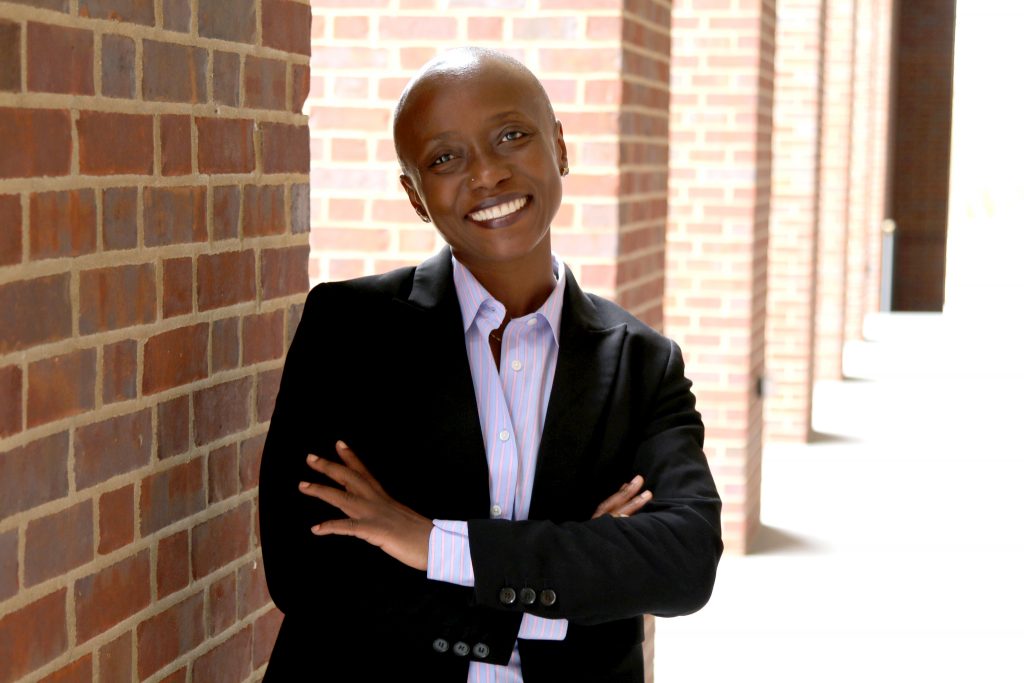
Following a nationwide search, Stetson University Executive Vice President and Provost Noel Painter, Ph.D., announced the appointment of Michèle Alexandre, a noted civil rights, gender and race scholar, and author of “The New Frontiers of Civil Rights Litigation,” as the next dean of Stetson University College of Law in Gulfport, Florida. Alexandre is the College of Law’s first African-American dean. The appointment is effective June 2019.
“Dean
Alexandre brings an extraordinary wealth of vision and expertise to
this position,” said Painter. “Her work in civil
rights and gender equity fit hand in glove with Stetson Law’s emphasis
on social justice and global citizenship, and our ongoing work for
veterans, the elderly and the environment.”
“I
am thrilled to join the Stetson family,” Alexandre remarked. “Stetson’s
commitment to training global citizens and practice-ready lawyers
represents a galvanizing vision for legal education in the
twenty-first century. The College of Law’s priorities regarding social
justice, academic rigor and student engagement are dear to my heart. I
am eager to work with all aspects of the law school, the
university and with its amazing alumni to help the law school continue
to grow and reach new heights.”
Stetson University College of Law is ranked No. 1 in Trial Advocacy and No. 3 in Legal Writing in the nation by U.S.
News & World Report, and is Florida’s first law school.
Alexandre is currently serving as the associate dean for Faculty Development and Intellectual Life, professor of law, and the Leonard B. Melvin, Jr. Lecturer at the University of Mississippi School of Law. Her broad expertise and commitment to justice is evidenced in the organization of a biennial national conference on sustainability and social justice for poor populations in the rural South, occurring since 2011. Alexandre has experience that allows her to be laser-focused on excellence in legal education while leveraging Stetson’s commitment to the core aspects of the liberal arts. At the University of Mississippi, she chaired the undergraduate Honors curriculum committee, led the Honors College faculty, and taught courses in the undergraduate international studies program. She has a J.D. from Harvard Law and was Colgate University’s first black valedictorian.
“Michèle Alexandre will lead Stetson Law in educating the next generation of outstanding Stetson lawyers,” said Stetson
University President Wendy B. Libby, Ph.D. “She is the right person to affirm and build on our reputation for excellence.”
Michèle Alexandre Biography
Professor Michèle Alexandre joined the University of Mississippi in 2008 as an associate professor, from the University of Memphis School of Law. Professor Alexandre is the first black valedictorian of Colgate University. She earned her Juris Doctor (J.D.) from Harvard Law School. Her teaching and scholarly areas include constitutional law, international law, civil rights law, disability law, critical race theory, human rights, and gender.
Professor Alexandre is the author of the civil rights textbook, “The New Frontiers of Civil Rights Litigation” (Carolina Academic Press), and “Sexploitation: Sexual Profiling and the Illusion of Gender” (Routledge, 2014). She was named one of Ebony Magazine’s Top 100 influential African Americans of 2013 and one of the 50 “Most Influential Minority Law Professors 50 Years of Age or Younger” by Lawyers of Color Magazine. She has received Fulbright and Watson Fellowships.
Alexandre
also works on issues of sustainability and economic independence for
small farmers in Mississippi’s Delta and other areas of the rural South.
Since 2012, she has organized the
Race and Sustainability Conference hosted by the University of
Mississippi. This conference is a national conference focused on issues
of sustainability and social justice for poor populations of the rural
South.
Alexandre has published numerous law review articles, book chapters and op-eds. She has published law review articles in the Washington and Lee Law Review, the Duke Journal of Gender Law and Policy, the UCLA Chicano/a-Latino/a Law Review, the Hastings Women Law Journal, the Oxford Round Table’s Forum on Public Policy, the Boston College Journal of Environmental Affairs Law Review, the William and Mary Journal of Women and the Law, the American University Journal of Gender, Social Policy and the Law, the UMKC Law Review, the University of Pennsylvania Journal of Law and Social Change, the Indiana Law Review (spring 2013) and the Oregon Law Review (spring 2013). In addition, she has published book chapters with Carolina Academic Press (Law, Property, and Society), Ashgate Publishing (Race to Injustice: Lessons Learned from the Duke University Lacrosse Players’ Rape Case) and Routledge (Transcending Boundaries of Law).
Alexandre received the Ben A. Hardy Faculty Excellence Award for outstanding teaching, scholarship, and service in 2016. In 2017, she was selected as an SEC-U Academic Leadership Development Program Fellow for 2017-18.
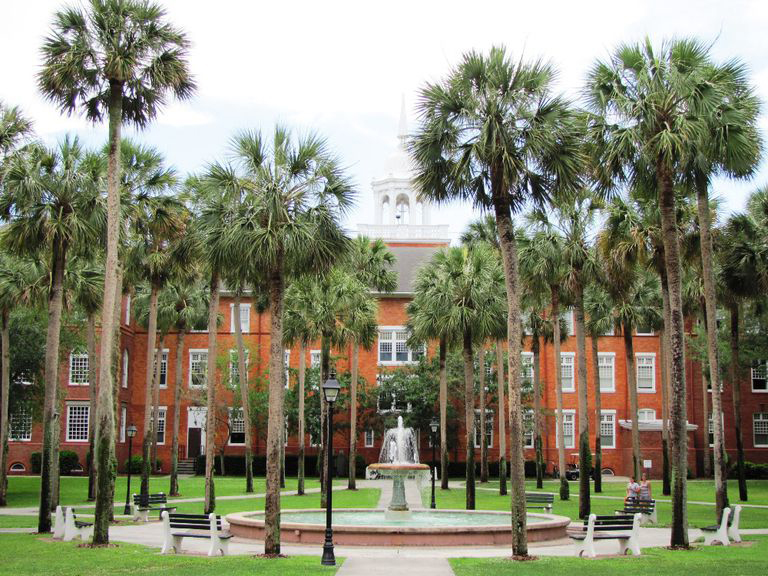
Stetson University’s Elizabeth Hall in DeLand, Florida.
On college campuses across the country, conversations about race, politics and other issues have become flashpoints in the debate over free speech.
Eric Kurlander, Ph.D., Stetson professor of history, said faculty, staff and students can feel hesitant to discuss these important issues, fearing they may come under attack for expressing views that don’t conform to campus norms.
Kurlander served on a Stetson task force, convened by President Wendy B. Libby, Ph.D., in December 2017 to develop a university statement affirming academic freedom and civil discourse.
The task force gathered input from students, faculty and staff on Stetson campuses and recently received final approval from the university’s Board of Trustees for the “Statement of Principles of Free Expression.”
“This statement puts us out in front of many other colleges and universities in both principle and practice,” said Kurlander, who presented the statement to the Board of Trustees with Sven Smith, Ph.D., assistant professor of sociology, and Kevin Winchell, associate director of community engagement.
Added President Libby, “We greatly appreciate the work and time Eric, Sven and Kevin put into this, as well as Peter Lake and others at the College of Law. It is extremely important to the entire Stetson community, but it was certainly not easy, and the final statement is a reflection of the thoughtful discussions they have had.”
Encouraging Diverse Speakers
Stetson Law Professor Peter Lake, a member of the task force, said the statement comes at an ideal time. In recent days, President Trump has said he will sign an executive order guaranteeing free speech on college campuses. College and universities that don’t support free speech could lose their federal funding.
Trump made the announcement Saturday, March 2, at a conservative conference, following the assault of a conservative activist while he was tabling at the University of California campus at Berkeley. Neither the activist nor the attacker were students at Berkeley.
“The thing that almost gives me chills was the fact that Wendy (Libby) must have a crystal ball because President Trump is considering signing a free expression executive order and having a statement of this type is exactly the sort of thing a university College of Law needs to ensure that we’re in compliance with any executive mandate that might come out on this,” Lake said.
Even before the statement received final approval from the Board of Trustees, Lake was already experiencing the benefits of such a document. Lake invited Judge Kenneth Starr to be the guest speaker Feb. 3 at Stetson’s annual National Conference on Law and Higher Education in Clearwater Beach. Judge Starr’s presentation was warmly received at the event, but did receive a handful of comments on digital media.
Starr left the presidency at Baylor University in 2016 in the wake of an investigation involving reports of sexual assaults on campus. A former federal appeals court judge, Starr also headed the investigation of President Clinton in the 1990s, leading to impeachment proceedings.
“I invited Judge Kenneth Starr to speak at my national conference and I’m sure you saw there were some folks outside the College of Law who criticized that choice and I felt that the Statement (of Principles of Free Expression) supported my institution to offer broad programming with a variety of ideas,” Lake explained.
“Having a statement like that is a platform for discussions about bringing more diverse speakers and having a broader conversation with civil boundaries associated with it,” he said.
A Civic Responsibility
Members of the Stetson task force say the university has an academic mission and a civic responsibility to teach students how to engage in challenging conversations about race, religion, politics, gender, class and privilege — with civility.
“It’s not just a contract with our students. It’s also a contract with our society and with our democracy,” Winchell said at a recent All Staff Meeting on the DeLand campus. “We have a civic — almost moral – responsibility to ensure we’re inculcating these habits of citizenship, so that our students will, as our mission statement says, reach their full potential as informed citizens of our local and global communities.”
Students and others need to listen with empathy when others have views that differ from their own. They need to develop habits of critical inquiry, evaluating the evidence and debating collegially, according to Winchell and Stetson’s new Statement of Principles.
The statement says the university adheres to “the principle that debate and dialogue should not be suppressed because some members of our University community or individuals outside the University consider such views to be politically harmful, offensive, politically incorrect, or pernicious. Expressed views are open to criticism, debate, and condemnation. Open debate and dialogue is a natural part of the marketplace of ideas. Hence, attempts to suppress or punish protected expression or speakers are anathema to the free expression necessary for intellectual and cultural growth.”
The statement also makes clear that boundaries exist on free speech. The federal Title IX prohibits expressing sexual discrimination and misconduct. Existing laws prohibit threats of violence, harassment, liable, slander and other harmful actions. And the university is governed by a Code of Community Standards and by policies on civil protests.
“If you’ve been following some of the national news, there are many campuses that have really struggled with navigating these challenging conversations about race or religion or politics or privilege,” Winchell said. “Students often feel like they’re silenced or marginalized because they don’t know how to approach these challenging conversations, but they really want to talk about them because they care about these issues.
“This is a document that is written to stand alongside our mission and our values,” he added. “It is intended to communicate how central free expression is to us being able to accomplish our civic and academic missions.”
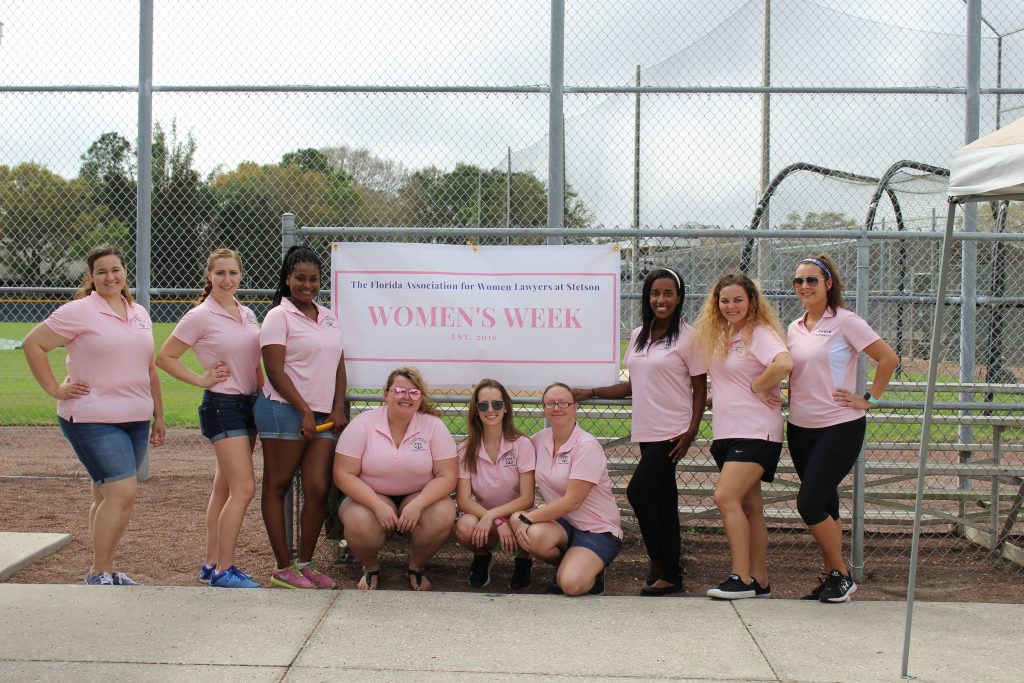
FAWLS at Stetson hosted the annual Women’s Week program. (L-R): Megan Summers, Rebecca Klonel, Shennia Laurence, Rachel Wise, Kim Lopater, Michelle Moretz, Emeraude Lerebours, Kelsey Norman and Taylor Scribner.
The Florida Association of Women Lawyers at Stetson hosts an annual Women’s Week program to raise awareness, encourage advocacy, and initiate action on current women’s rights issues in the U.S. through various pro bono, professional development, and educational events.
Kimberly Lopater, president of the Florida Association for Women Lawyers at Stetson Law, described the annual Women’s Week program as empowering.
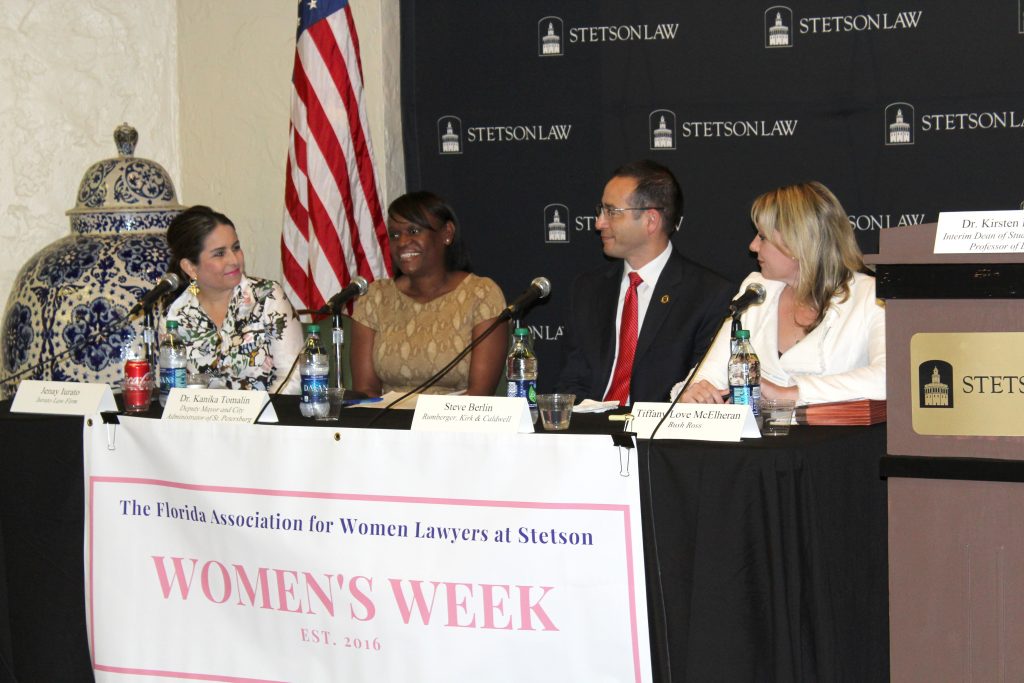
(L-R): Jenay Iurato (Iurato Law), Dr. Kanika Tomalin (Deputy Mayor of St. Petersburg), Steve Berlin (Rumberger, Kirk & Caldwell), and Tiffany Love McEhleran (Bush Ross, PA).
This year, students had an opportunity to participate in pro bono activities and network with nine influential practitioners and the Florida Bar president, Michelle R. Suskauer, who spoke on the Gulfport campus on Feb. 26.
(L-R): Richard Pollack (Trenam Law), Jeanie Poley (Hill Ward Henderson), Joann Grages Burnett (Stetson Law Office of Career and Professional Development), Travis Coy (Assistant State Attorney with the 13th Judicial Circuit), Jason Bent (Stetson Law Associate Dean of Academic Affairs and Professor of Law).
“In the future, I would like to see Women’s Week develop into a more collaborative program in which more student organizations work together to promote gender equality and women’s rights,” said Lopater. “There is a big misconception that Women’s Week is just for women, and that is simply not true.”
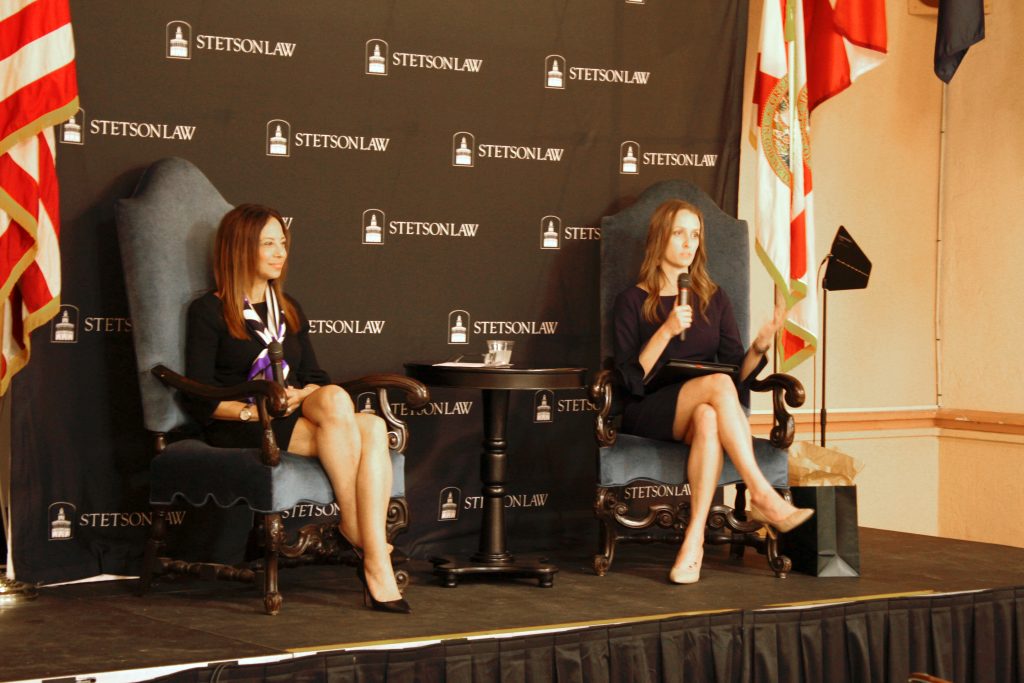
Florida Bar President Michelle Suskauer (far left) spoke at Stetson Law during Women’s Week.
“With the help of other student organizations, we can debunk this gender myth and focus on the big goals––educating and advocating,” said Lopater. “One of the simplest ways that students can contribute to Women’s Week is through our pro bono project.”
This year, students had an opportunity to contribute to a fundraiser and supply drive for female veterans of the Tampa Crossroads Athena House either as participants or volunteer at the Superhero 5k. Students were also invited to sign letters to the Florida legislature at the Operation Athena lunch to address female veteran-parents, the pink tax, and HB 49/SB 332 Dignity for Incarcerated Women.
The Superhero 5K included participants and volunteers.
“Aside from the pro bono work, the greatest way that students can contribute to Women’s Week is by showing up,” said Lopater.
FAWLS raised more than $1200 for Athena House, students wrote 50 cards of encouragement to female veterans, and donations are still being collected.
“FAWLS uses Women’s Week as a way to get students active in the community so they can be reminded of the unique power that we have to influence the world around us,” Lopater explained.
“We have been pushing people out of mental health institutions and onto the street,” Dr. Risdon N. Slate told the audience gathered to hear him lecture during the Student Leadership Development Program Leadership Luncheon on Feb. 20. “I do not believe that a person should have to commit a crime in order to obtain recovery in our criminal justice system.”
Dr. Risdon Slate spoke at Stetson Law. Photo by Austin Sigl.
Slate shared that people who have a mental illness tend to be victims, rather than perpetrators. Substance abuse combined with a lack of treatment tend to heighten the risk for violence among persons with mental illness in that rare instance where violence might occur.
“I hope that someday society will treat people with mental illness the same as someone with diabetes,” said Slate.
He emphasized that recovery is possible and mentally ill people have rights, which include a right to treatment in a safe environment, a right to the least restrictive environment, and a right against imminent harm to oneself or others involving grave disability.
“We need more judicial intervention leaders at behavioral health courts so that we can make a difference within our community,” Slate said. “Law enforcement can also act as a resourceful leader by performing effective crisis intervention training and making an attempt to establish more diversion programs in order to help people who are mentally ill.”
The next Student Leadership Development luncheon is scheduled for March 6.
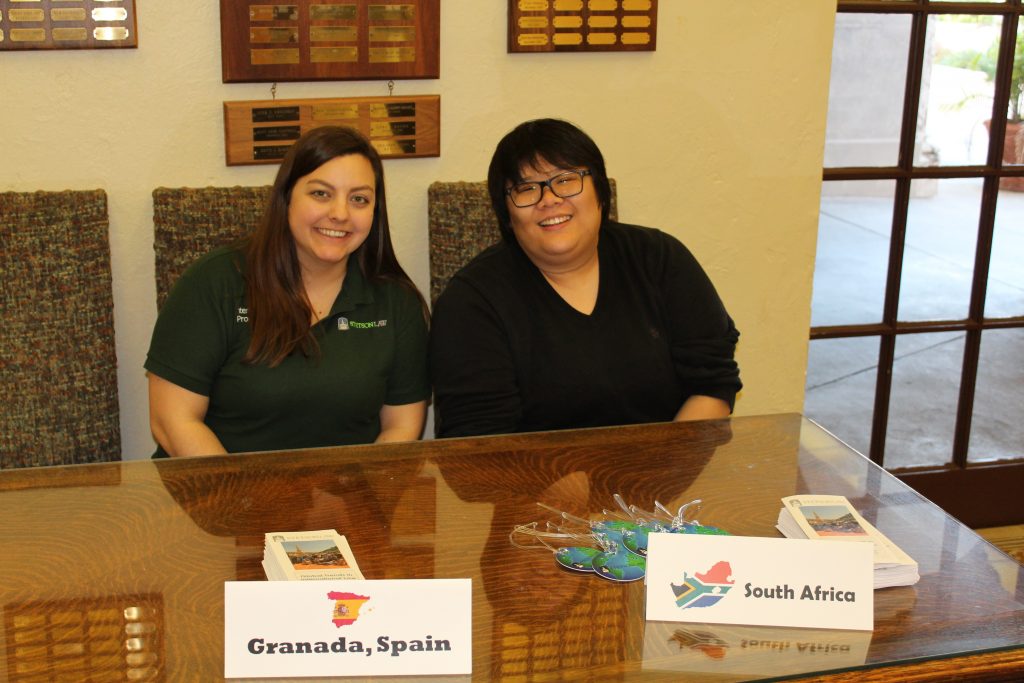
(L-R): Alicia Winterkorn with Sy-Woei Hao. Photo by Frédéric Boidin.
By Sarah Shirley
“Students who study abroad grow both personally and professionally,” said Kristen McConnell, Associate Director of International Programs.
Stetson hosted a Study Abroad Fair on Feb. 5 in the Mann Lounge. Study Abroad Fairs are held throughout the academic year.
By studying around the world, law students can learn a variety of soft skills, including leadership, communication, problem-solving, and adaptability. McConnell said that the study abroad experiences can be life-changing and transformative.
Stetson launched its first summer study abroad programs in 1998 in Estonia and Granada with the goal of providing a sound legal education relevant to the global legal community. Today, Stetson Law offers study abroad programs in Spain, the Netherlands, England, South Africa, Barbados, the Cayman Islands, India and Ireland.
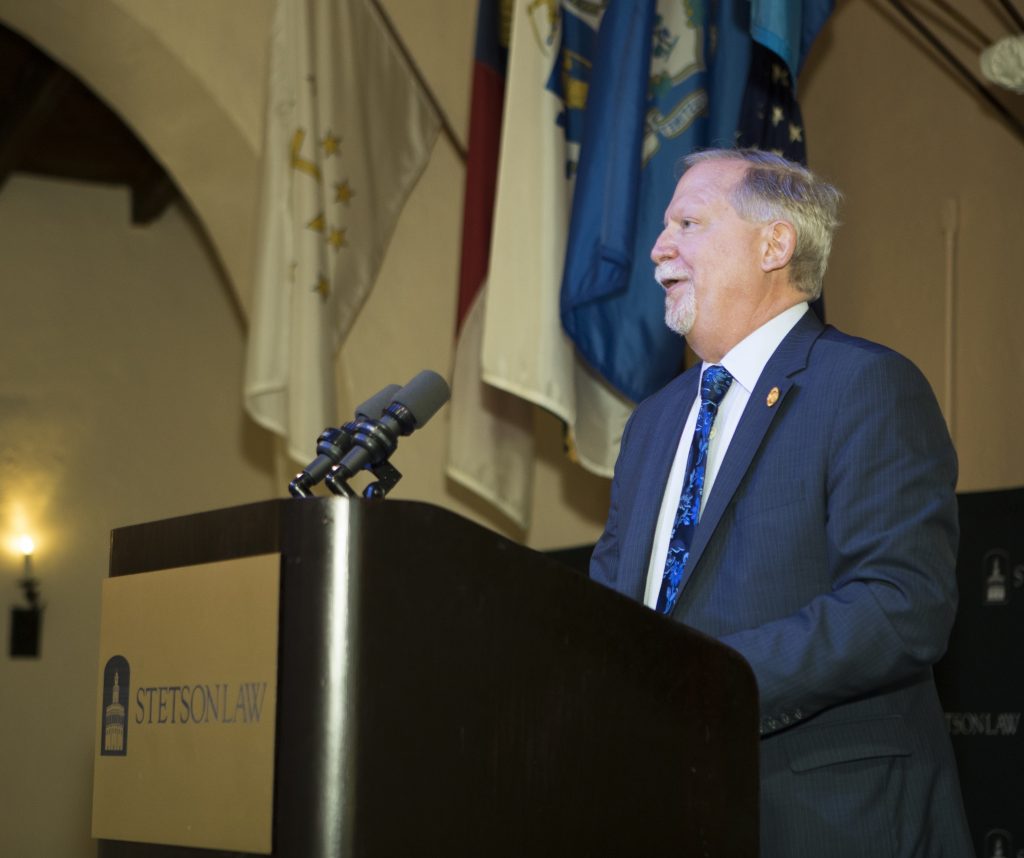
American Bar Association President Bob Carlson visited Stetson University’s Gulfport campus on Feb. 12 and presented to students, faculty and staff.
Carlson, who took the helm of the ABA in 2018, is focused on the role bar services play in an independent judicial system, changes in legal education and bar admission, and wellness for lawyers and law students.
“Lawyer wellness starts at law schools,” said Carlson. “The program here is very exciting and we’ll be talking about this program with other law schools.”
He encouraged the law students in the audience to join the ABA and stand together to support the institution. He described the importance of an independent judiciary, the rule of law, free speech and a free press in helping a just society to prevail. He also encouraged students to become involved in service to their community.
Carlson previously served as president of the State Bar of Montana from 1993 to 1994, on the executive council of the National Conference of Bar Presidents, and chaired the ABA House of Delegates.
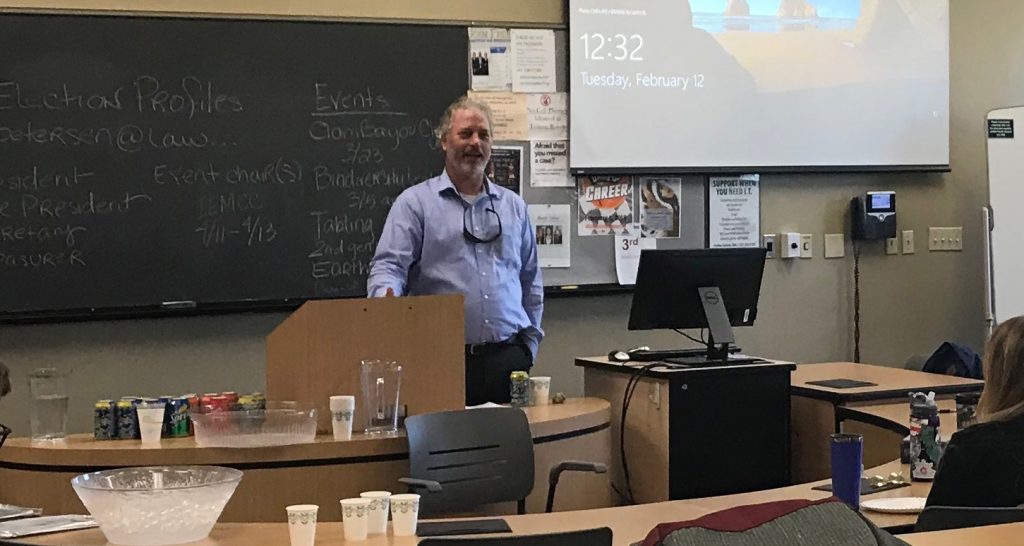
Andy Zodrow spoke at Stetson Law. Photo by Sarah Shirley.
By Sarah Shirley
“Environmental law is about defending the rule,” said Andy Zodrow J.D. ’95 of the Environmental Protection Commission. Zodrow visited Stetson’s Gulfport campus on Feb. 12 to talk with students about the path to a career in environmental law.
“What a lot of people don’t know is that you don’t have to come from an environmental background to have a career in environmental law,” said Zodrow. “Public interest, government, and private practice are all unique areas within environmental law.”
Zodrow shared that if students are interested in environmental law, a good foundational class offered at Stetson is administrative law. Zodrow also encouraged students to start early with participation in internships in order to get hands-on experience within the field.