Skip to content

Eye-Opening Civil Rights Travel Experience Returns to Stetson Law

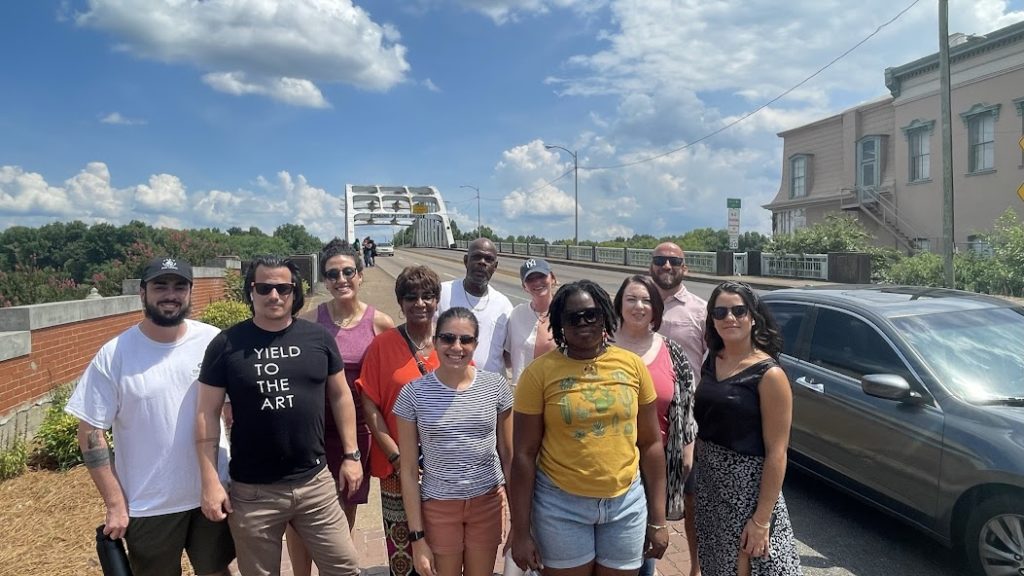
Eleven people stand on the side of the road near a bridge on a sunny day.
Students with Stetson Law’s 2022 Civil Rights & the Law Course pose for a group shot before following in the footsteps of activists who marched in Selma, Alabama.

A group of law students has just wrapped up a once-in-a-lifetime experience exploring the places, events, and people that shaped the Civil Rights Movement.

The two-week course took students to places like the Edmund Pettus Bridge in Selma, Alabama, the National Civil Rights Museum in Memphis, Tennessee, and the Equal Justice Initiative’s Legacy Museum in Montgomery, Alabama. Along the way, students had the opportunity to converse with activists and others whose actions led to fundamental shifts toward fairer treatment of Black Americans. The course’s first week consisted of in-class and virtual discussions to help set the table for the immersive experience that took place the following week.

This is the first time the course has been offered since before Covid-19 concerns limited travel, and all student travel expenses were covered by scholarships.

The course explored the Civil Rights Movement through a legal lens: namely, how state and federal law have been used as a tool for racial and social injustice, efforts to justify these laws, the movement’s enduring inspiration of modern civil rights campaigns, and how it was an intellectual, strategic, and legal endeavor in addition to being a movement around morals and shared humanity.

LibraryGroupShotCivilRights
previous arrow
next arrow

Stetson University Executive Director of Diversity, Collaboration and Inclusion Carmen Johnson and University of Alabama School of Law Professor Emeritus Martha Morgan co-taught the course, which is part of a university-wide curricular initiative and commitment to education about social justice and the lessons of the Civil Rights Movement. A similar undergraduate-level course was available to students at Stetson University’s DeLand campus this summer.

“It is an honor to have such an impactful course here at Stetson, where it is celebrated across our campuses as an inspiration for students to have an impact in their communities, no matter what career or passions they choose,” Johnson said. “This is a unique opportunity for students to not only study the grassroots and legal advocacy that occurred during Civil Rights Movement, but to also delve into some of the history that sparked the Movement and explore the strategies of current civil rights struggles.”

Experiential learning with purpose

The course took students to celebrated places where Civil Rights activists risked their lives to protest social injustice, infamous sites of racially motivated violence, somber monuments to acts of brutality endorsed by Southern policymakers in the Civil Rights era, and museums offering an immersive look at the movement.

In Montgomery, students engaged in an intimate dialogue with civil rights leader, Dr. Bernard Lafayette, who was one of the key organizers of the Nashville Student Sit-In Movement, the Freedom Rides, and the voting rights movement in Selma, Alabama in coalition with the Rev. Dr. Martin Luther King, U.S. Rep. John Lewis, and others. In Memphis, students explored the National Civil Rights Museum, which was established in the Lorraine Motel, the site of Dr. Martin Luther King, Jr.’s assassination. In Selma, Alabama, they walked the bridge where Civil Rights leaders like Rep. John Lewis were assaulted by police as they marched – and pondered the meaning of “Good Trouble” before a mural of Lewis in his Atlanta home district. In Montgomery, Alabama, students stood among the dramatic and somber memorials for enslavement, lynchings, and mass incarceration of Black Americans at both The Legacy Museum and The National Memorial for Peace and Justice.

While often emotionally challenging, students said the experience strengthened their resolve to advocate for greater social justice.

“I have a renewed call to action, to make an impact,” said student La’Tonya Lynn. “If I am resilient and persevere, I too can be victorious, even when faced with adversity.”

Asked what future law students should consider when taking the course, student Neil Dalson said the experience can be pivotal for any law student, regardless of their background or chosen area of expertise.

“It has been one of the most rewarding and eye-opening experiences,” Dalson said. “Regardless of why you chose law school, or what area you specialize in, this course will become central to how you approach law.”

Campus and university officials say it is important that this immersive experience is available to Stetson Law students – especially considering the college’s emphasis on advocacy.

“As an institution dedicated to advocacy education, it is critical that we offer experiences that show students why societies need passionate advocates like them,” said Stetson Law Interim Dean Theresa Pulley Radwan. “This course gives them a once-in-a-lifetime opportunity to learn about and reflect upon the profound, systemic injustices that spurred the Civil Rights Movement and the brave activists who sacrificed so much for progress – many of whom continue to do so today.”

Compelling Classroom Conversations

To help set the scene for students ahead of their trip, the course’s first week consisted of powerful perspective from Civil Rights leaders and historians.

Melissa Fay Greene, author of Praying for Sheetrock and The Temple Bombing, spoke about intersectionality and coalition building among different civil rights struggles, including the Black and Jewish communities during segregation in Atlanta.

University of South Florida Professor of Southern History Ray Arsenault, an expert on the Civil Rights Movement, spoke of the importance of civil disobedience in the push to change society.

“It’s the moral and physical courage of these individuals that disrupted and confounded the racists expectations of whites. They didn’t act the way that Black people were ‘supposed’ to act…because this movement culture gave them a new sense of identity, a new sense of themselves, empowering them, really, to challenge and bring down a legal and social system dedicated to racial discrimination and white supremacy.”

Dr. Alexander Brown, who participated in the Birmingham Crusade and Children’s Marches and was in Selma on the bridge on Bloody Sunday, told compelling stories about his experiences growing up in Birmingham, Alabama during segregation and the dawn of the Civil Rights movement there.

Brown, who knew two of the girls who died in the racially motivated bombing of the 16th Street Church, cautioned the students not to let their grief and anger over past events – however unjust and upsetting – consume them.

“You are about to go on a tour that’s going to really open your eyes,” he said. “Understand that negative feelings about that now are really unproductive. What we need now is a recognition of what has happened and your resolve to work toward that not happening again.”

American Law Institute Names Professor Podgor A Life Member

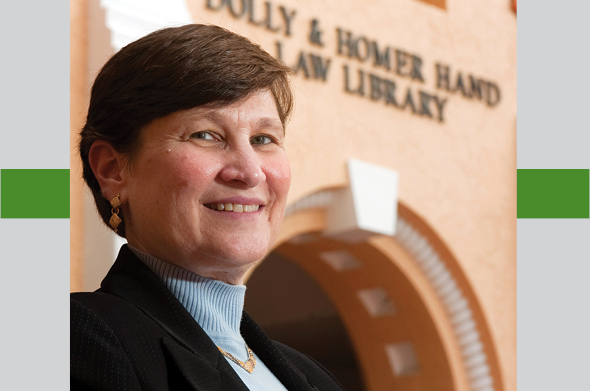
Law Professor Ellen Podgor smiles in front of the library.
Law Professor Ellen Podgor, an expert in white collar crime

For her 25 years of service to its mission of clarifying, simplifying, and modernizing common law, the American Law Institute has given prestigious Life Member status to Stetson Law Professor Ellen Podgor.

Podgor, a nationally recognized criminal law scholar whose award-winning work focuses on white collar crime, was nominated to ALI and elected to the group in 1997. While several other Stetson Law faculty members are members, she is the only current faculty member to have a Life Membership.

Exclusive group, invaluable work

Currently on the eve of its centennial, the institute has been dedicated to the mission of making the law clearer, more consistent, and reflective of modern society since its founding in 1923. Its work entails drafting, discussing, refining, and publishing “Restatements of the Law, Model Codes, and Principles of Law that are enormously influential in the courts and legislatures, as well as in legal scholarship and education,” according to the organization’s website.

The ALI consists of law professors, lawyers, and judges who have earned significant achievements in their field and have shown interest in making the legal system better serve the people. Prospective members are nominated by current members, and the recommendation must be backed by at least two other members.

Rethinking the penal code

Since joining ALI, Podgor has been a member of six of the organization’s consultative projects, and has been an active member of the Model Penal Code Sentencing Project. The effort aims to examine the sentencing guidelines of the ALI’s existing Model Penal Code “in light of the many changes in sentencing philosophy and practice that have taken place” since the code was developed more than half a century ago.

Several years ago, she was also co-author, along with Rutgers Law Professor Roger Clark, of the Motion to Oppose the Death Penalty. Although the membership did not vote to oppose the death penalty, they did, two years later, remove the death penalty provisions from the Model Penal Code.

“Law reform work can often feel tedious as one works line-by-line through proposed statutory language,” Podgor said. “It is enormously rewarding, however, to look back over the past 25 years of being a part of the ALI’s important work and see all that has been accomplished to advance our legal process. But it is also important to recognize that there is so much more work yet to be done.”

Stetson Law’s ALI legacy

A popular professor who has authored numerous books and articles on white collar crime and other aspects of criminal law, has been quoted on major cases in national media outlets, and launched Stetson’s Law’s Business Law Review Symposium, Podgor was named the college’s Gary R. Trombley Family White-Collar Crime Research Professor in 2011. She is editor of the highly regarded White Collar Crime Law Prof Blog.

Those who have worked with her over the years say her ALI Life Member status is fitting.

“Achieving Life Member status is a well-deserved recognition Professor Podgor has received for her dedication to law reform and justice,” said Stetson Law Interim Dean Theresa Pulley Radwan, who is also an ALI member. “She elevates everything in which she is involved, and we are incredibly fortunate that she is a member of the Stetson Law community.”

The other Stetson Law faculty members belonging to the ALI are professors Kristen Adams, Rebecca Morgan, Luz Nagle, and Candace Zierdt, as well as Liz Moody, emeritus professor, who is also a Life Member.


Students Help on Amici Brief in SCOTUS Clean Water Case

Sackett v. Environmental Protection Agency could determine the extent of Clean Water Act protections across the U.S.

With help from faculty, Stetson Law students contributed significantly to an amici brief filed by Professor Royal Gardner, director of the college’s Institute for Biodiversity Law and Policy filed on behalf of twelve scientific organizations in a case that could prove critical in the fate of the Clean Water Act.

What the case is about

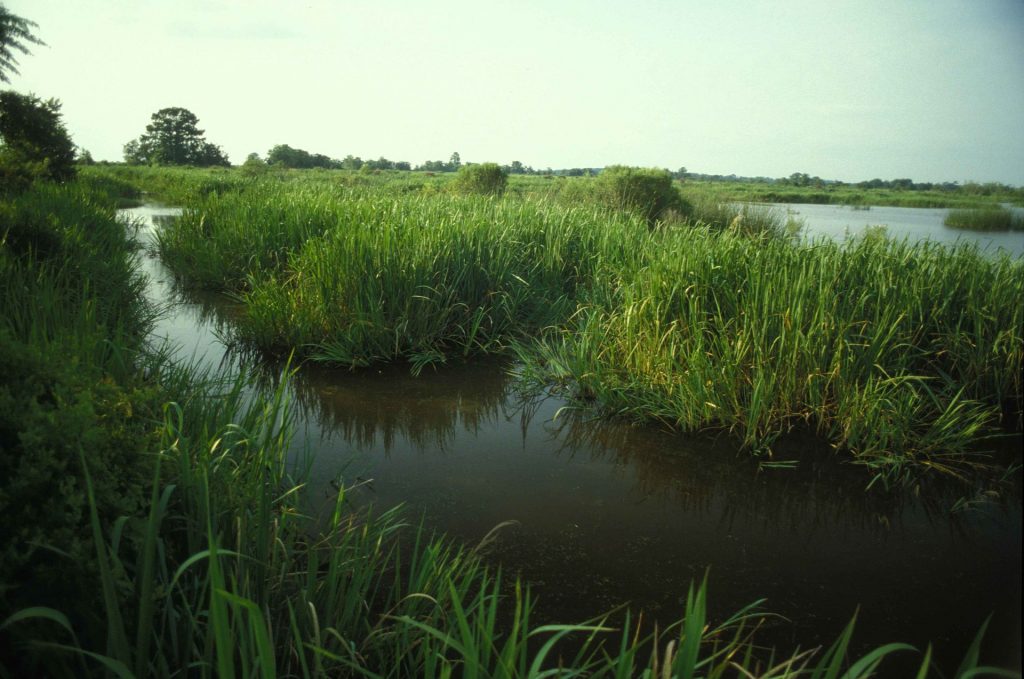
The case, Sackett v. Environmental Protection Agency, may change which waters are defined under the Clean Water Act. Expected to be the first the U.S. Supreme Court hears when its new term starts in October, it is the culmination of a lawsuit stemming from an Idaho couple’s attempt to construct a home on a wetland that the EPA considered to be “water of the United States” (WOTUS). For over a decade, litigation ensued, with environmental groups advocating for maintaining the current standard.

If decided in favor of the petitioners, the ruling could undo protections for millions of acres of wetlands directly connected to lakes, rivers, and other ecosystems.

Behind the brief

Amici curiae (“friends of the court”) briefs have been filed both for and against the Sacketts. Stetson Law faculty and students researched and wrote the brief on behalf of 12 scientific organizations that support stronger protections for waters of the United States (WOTUS).

These scientific organizations are the American Fisheries Society, American Institute of Biological Sciences, Association for the Sciences of Limnology and Oceanography, Coastal and Estuarine Research Federation, Ecological Society of America, Freshwater Mollusk Conservation Society, International Association for Great Lakes Research, North American Lake Management Society, Phycological Society of America, Society for Ecological Restoration, Society for Freshwater Science, and Society of Wetland Scientists.

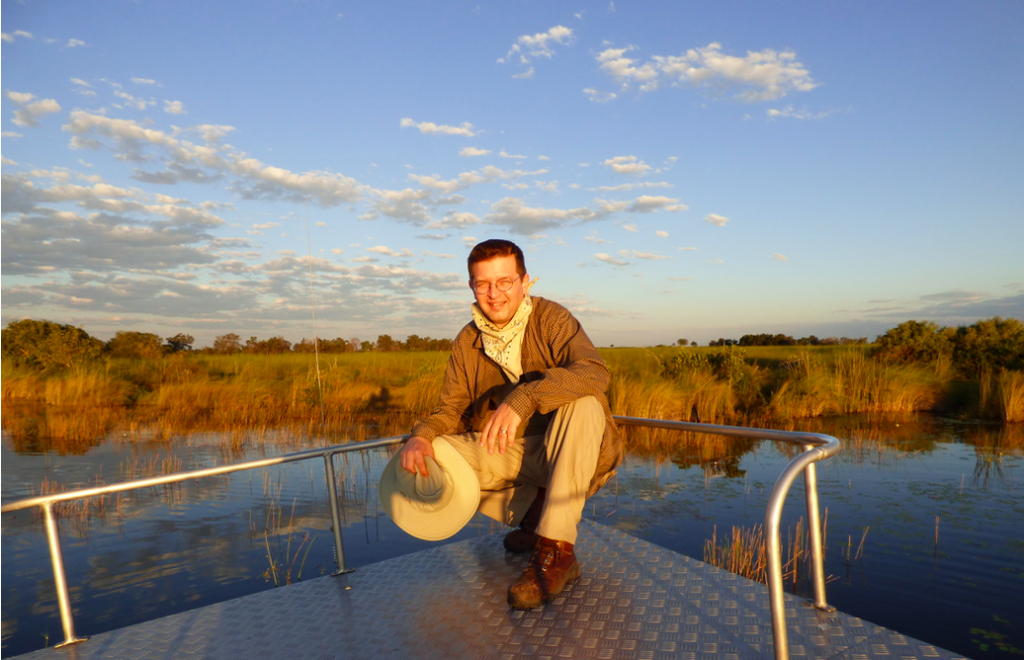
Stetson's biodiversity institute director Royal Gardner visited the Okavango Delta, Botswana in May.
Professor Royal Gardner, director of Stetson Law’s Institute for Biodiversity Law & Policy.

The brief asserts that science needs to inform the approach to determining whether wetlands should be protected, and the science shows that wetlands, even when one cannot see them connected to other waterways from the surface, support the integrity of other bodies of water.

“If Petitioners’ proposed ‘continuous surface-water connection’ to a traditional navigable water were required for wetlands, more than 50% percent of wetlands in some watersheds would no longer be protected by the Clean Water Act. Were such a standard applied to streams, ephemeral and intermittent streams would not be jurisdictional waters, and thus more than 90% percent of stream length in some watersheds would no longer be protected by the Clean Water Act,” the brief summary reads.

A valuable experience

To the Stetson Law students who participated, it was a chance to use their budding advocacy skills in an area they are passionate about.

“Though work on the brief was challenging, each of us who participated understood the importance of our efforts and the high stakes riding on the case,” said student William McCann, who assisted with the document’s citations.

Recent Stetson Law graduate Lauren Beames said she knew it would be an exciting, collaborative experience. Between sessions studying for the Florida bar exam, she saw Professor Gardner, who gave her a printed copy of the brief after it had officially been accepted.

“Seeing the time I spent sifting through copious amounts of scientific research and legal authority constructed into strong, sound legal arguments in an amicus brief that will go before the United States Supreme Court is an experience, I am extremely proud to have been a part of,” Beames said.

Student Cal Raubolt, who worked on the brief’s citations, said what struck him was how so many people came together to make it come about – something that is not always apparent when one reads a Supreme Court decision and its pertinent documents.

“In reality, there are dozens of hands that put in so much hard work for it to ever get to that point,” he said. “It is beautiful to be able to say that my hands were a part of that hard work, however small a part it was.”

Second-year law student Tyler Vansant, who assisted in research for the brief, said the experience gave him an even closer glimpse of the intricacies of environmental policy.

“Working on this brief was an invaluable way to learn more about the very complex science of wetlands (and WOTUS in general) and gave me a much deeper understanding of the challenges that the EPA and other agencies face in creating rules and policy in this area,” he said.

Brooke M. Cleary, who helped proofread the document, said the project was a critical exercise in legal writing that showcased Stetson Law’s culture of collaboration.

“This unique experience enhanced my writing competencies and furthered my passion for environmental law, specifically waters of the United States,” Cleary said. “I’m so thankful Professor Gardner provided this opportunity to assist with his presentation to the Supreme Court.”

The students were part of a legal team that included Katherine Pratt, Stetson’s Foreman Biodiversity Fellow, Prof. Erin Okuno of the University of Miami, Prof. Steph Tai of the University of Wisconsin, and Kathleen Gardner of Shearman & Sterling LLP, a global law firm that supports the Biodiversity Institute on a pro bono basis.

The brief is not the first Stetson Law project to play a role in a SCOTUS clean water case. In 2018, the college filed an amici curiae in County of Maui v. Hawaii Wildlife Fund et al. The following year, the Court cited the brief in its decision in favor of stronger protection of water resources.

Legal Scholar with Stetson Ties Writes About Justice in Wartime Ukraine

A Ukrainian flag flies in front of a courthouse in Berdyansk, Ukraine.
The courthouse in the author’s hometown of Berdyansk, Ukraine. The facility is currently closed, as the city is under Russian occupation.

Dmitriy Kamensky first came to Stetson Law as a Fulbright Visiting Scholar in 2015 interested in studying white collar crime. The Ukraine native ultimately published an article in the Stetson Law Review in 2016 and another in the Mississippi College Law Journal.

He returned to campus as a visiting professor in 2017 and 2019 and taught an introductory course in comparative criminal law that examined the similarities and differences between criminal law in the U.S. and European countries, namely Ukraine and Germany.

Currently in an undisclosed location, Kamensky has seen the extensive toll of Russia’s invasion of Ukraine close up. He recently wrote about the impact it’s having on day-to-day functioning of the justice system in Ukraine for the latest edition of Los Angeles Lawyer.

His article, titled “Ukraine’s Court System Operating Despite Bombardment,” looks at the resilience Ukraine’s justice system has shown amid the violence: “the country’s judicial system,” Kamensky writes in the article’s opening paragraph, “is still functioning, albeit in emergency mode.”

The courts’ ability to do so varies by region.

In communities experiencing heavier violence, appellate and local courts have completely ceased to function.

At the time of his writing, he notes, about one fifth of the country’s appellate and local courts are not currently functioning, and dozens of Ukraine’s 777 courthouses have been badly damaged, if not destroyed. Kamensky even shared a photo of extensive damage to his own office that resulted from shelling.

Judges and courthouse staff in these areas have been relocated to other areas and carry out their work remotely.

One major challenge, Kamensky writes, is the handling of incarcerated individuals and those in custody awaiting legal proceedings – but many of the tools that helped keep the justice system moving during the height of the Covid-19 pandemic are proving useful in these circumstances.

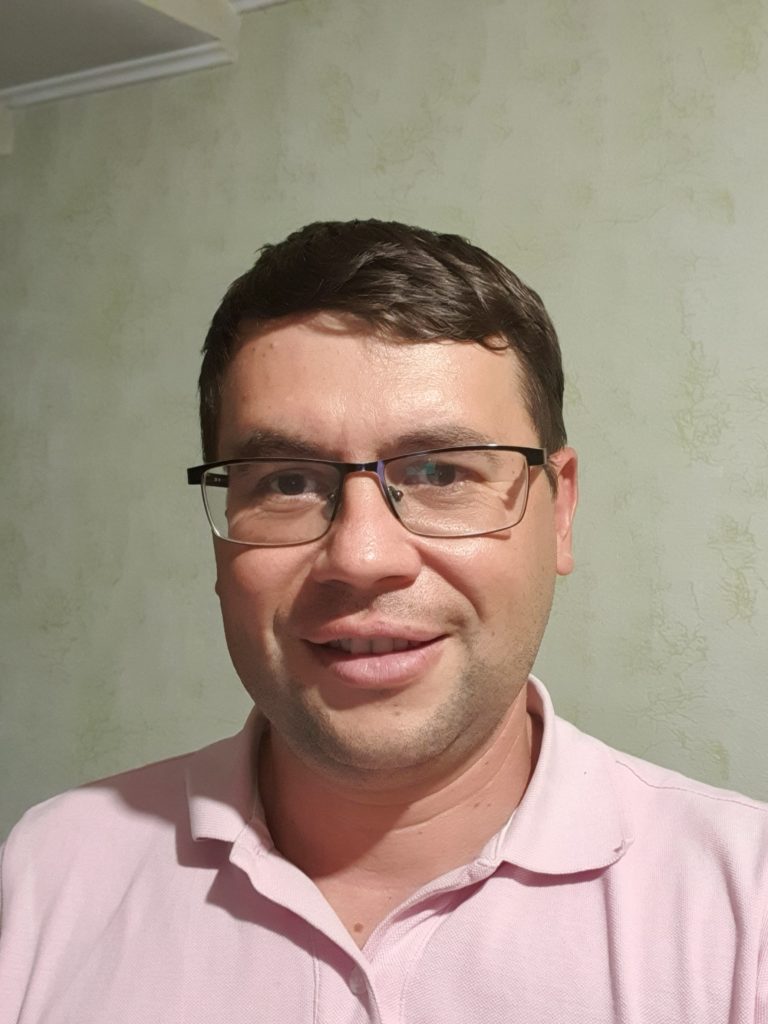
A headshot of Ukrainian legal scholar Dmitriy Kamensky.
Ukraine native Dmitriy Kamensky was a Fulbright vising scholar at Stetson Law in 2015 before returning to teach in 2017.

“Such challenges in the temporarily controlled jurisdictions are met with the use of digital tools, e.g., court video- and audio-conference systems, electronic document filing, and e-signing within the new nationwide E-Court system (a web-based platform for the convenience of case parties and court members),” Kamensky writes.

Even as they operate under duress, he notes, judges are donating half their salaries to Ukraine’s defense efforts, and those working within the country’s justice system remain committed to carrying out their important work.

“Even in the face of hostilities, stress, and mounting pressures, the national courts are going beyond their limits to deliver justice to those who deserve it – ordinary Ukrainian citizens on the ground in this conflict,” he writes.

Kamensky’s work was accompanied by a piece written by Ukrainian Supreme Court Justice Mykola Mazur on the current state of the country’s Supreme Court operations.

The original article appears in the June 2022 edition of Los Angeles Lawyer, a publication by the Los Angeles County Bar Association. Read the full article here.

Moot Team Achieves a “Double-Double” at Orseck

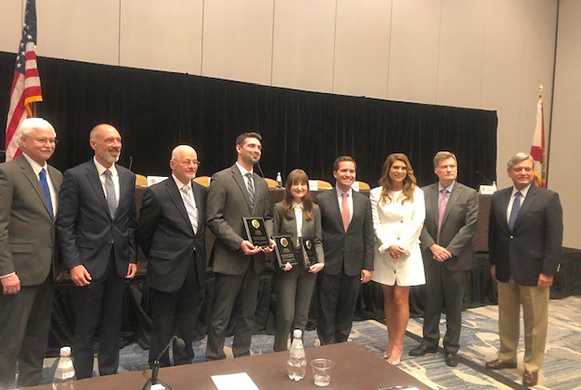
A group of students and Florida Supreme Court Justices line up for a photo.
Left to right: Justice Ricky Polston, Justice Alan Lawson, Chief Justice Charles T. Canady, Tyler Brown, Hannah Klonowski, Justice John D. Couriel, Justice Jamie R. Grosshans, Justice Carlos G. Muñiz, and Justice Jorge Labargo.

For the second year in a row, a Stetson Law team won the Robert Orseck Memorial Moot Court Competition at The Florida Bar annual conference in Orlando.

Team members Tyler Brown, Thomas Fuhrman, and Hannah Klonowski brought home the win from this prestigious competition—but the triumph doesn’t end with that back-to-back win. Klonowski won the Best Oralist, Preliminary Rounds award and the Best Oralist, Final Round award, repeating fellow student Jessica Merkel’s wins during the 2021 event. Professor Brooke Bowman, Director of the Moot Court Board, coached the students.

The overall competition win and the pair of Best Oralist awards make for a “double-double” at an important event that took place in-person for the first time in three years.

Hosted by the Florida Bar Association’s Young Lawyers Division, the competition happens each year as part of The Florida Bar conference. The proximity to so many legal professionals means that actual sitting judges from the circuit courts and the district courts of appeal join with attorneys to judge the preliminary rounds. Teams that advance to the final round get to argue in front of the justices of the Florida Supreme Court—something very few attorneys even have the honor of doing.

It’s an opportunity for students to make connections while sharpening their craft with help from some of Florida’s top lawyers.

Stetson Law’s track record at Orseck has been stellar. Here’s a look at the wins and other successes the college has had in the last 28 years:

  • Seven championship wins;
  • Nineteen appearances in the final round;
  • Six Best Advocate, Final Round awards;
  • Five Best Advocate, Preliminary Rounds awards;
  • Nine Best Brief awards;
  • Two double advocate awards;
  • Two times winning three awards—Best Team; Best Brief; and the Best Oralist, Final Round; and
  • One time winning all four awards—Best Team; Best Brief; Best Oralist, Preliminary Rounds; and Best Oralist, Final Round.

Learn more about Stetson Law’s Moot Court Board.

Stetson Law’s Lambda Chapter Hoists Flags for Pride 2022

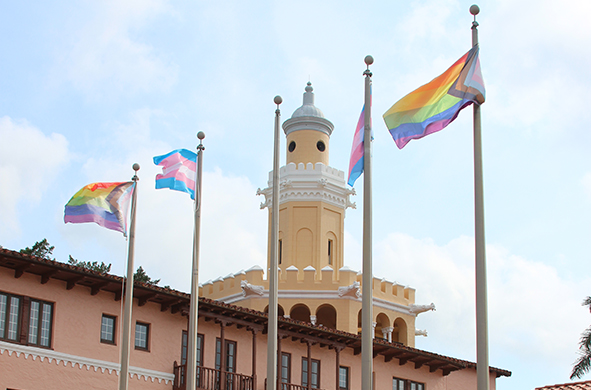
The Progress Pride and Trans Pride flags will fly over the Stetson Law campus
The Progress Pride and Trans Pride flags will fly over Stetson Law’s Gulfport campus through June 30.

Ahead of a busy weekend full of Pride festivities in St. Petersburg, Stetson’s chapter of Lambda Legal Society, a student organization for LGBTQ+ students, raised two Progress Pride flags and two Trans Pride flags on a poles in the Sebring Horseshoe Courtyard. The event took place Friday afternoon with members of campus leadership and staff gathered to celebrate with students.

It’s the second year the flag has flown on Stetson Law’s grounds. Lambda Legal Society officials say the flag signifies the LGBTQ+ community’s enduring legacy in the community and beyond.  

“Raising the Pride flag for the final days of Pride Month is a personal reminder that our community will keep rising even when the glitter and beads are swept up,” said Lei-Lani Rogers, president of Lambda. “The Pride we infuse in our actions and our identities is more than just a month. It’s who we are, and I’m always overjoyed when we can share that with others.”

Lambda Legal’s campus activities throughout the year have also included extensive participation in Diversity Week events earlier in the year, tabling on campus, distributing pronoun pins to help normalize the use of preferred pronouns, and participating in local Pride events. On Sunday, June 26, Lambda Legal members will have an outreach booth at St. Pete Pride’s street party event in the city’s Grand Central District.

Just like these efforts, flying Pride flags in such a prominent place on campus signifies the College of Law’s commitment to diversity and inclusion, particularly through advocacy.

“We are here as passionate advocates of justice for all in support of Lambda Legal Society,” said Stetson Law Interim Dean Theresa Pulley Radwan. “We celebrate the LGBTQ community today and every day.”

The flag also sends a signal that to members of the LGBTQ community who might be considering a career in law that there is a place for them at Stetson Law.

“Raising the flag is on campus is a message to any aspiring law student that our community is alive and thriving in the legal sphere,” Rogers said. “Even more important, our foundation, our school, is standing with us.”

The Progress Pride flag will be on display through June 30.

Learn more about Lambda Legal Society.

Stetson Law Alums Honored at ’22 Florida Bar Convention

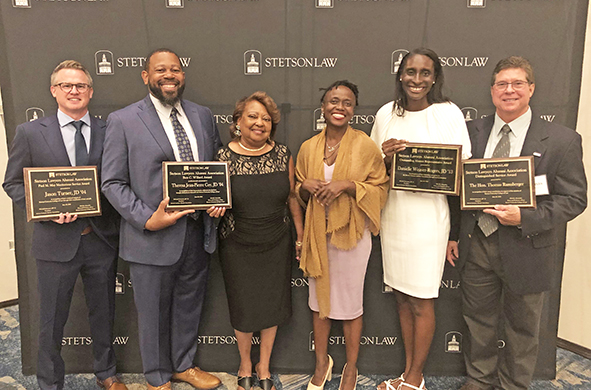
Six people pose and hold their awards in front of a Stetson Law backdrop.
The 2022 Stetson Lawyers Alumni Association award winners pose with Dean Michèle Alexandre at the June 23 awards reception in Orlando.

Amid the buzz of the Florida Bar Association’s annual convention in Orlando, the Stetson Lawyers Alumni Association (SLAA) honored five Stetson Law community members with prestigious awards recognizing their selfless service. Given out during a reception Thursday, June 23, the awards highlighted the diverse ways these alumni and friends have helped Stetson Law flourish as an institution.

The first in-person SLAA awards ceremony since the Covid-19 pandemic began, it was a chance to reconnect with friends and colleagues from the Stetson Law community.

“After a multi-year hiatus, it is refreshing to gather together as a community here at the Bar Convention,” said Stetson Law Dean Michèle Alexandre. “I am overjoyed to see so many familiar faces in the crowd tonight – many of whom I have not seen in-person for quite some time.”

After the dean updated attendees on recent developments at the College of Law, including the construction of the new Advocacy Institute, SLAA president Mitch Schermer took to the podium, where he handed out five awards to individuals who, through their deeds and actions, personify what it means to be a Stetson Lawyer.

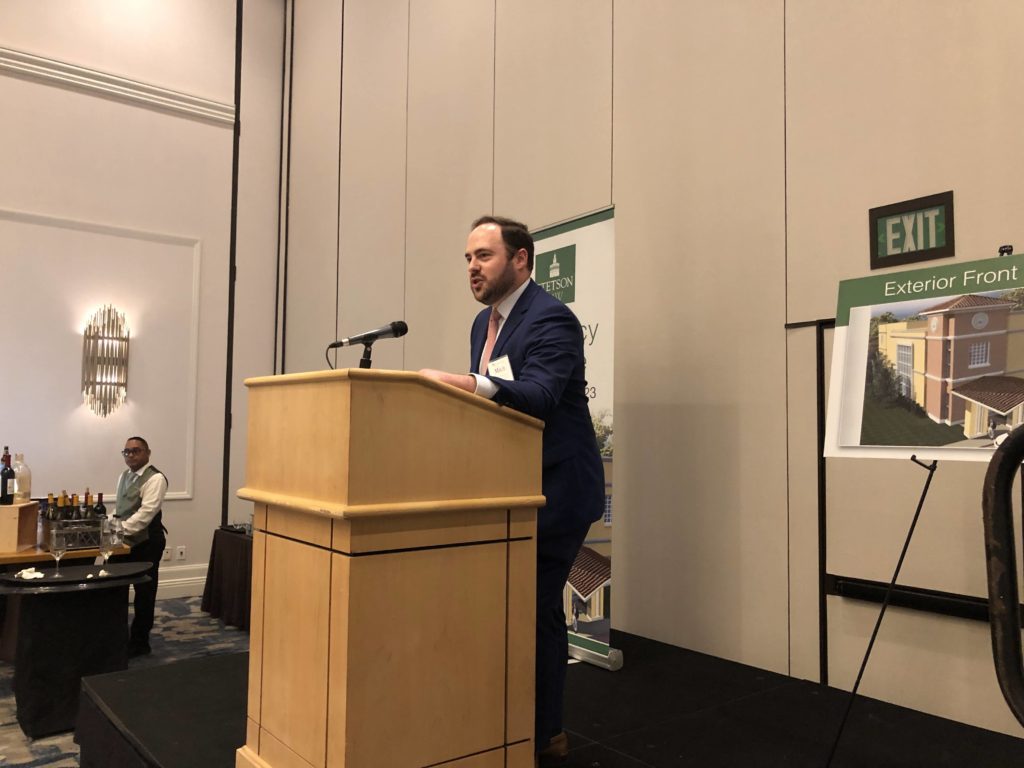
Stetson Lawyers Alumni Association President Mitchell Schermer stands at a podium during the  2022SLAA awards ceremony.
Stetson Lawyers Alumni Association President Mitchell Schermer announces the 2022 SLAA award winners.

The awards were: Outstanding Alumni Representative, Distinguished Service, Distinguished Alumnus, the Paul M. May Meritorious Service Award, and the Ben C. Willard Award.

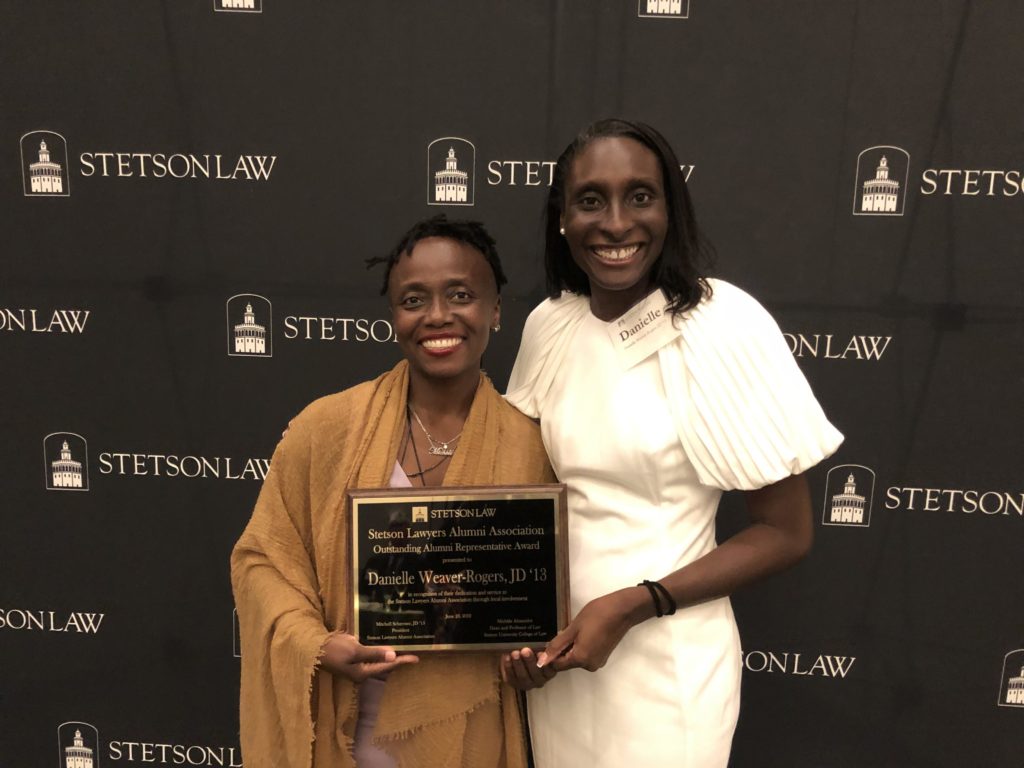
Outstanding Alumni Representative Award: Danielle Wever-Rogers ’13

Dean Michele Alexandre and Danielle Wever-Rogers pose with a plaque awarded to Wever-Rogers.
Alumna Danielle Wever-Rogers was honored with SLAA’s 2022 Outstanding Alumni Representative Award.

Every year, this award is given to someone whose involvement with SLAA through local activities goes above and beyond. Wever-Rogers, a 2013 Stetson Law Graduate, is a member of the College’s SLAA Advisory Council and worked closely with the Black Law Students Association (BLSA) to help plan and raise money for their Spring Gala. She is an assistant city attorney with the City of St. Petersburg and is also an adjunct professor at Stetson Law.

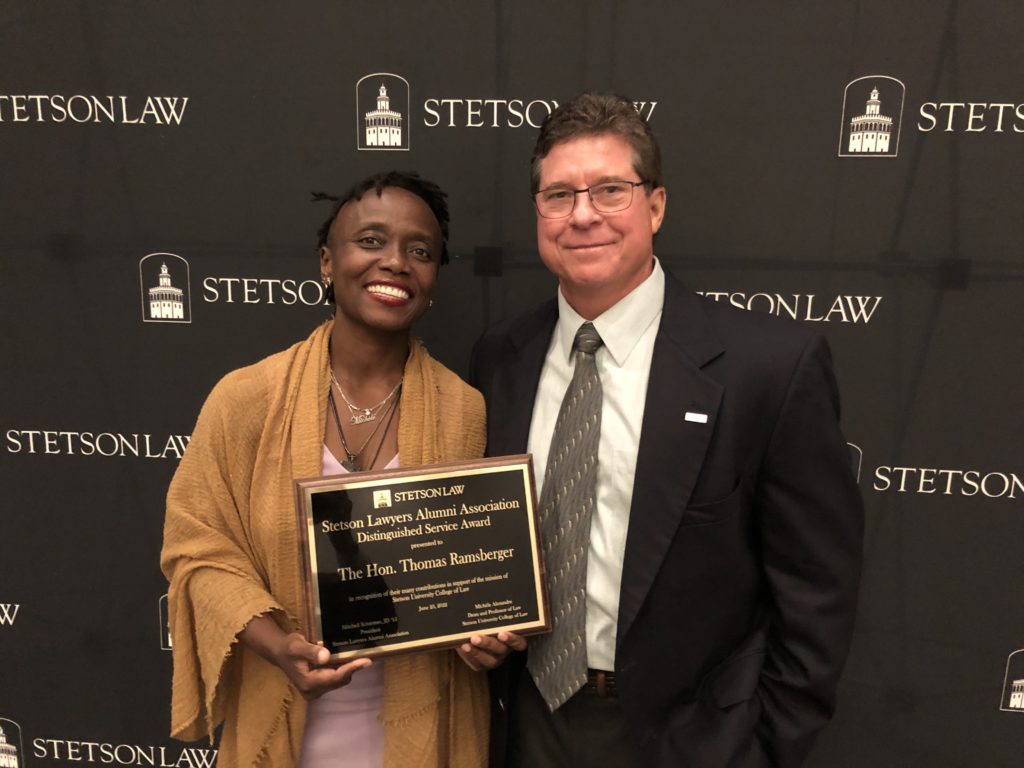
Distinguished Service Award: The Honorable Thomas Ramsberger

Dean Michele Alexandre and The Hon. Thomas Ramsberger pose with a plaque honoring Ramsberger's service.
The Hon. Thomas Ramsberger was given SLAA’s Distinguished Service Award in 2022.

This award is reserved for non-alumni whose contributions to Stetson Law have been significant, meritorious, and continuing. As a beloved adjunct professor with over 20 years of dedicated service to the college of law, The Hon. Thomas Ramsberger has impacted hundreds, if not thousands, of alumni.

Distinguished Alumnus: Christopher Dougherty ’85

Recognizing alumni who have brought honor to themselves and the College of Law through outstanding service in their chosen profession, this award was given to Dougherty for his extensive legal career and military service. Dougherty is Chairman Emeritus at Marshall Dennehey Warner Coleman & Goggin, where he practiced for more than 31 years. He also served 26 years of active and reserve service as a Marine colonel, having served as a General Courts-Martial certified Military Judge. Currently, he serves as a member of the Veterans Law Institute Advisory Board and has endowed the Colonel William R. Eleazer USMC and Brigadier General James P. King USMC Veterans Scholarship to help veterans who attend Stetson Law.

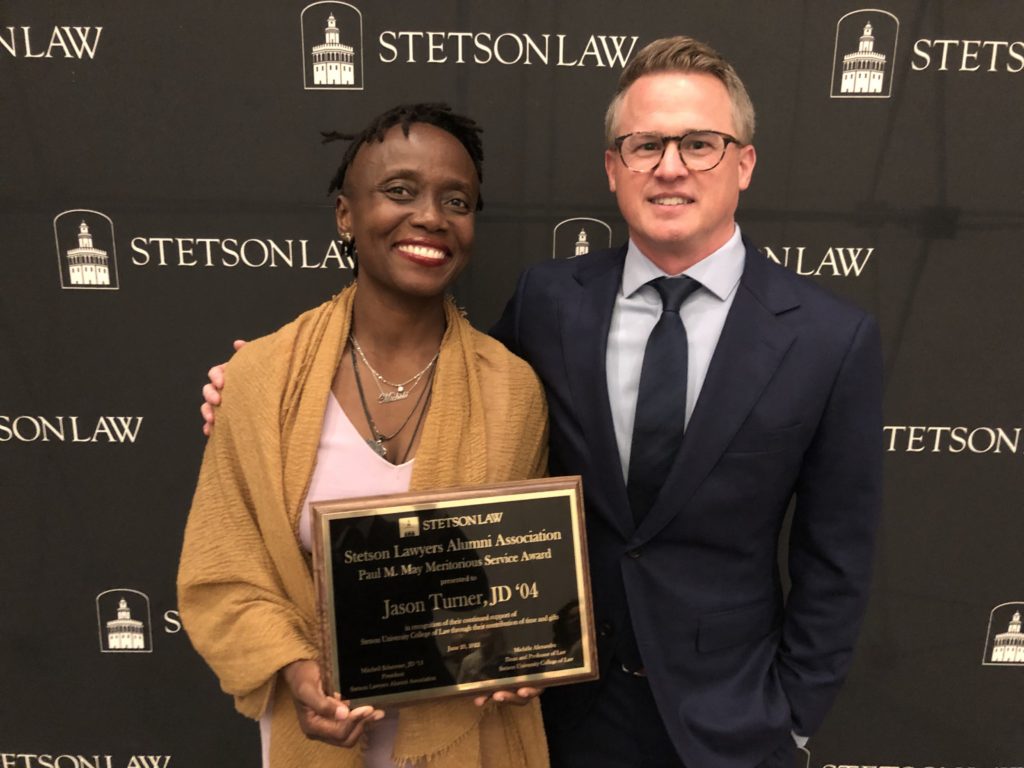
The Paul M. May Meritorious Service Award: Jason Turner ’04

Dean Michele Alexandre and alumnus Jason Turner pose with Turner's award plaque.
Stetson Law alumnus Jason Turner accepts the Paul M. May Meritorious Award at the 2022 SLAA awards.

Named for 2021 Stetson Law Hall of Fame Inductee Paul Marshall May, known for his extraordinary efforts to evolve SLAA into the robust group it is today, this award recognizes alumni who have offered sustained support of Stetson Law through contribution of both time and gifts. Honoree Jason Turner is a Partner with Keller, Turner, Andrews & Ghanem in Nashville, Tennessee, where he practices entertainment and sports law. He is a member of the Stetson Law Board of Overseers, serving as Secretary of the Board and Chair of the Finance Committee. He has been extremely generous in his financial support of Stetson Law, where he endowed the LeRoy Y. Hooks Elder Law Scholarship and provided a significant matching gift to support the 2022 spring giving campaign.

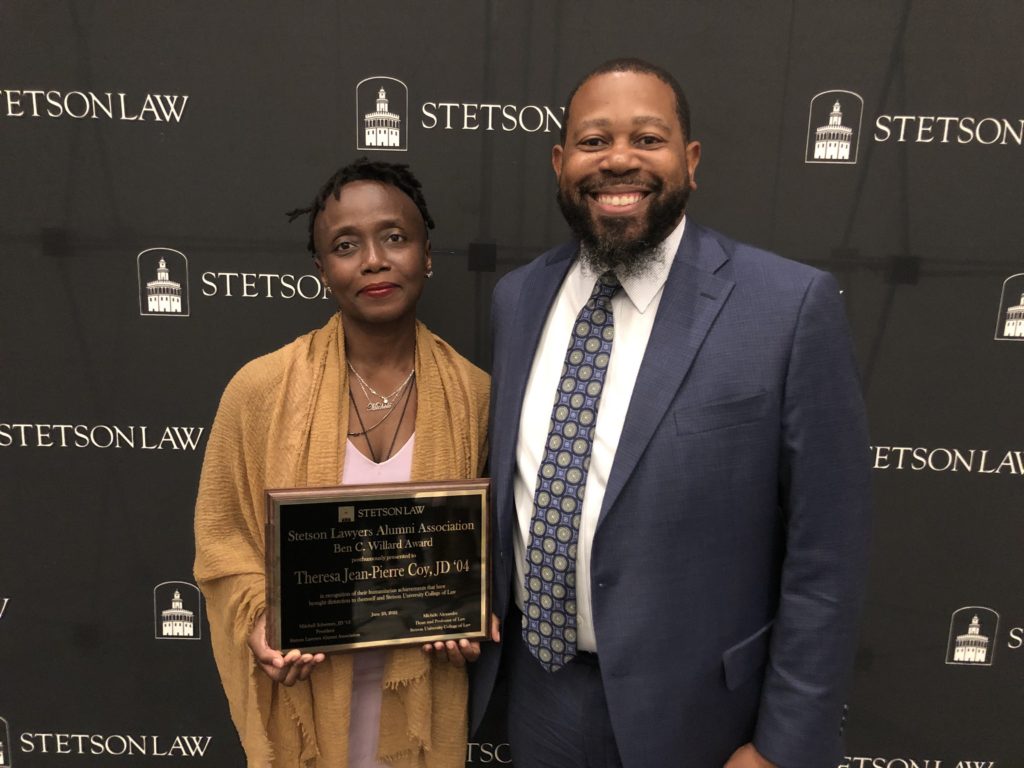
The Ben C. Willard Award: Theresa Jean-Pierre Coy ’04 (posthumous)

Dean Michele Alexandre poses with alumnus Travis Coy before handing him a plaque.
Stetson Law alumnus Travis Coy accepted the Ben C. Willard Award on behalf of his late wife, Theresa Jean-Pierre Coy.

Stetson Law alum Ben C. Willard graduated in 1914 ahead of his dedicated career in service to his state and nation. This year, the award posthumously honors an alumna whose passion for and commitment to the Stetson Law community had an immeasurable impact – especially for the Black female students she inspired.

Jean-Pierre Coy was a powerful, prominent force within the Tampa Bay area’s legal community, but she was never too busy to return to campus to help students either as an adjunct professor or as a mentor.

“Theresa was an amazing person: A wife, mother, lawyer, professor, friend, community leader, and staunch advocate for justice,” Schermer said. “We lost a titan far too early.” Her husband, Travis Coy, also a Stetson Law alum, accepted the award on her behalf.

Stetson Law Joins International Sea Turtle Agreement

The American Convention for the Protection and Conservation of Sea Turtles’ Conference of Parties met in Panama in June.

Stepping up its efforts to help protect vulnerable sea turtle populations in the Western Hemisphere, Stetson Law’s Institute for Biodiversity Law and Policy officially entered into an agreement with the Inter-American Convention for the Protection and Conservation of Sea Turtles (IAC) on June 17.

The agreement, a memorandum of cooperation between the two entities, was approved during a meeting of the IAC’s Conference of Parties in Panama.

Though unprecedented, the agreement does not mark the first time Stetson Law has collaborated with the IAC.

Through the Biodiversity Institute, Stetson Law has long supported the IAC. The college hosted events for IAC committees in 2011 and again in 2019. Stetson Law students also compiled a digital archive of all IAC parties’ laws and regulations relevant to sea turtles, which is now available on the IAC’s website.

The new agreement steps up that support with the addition of consultation on issues that need legal insight, assisting with research, and hosting more IAC meetings and conferences.

A sea turtle is swimming through bright blue water over white sand.
A sea turtle gliding over the white sand of the Caribbean Sea.

It’s a mutually beneficial relationship: the Stetson Law community will lend its expertise in a manner that helps further the IAC’s mission while giving students the opportunity to see firsthand how environmental agreements work.

“It is one thing to read about an environmental treaty in book, but it’s a completely different matter for the students to see it in practice,” said Law Professor Royal Gardner, director of the Institute for Biodiversity Law and Policy. “Our collaboration with the IAC provides students the opportunity to better understand how countries—and individuals—work together to protect sea turtles.”

A collaborative effort among coastal and island nations in the Western Hemisphere, the convention develops and implements “harmonious measures between nations, multilateral coordination of conservation and protection actions, and oversight of the implementation of a regional agenda,” according to the IAC website. It offers a legal framework for member countries to take action to help sea turtle populations recover and grow, including protections for critical habitats like nesting beaches using the best data available and taking environmental, socioeconomic, and cultural factors into consideration.

The member countries are Argentina, Belize, Brazil, Chile, Costa Rica, Dominican Republic, Ecuador, Guatemala, Honduras, Mexico, The Caribbean Netherlands, Panama, Peru, the U.S., Uruguay, and Venezuela.

The agreement is the Biodiversity Institute’s second Memorandum of Cooperation with an international environmental secretariat. The other is with the Ramsar Convention, an international treaty on sustainable use of wetlands. As part of this agreement, the Stetson community contributed significantly to the development of the first Global Wetland Outlook in 2018, a report on the state of the world’s wetlands, which is the Ramsar Convention’s flagship publication.

Learn more about the Institute for Biodiversity Law and Policy.

EATS 2022: A Sharp Focus on Advocacy

A room full of conference attendees watches a presentation on competition ethics in Stetson Law's Great Hall
The 2022 edition of EATS was full of compelling discussions among passionate advocacy educators.

In-person for the first time since 2019, Stetson Law welcomed professionals from around the country who specialize in advocacy education to the annual Educating Advocacy Teachers (EATS) Conference on its beautiful Gulfport campus.

Taking place from June 13-15, the event offered eye-opening insights into the state of trial advocacy education in 2022 through panel discussions, workshops, breakout sessions, and even beach happy hours and improv sessions. Some 95 attendees participated; 70 of them attended in person, and 20-25 took part online.

“As advocacy experts, you are leading legal education. It’s not just about experiential learning. It’s not just about competition,” said Stetson Law Dean Michèle Alexandre at the start of a panel discussion on the art and science of persuasion. “You are helping us learn how to teach our students, how to prepare them for 21st Century real-life problem-solving. And because of that, this conference and your partnership is even more important to us.”

Three days of compelling discussions

Taking place in the Great Hall and the Florin-Roebig Courtroom, EATS events explored many dimensions of advocacy in the classroom and the competition arena. Hailing from communities across the U.S., speakers included judges, professors from top-ranked law schools for advocacy (including Stetson Law), mock trial and moot court program directors, and practicing attorneys who shared teaching techniques and experiences and explored new teaching methods, models, and technology.

“The 2022 EATS Conference was packed with creative, generous educators interested in elevating the entire advocacy community, not just themselves,” said Stetson Law Professor Elizabeth Boals, Director of the Center for Excellence in Advocacy. “This type of collaborative and collegial environment is what EATS was founded upon and will continue to foster in the future.”

One discussion explored a possible connection between the discipline and bar examination passage. Another was a hands-on demonstration of new presentation technology. Other topics included:

  • Improv as a teaching tool
  • Competition ethics
  • Creating advanced advocacy and specialized courses
  • Avoiding competition-related drama

On Wednesday, June 15, a lunchtime ceremony honored the winner of Stetson Law’s Annual Advocacy Writing Competition, Vania M. Smith, author of the article “Advocacy Competitions or Courtroom Cosplay? The Case for Rejecting Theatrics and Rewarding Authenticity at Law School Mock Trials.” The Catholic University of America School of Law alumna’s work will be published in an upcoming edition of the Stetson Journal of Advocacy and the Law.

The conference also celebrated the winners of the Edward D. Ohlbaum Professionalism Award (John Henry, Loyola School of Law Los Angeles), the Lifetime Achievement Award (Cary Bricker and Jay Leach, Pacific McGeorge School of Law), and the Cornerstone Award (Hon. Jim Roberts, Samford University Cumberland School of Law).

See the full EATS 2022 event schedule and speaker list.

The right time & place to talk advocacy

Under the leadership of Boals and her team, the latest edition of EATS carried on a tradition that has enhanced Stetson Law’s reputation as a top destination for advocacy for the better part of 20 years.

The event is just one reason Stetson Law’s advocacy program routinely sits at or near the top of U.S. News & World Report’s top schools for trial advocacy.

Through rigorous coaching from faculty, alumni, and others, students participating in the school’s three advocacy boards (Dispute Resolution, Moot Court, and Trial Team) regularly bring home competition trophies. Through hosting national and international competitions like the International Environmental Moot Court Competition and the National Pretrial Competition, the College of Law invites young advocates to sharpen their skills. Through offering experiential learning through clinics and externships, Stetson Law also ensures that students interested in advocacy gain the real-world skills they need to succeed as advocates.

See Stetson Law’s Advocacy At-A-Glance.

The 2022 event took place as construction of Stetson Law’s Advocacy Institute was well underway. Scheduled to open in June 2023, the facility will add an unprecedented amount of courtroom and collaboration space to help the college remain a national leader in advocacy, a discipline that is critical to the principle of justice for all.

“This is serious business,” Alexandre said. “We all came to law because we love it. We are decades deep in this game. And we are not going to stop because we know this is the most important thing we are doing for society. We are unleashing generations of folks. Young people, mature people, all types of folks come to law school now. They will be the ones securing democracy. They will be the ones who will help us figure out what in the devil we’re going to hand over when we pass on.”

Stetson Law’s Lambda Branches Out With Pride

Two people site at a table featuring memorabilia in Stetson Law's Banyan Courtyard
Lei-Lani Rogers, president of Stetson Law’s Lambda Legal Society (left), and Hunter Wolf, the group’s vice president

With the spring semester having drawn to a close, it may be quiet around campus, but Lambda Legal Society, Stetson Law’s LGBTQ+ student organization, is busy sharing its message with the community.

The group, which became a National LGBTQ+ Bar Association affiliate in 2021, will have a presence at Gulfport Pride on June 4 as well as St. Pete Pride on June 26. Members plan to table at both events. To Lambda president Lei-Lani Rogers, a 2L at Stetson Law, the community involvement is an opportunity to help promote legal protections for the LGBTQ+ community in the Tampa Bay region and beyond. Among LGBTQ and allied communities across Florida, there is concern over what they see as efforts at the state level to reverse decades of progress via legislation like the Parental Rights in Education bill, which critics refer to as the “Don’t Say Gay” law.

“Pride Month is a call to action for both the LGBTQ+ community and allies, but it’s particularly a time of visibility for our demographic,” Rogers said. “Florida is a hot spot currently for LGBTQ rights and representation and June is our time to be loud and proud when we say gay.”

Engaging Neighbors in Gulfport

Stetson Law is blocks away from downtown Gulfport, a longtime LGBTQ+ hub for locals and visitors alike. Underscoring this proximity is Lambda’s partnership with the Gulfport Public Library’s LGBTQ Resource Center for Gulfport Pride, which is currently slated to take place June 4.

The partnership made sense for Lambda due to the resource center’s far-reaching efforts. These include offering the BranchOut scholarship to LGBTQ+ students, hosting the SpeakOut series of events to talk about intersectionality, and currently, and hosting ArtOut, an exhibition consisting of 53 works from 35 artists representing 8 different countries, throughout June.

Rogers said the group’s board president, Susan Gore, is “a powerhouse” whose passion for promoting representation of the LGBTQ+ community is an inspiration.

“Seeing a direct injection of activism in Gulfport, seconds away from the school, inspires Lambda to do the same, and what better way to do so than partnering with another group?” Rogers said.

More to come from Lambda

Later this month, members of the group will table at the St. Pete Pride celebration on Saturday, June 25 to help engage the community on what Lambda does and why their work is important.

As for the rest of the summer, Rogers said Lambda is planning for a full slate of activity over the 2022-23 academic year, namely events that spark discussion among peers and the Stetson community as a whole.

In 2021-22, the organization tabled at several events on campus, where they offered pronoun pins and other items to promote a welcome environment for LGBTQ+ students and allies.

Last year, Lambda Legal Society created a new endowed scholarship for students who have shown dedication to advocating for the LGBTQ community through academic work, campus activities, or professional endeavors.

Learn more about Lambda Legal Society.

Law Professor Luz Nagle on Extradition of High-Profile Latin Americans

The Christian Science Monitor quoted Law Professor Luz Nagle in a March 4, 2022 story titled “A door of hope has opened’: A fresh start for justice in Honduras?”

A headshot of Professor Luz Nagle
Stetson Law Professor Luz Nagle

An excerpt:

“Extradition to the U.S. from Latin America was long justified by weak justice systems that couldn’t handle trials of high-profile politicians or kingpins, says Luz Estella Nagle, a law professor focused on transborder crime at Stetson University in Florida. Although there has been significant U.S. government investment in the region’s justice systems, corruption is still its Achilles’ heel. 

In 2016 and 2017 alone, the U.S. sent more than $104.56 million to Honduras in aid earmarked for justice-system and police reform, according to the latest available data from the Central America Monitor by the Washington Office on Latin America.

“Some feel that [legal] aid has been wasted. Because if we’ve invested so much money and time, … why has so little changed?” says Ms. Nagle.”

Read more here.

Construction on New Advocacy Institute Begins

Stetson officials wear hard hats in front of the construction site of the new Advocacy Institute
Stetson officials mark the start of construction of the Stetson Law Advocacy Institute.

It’s official: Stetson University College of Law is on its way to having a state-of-the-art advocacy facility.

Once it opens, it will comprise 16,000 square feet of beautifully renovated space. It will feature two new courtrooms, four new practice courtrooms, office and meeting space, a trophy and awards lobby, a new elevator, a renovated lobby entrance, and the campus bookstore. The fresh, collaborative, morale-building space will offer a one-of-a-kind educational experience for Stetson Law students.

With more courtroom and collaboration space than any other law school campus, the facility will elevate Stetson Law’s national status.

Stetson Law Dean Michele Alexandre speaks in the Great Hall.
Stetson Law Dean Michèle Alexandre

“ The Advocacy Institute will be a multifaceted space with state-of-the-art technology, showcasing Stetson Law’s tradition of training students to become comprehensive advocates. This is a space where students, faculty, staff, colleagues from other law schools, and community stakeholders will seamlessly collaborate using the latest technological tools,” said Stetson Law Dean Michèle Alexandre

A Pioneer in Advocacy Education

Stetson Law has long been an innovator in the trial advocacy space. Once seldom taught on law school campuses, advocacy skills are of utmost importance within the legal profession. They foster an impeccable command of law and policy, the ability to argue on behalf of clients at every stage of a case, and the confidence to do so effectively in challenging settings.

Stetson University President Christopher Roellke speaks at a podium in the Great Hall
Stetson University President Christopher Roellke

Recognizing the importance of these skills early on, Stetson Law was a pioneer in advocacy education and over the years has cultivated a reputation as a leader in the field through competitions, events, and stellar faculty leadership. U.S. News & World Report has ranked Stetson Law #3 in the nation for advocacy education for 2023.

“Through its decades-long commitment to advocacy as a cornerstone of an excellent legal education, the College of Law has built a remarkable regional and national reputation and the Institute will help to support and further that reputation in the future,” said Stetson University President Christopher Roellke, PhD.

Advocacy: It’s “in our DNA”

As it continues to lead the nation in advocacy education, Stetson Law strives to innovate new ways to inspire students to be the best advocates they can be. The new Advocacy Institute will greatly enhance this effort.

Stetson Law Board of Overseers Chair Greg Coleman speaks at a podium in the Great Hall.
Stetson Law Board of Overseers Chair Greg Coleman.

“At Stetson Law, advocacy is what we do – it’s in our DNA,” said Greg Coleman, Chair of Stetson Law’s Board of Overseers. “Although we are exceptionally proud of our high national ranking in Trial Advocacy and the success of our Advocacy Boards, advocacy goes far beyond just this. In fact, it extends to everything we do as lawyers. In addition to the courtroom, our alumni advocate on behalf of their clients in business matters, transactional exchanges, and fighting for the rights of the indigent and oppressed. Advocacy is simply part of being a Stetson lawyer.”

Benefitting Stetson University as a whole

Officials within the greater Stetson University community say the project is a symbol of the value the university sees in all of its students.

Stetson Board of Trustees Chair Maureen Breakiron-Evans speaks at a podium in Stetson Law's Great Hall.
Stetson Board of Trustees Chair Maureen Breakiron-Evans.

“This facility will build upon the campus’s reputation as one of the top destinations for advocacy in the country,” said Stetson University Board of Trustees Chair Maureen Breakiron-Evans. “Yet it’s not just for those with an advocacy concentration who benefit from this strategic investment. Any success at Stetson, whether at the College of Law or at DeLand, belongs to the entire Stetson community.”

Prominently located in the old Dana Library, the Institute will serve as a welcome point for students and visitors alike; officials fully expect it to become the crown jewel of this campus.

For more information about the Advocacy Institute or to learn about naming opportunities, please contact the Stetson Law Development and Alumni Relations Office at (727) 562-7818 or [email protected].