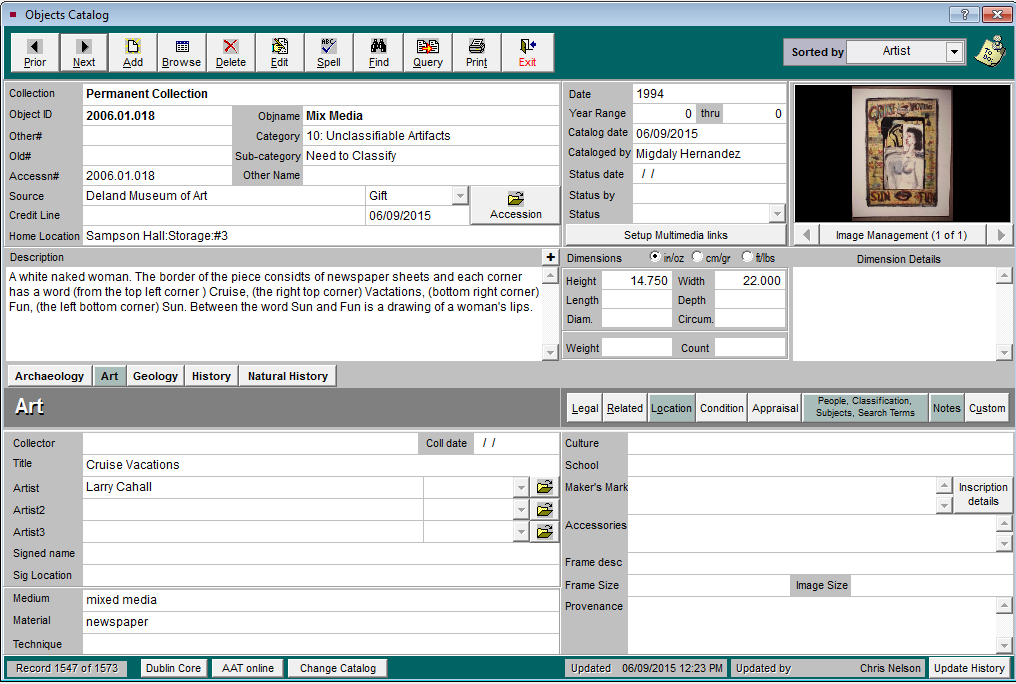
May 29th || Larry Cahall—a semi-abstract artist from Philadelphia—donated over 100 paintings he made to Stetson University between 2001-2006. One third of his paintings are displayed currently on campus. However, this collection was never inputted into the Past Perfect database so, Tonya has assigned me to add an accession number onto each piece. An accession number is like a recording number for the museum records. The first set of numbers is usually the year the artist or donor gave us the piece; however, if there are no records to when the piece was donated to the museum, then we would put the current year. The next set is just categorizing the piece into section such as XXXX.01.XXX means it is “part 1” of the collection. Finally, the last three numbers is numbering each individual piece in order from 001-999. After adding their accession numbers for most of the collection, I had to arrange and make sure each piece was stored in a proper location. Once that was over, I had to input all of the information of each individual piece in the PastPerfect program.
Important terms:
ACCESSION (1) An object, or group of objects, acquired by a museum as part of its permanent collection. (2) The act of recording/processing an addition to the permanent collection.
DEACCESSION (1) An object that has been removed permanently from a museum collection, usually through sale or exchange. (2) The process of removing an object permanently from the collection.
UNDOCUMENTED Objects: Objects in the collections that lack any useful documentation as to how they were acquired.
If you decide to accession an undocumented object into the collection, consider assigning it a number unique to FIC objects.
Numbering Undocumented or Found In Collection Objects (FIC):
Use a unique number ensures that the object can be tracked easily and that, should the object’s original accession number surface at some point, the FIC number can be retired without creating a gap in the standard accession number sequence.
For example, all FIC objects found each year will be assigned:
A larger lot number than is impossible to reach in a given year 2003.800.001-, 2004.800, 001-
A yearly number which, because of your institution’s date of founding, would be impossible to have, i.e. 1950.001.001- if your museum was founded sometime after 1950.
You can also add a flag in your collections management database that identifies the object as FIC. Whatever system you choose, make sure the number is unique, unlike any of your museum’s other numbering schemes, and be consistent.