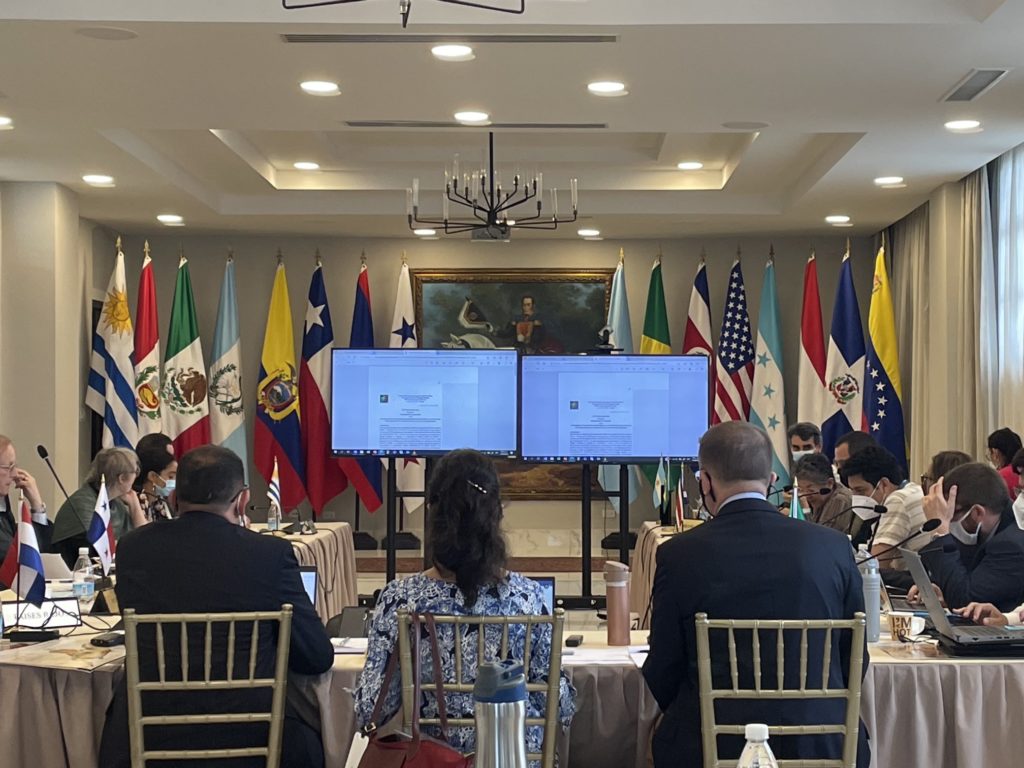
The American Convention for the Protection and Conservation of Sea Turtles’ Conference of Parties met in Panama in June.
Stepping up its efforts to help protect vulnerable sea turtle populations in the Western Hemisphere, Stetson Law’s Institute for Biodiversity Law and Policy officially entered into an agreement with the Inter-American Convention for the Protection and Conservation of Sea Turtles (IAC) on June 17.
The agreement, a memorandum of cooperation between the two entities, was approved during a meeting of the IAC’s Conference of Parties in Panama.
Though unprecedented, the agreement does not mark the first time Stetson Law has collaborated with the IAC.
Through the Biodiversity Institute, Stetson Law has long supported the IAC. The college hosted events for IAC committees in 2011 and again in 2019. Stetson Law students also compiled a digital archive of all IAC parties’ laws and regulations relevant to sea turtles, which is now available on the IAC’s website.
The new agreement steps up that support with the addition of consultation on issues that need legal insight, assisting with research, and hosting more IAC meetings and conferences.
A sea turtle gliding over the white sand of the Caribbean Sea.
It’s a mutually beneficial relationship: the Stetson Law community will lend its expertise in a manner that helps further the IAC’s mission while giving students the opportunity to see firsthand how environmental agreements work.
“It is one thing to read about an environmental treaty in book, but it’s a completely different matter for the students to see it in practice,” said Law Professor Royal Gardner, director of the Institute for Biodiversity Law and Policy. “Our collaboration with the IAC provides students the opportunity to better understand how countries—and individuals—work together to protect sea turtles.”
A collaborative effort among coastal and island nations in the Western Hemisphere, the convention develops and implements “harmonious measures between nations, multilateral coordination of conservation and protection actions, and oversight of the implementation of a regional agenda,” according to the IAC website. It offers a legal framework for member countries to take action to help sea turtle populations recover and grow, including protections for critical habitats like nesting beaches using the best data available and taking environmental, socioeconomic, and cultural factors into consideration.
The member countries are Argentina, Belize, Brazil, Chile, Costa Rica, Dominican Republic, Ecuador, Guatemala, Honduras, Mexico, The Caribbean Netherlands, Panama, Peru, the U.S., Uruguay, and Venezuela.
The agreement is the Biodiversity Institute’s second Memorandum of Cooperation with an international environmental secretariat. The other is with the Ramsar Convention, an international treaty on sustainable use of wetlands. As part of this agreement, the Stetson community contributed significantly to the development of the first Global Wetland Outlook in 2018, a report on the state of the world’s wetlands, which is the Ramsar Convention’s flagship publication.
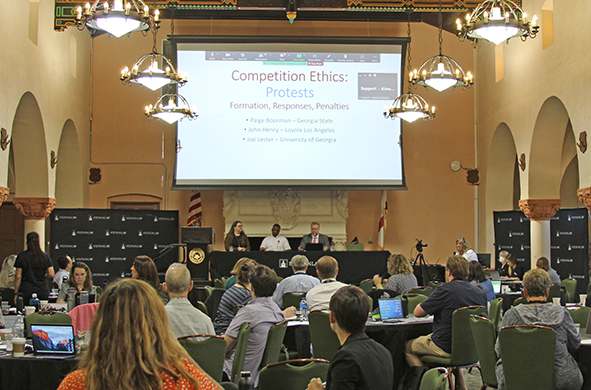
The 2022 edition of EATS was full of compelling discussions among passionate advocacy educators.
In-person for the first time since 2019, Stetson Law welcomed professionals from around the country who specialize in advocacy education to the annual Educating Advocacy Teachers (EATS) Conference on its beautiful Gulfport campus.
Taking place from June 13-15, the event offered eye-opening insights into the state of trial advocacy education in 2022 through panel discussions, workshops, breakout sessions, and even beach happy hours and improv sessions. Some 95 attendees participated; 70 of them attended in person, and 20-25 took part online.
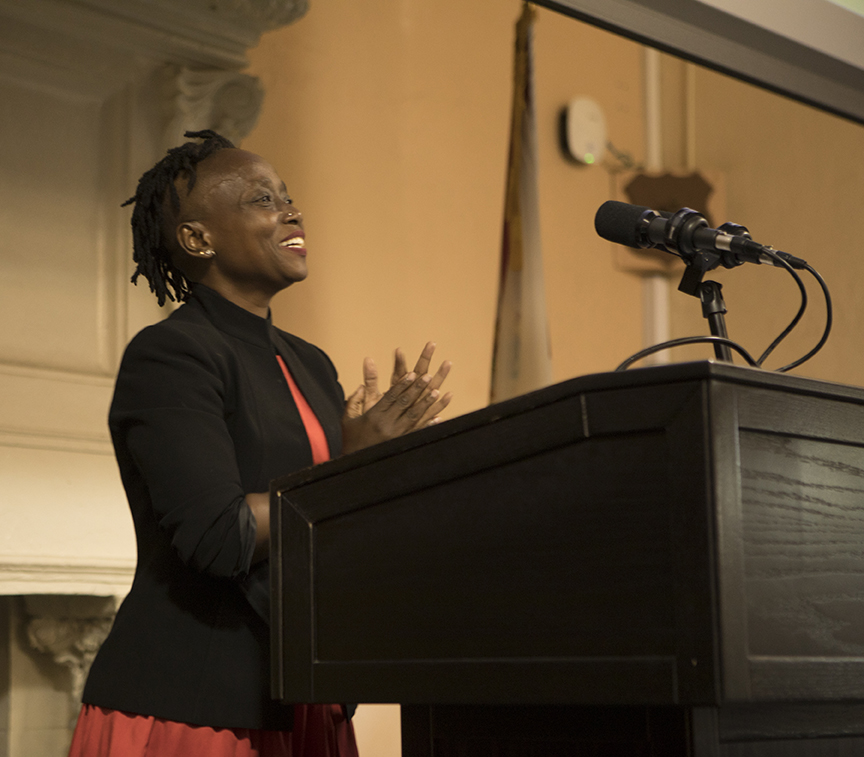
“As advocacy experts, you are leading legal education. It’s not just about experiential learning. It’s not just about competition,” said Stetson Law Dean Michèle Alexandre at the start of a panel discussion on the art and science of persuasion. “You are helping us learn how to teach our students, how to prepare them for 21st Century real-life problem-solving. And because of that, this conference and your partnership is even more important to us.”
Three days of compelling discussions
Taking place in the Great Hall and the Florin-Roebig Courtroom, EATS events explored many dimensions of advocacy in the classroom and the competition arena. Hailing from communities across the U.S., speakers included judges, professors from top-ranked law schools for advocacy (including Stetson Law), mock trial and moot court program directors, and practicing attorneys who shared teaching techniques and experiences and explored new teaching methods, models, and technology.
“The 2022 EATS Conference was packed with creative, generous educators interested in elevating the entire advocacy community, not just themselves,” said Stetson Law Professor Elizabeth Boals, Director of the Center for Excellence in Advocacy. “This type of collaborative and collegial environment is what EATS was founded upon and will continue to foster in the future.”
One discussion explored a possible connection between the discipline and bar examination passage. Another was a hands-on demonstration of new presentation technology. Other topics included:
Improv as a teaching tool
Competition ethics
Creating advanced advocacy and specialized courses
Avoiding competition-related drama
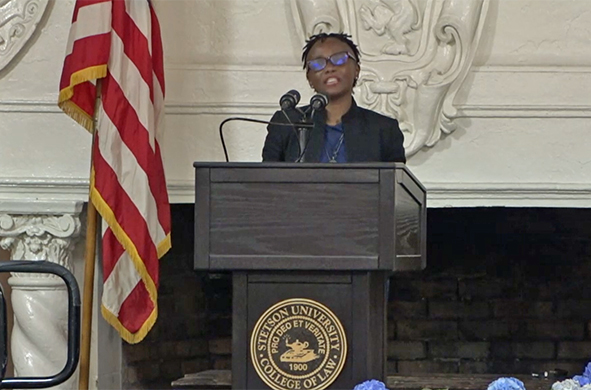
On Wednesday, June 15, a lunchtime ceremony honored the winner of Stetson Law’s Annual Advocacy Writing Competition, Vania M. Smith, author of the article “Advocacy Competitions or Courtroom Cosplay? The Case for Rejecting Theatrics and Rewarding Authenticity at Law School Mock Trials.” The Catholic University of America School of Law alumna’s work will be published in an upcoming edition of the Stetson Journal of Advocacy and the Law.
The conference also celebrated the winners of the Edward D. Ohlbaum Professionalism Award (John Henry, Loyola School of Law Los Angeles), the Lifetime Achievement Award (Cary Bricker and Jay Leach, Pacific McGeorge School of Law), and the Cornerstone Award (Hon. Jim Roberts, Samford University Cumberland School of Law).
Under the leadership of Boals and her team, the latest edition of EATS carried on a tradition that has enhanced Stetson Law’s reputation as a top destination for advocacy for the better part of 20 years.
The event is just one reason Stetson Law’s advocacy program routinely sits at or near the top of U.S. News & World Report’s top schools for trial advocacy.
Through rigorous coaching from faculty, alumni, and others, students participating in the school’s three advocacy boards (Dispute Resolution, Moot Court, and Trial Team) regularly bring home competition trophies. Through hosting national and international competitions like the International Environmental Moot Court Competition and the National Pretrial Competition, the College of Law invites young advocates to sharpen their skills. Through offering experiential learning through clinics and externships, Stetson Law also ensures that students interested in advocacy gain the real-world skills they need to succeed as advocates.
The 2022 event took place as construction of Stetson Law’s Advocacy Institute was well underway. Scheduled to open in June 2023, the facility will add an unprecedented amount of courtroom and collaboration space to help the college remain a national leader in advocacy, a discipline that is critical to the principle of justice for all.
“This is serious business,” Alexandre said. “We all came to law because we love it. We are decades deep in this game. And we are not going to stop because we know this is the most important thing we are doing for society. We are unleashing generations of folks. Young people, mature people, all types of folks come to law school now. They will be the ones securing democracy. They will be the ones who will help us figure out what in the devil we’re going to hand over when we pass on.”
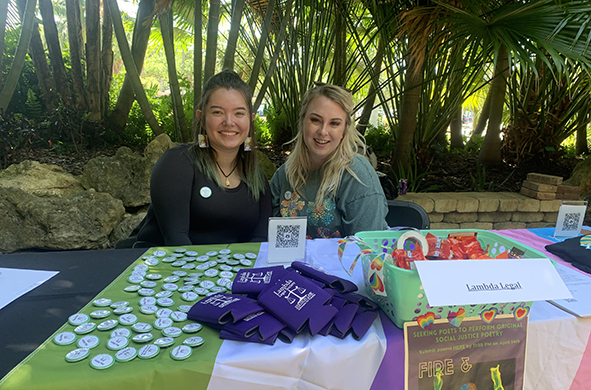
Lei-Lani Rogers, president of Stetson Law’s Lambda Legal Society (left), and Hunter Wolf, the group’s vice president
With the spring semester having drawn to a close, it may be quiet around campus, but Lambda Legal Society, Stetson Law’s LGBTQ+ student organization, is busy sharing its message with the community.
The group, which became a National LGBTQ+ Bar Association affiliate in 2021, will have a presence at Gulfport Pride on June 4 as well as St. Pete Pride on June 26. Members plan to table at both events. To Lambda president Lei-Lani Rogers, a 2L at Stetson Law, the community involvement is an opportunity to help promote legal protections for the LGBTQ+ community in the Tampa Bay region and beyond. Among LGBTQ and allied communities across Florida, there is concern over what they see as efforts at the state level to reverse decades of progress via legislation like the Parental Rights in Education bill, which critics refer to as the “Don’t Say Gay” law.
“Pride Month is a call to action for both the LGBTQ+ community and allies, but it’s particularly a time of visibility for our demographic,” Rogers said. “Florida is a hot spot currently for LGBTQ rights and representation and June is our time to be loud and proud when we say gay.”
Engaging Neighbors in Gulfport
Stetson Law is blocks away from downtown Gulfport, a longtime LGBTQ+ hub for locals and visitors alike. Underscoring this proximity is Lambda’s partnership with the Gulfport Public Library’s LGBTQ Resource Center for Gulfport Pride, which is currently slated to take place June 4.
The partnership made sense for Lambda due to the resource center’s far-reaching efforts. These include offering the BranchOut scholarship to LGBTQ+ students, hosting the SpeakOut series of events to talk about intersectionality, and currently, and hosting ArtOut, an exhibition consisting of 53 works from 35 artists representing 8 different countries, throughout June.
Rogers said the group’s board president, Susan Gore, is “a powerhouse” whose passion for promoting representation of the LGBTQ+ community is an inspiration.
“Seeing a direct injection of activism in Gulfport, seconds away from the school, inspires Lambda to do the same, and what better way to do so than partnering with another group?” Rogers said.
More to come from Lambda
Later this month, members of the group will table at the St. Pete Pride celebration on Saturday, June 25 to help engage the community on what Lambda does and why their work is important.
As for the rest of the summer, Rogers said Lambda is planning for a full slate of activity over the 2022-23 academic year, namely events that spark discussion among peers and the Stetson community as a whole.
In 2021-22, the organization tabled at several events on campus, where they offered pronoun pins and other items to promote a welcome environment for LGBTQ+ students and allies.
Last year, Lambda Legal Society created a new endowed scholarship for students who have shown dedication to advocating for the LGBTQ community through academic work, campus activities, or professional endeavors.
The Christian Science Monitor quoted Law Professor Luz Nagle in a March 4, 2022 story titled “A door of hope has opened’: A fresh start for justice in Honduras?”
Stetson Law Professor Luz Nagle
An excerpt:
“Extradition to the U.S. from Latin America was long justified by weak justice systems that couldn’t handle trials of high-profile politicians or kingpins, says Luz Estella Nagle, a law professor focused on transborder crime at Stetson University in Florida. Although there has been significant U.S. government investment in the region’s justice systems, corruption is still its Achilles’ heel.
In 2016 and 2017 alone, the U.S. sent more than $104.56 million to Honduras in aid earmarked for justice-system and police reform, according to the latest available data from the Central America Monitor by the Washington Office on Latin America.
“Some feel that [legal] aid has been wasted. Because if we’ve invested so much money and time, … why has so little changed?” says Ms. Nagle.”
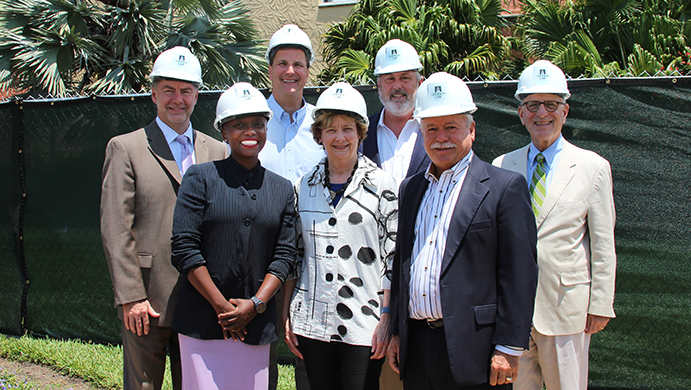
Stetson officials mark the start of construction of the Stetson Law Advocacy Institute.
It’s official: Stetson University College of Law is on its way to having a state-of-the-art advocacy facility.
Once it opens, it will comprise 16,000 square feet of beautifully renovated space. It will feature two new courtrooms, four new practice courtrooms, office and meeting space, a trophy and awards lobby, a new elevator, a renovated lobby entrance, and the campus bookstore. The fresh, collaborative, morale-building space will offer a one-of-a-kind educational experience for Stetson Law students.
With more courtroom and collaboration space than any other law school campus, the facility will elevate Stetson Law’s national status.
Stetson Law Dean Michèle Alexandre
“ The Advocacy Institute will be a multifaceted space with state-of-the-art technology, showcasing Stetson Law’s tradition of training students to become comprehensive advocates. This is a space where students, faculty, staff, colleagues from other law schools, and community stakeholders will seamlessly collaborate using the latest technological tools,” said Stetson Law Dean Michèle Alexandre.
A Pioneer in Advocacy Education
Stetson Law has long been an innovator in the trial advocacy space. Once seldom taught on law school campuses, advocacy skills are of utmost importance within the legal profession. They foster an impeccable command of law and policy, the ability to argue on behalf of clients at every stage of a case, and the confidence to do so effectively in challenging settings.
Stetson University President Christopher Roellke
Recognizing the importance of these skills early on, Stetson Law was a pioneer in advocacy education and over the years has cultivated a reputation as a leader in the field through competitions, events, and stellar faculty leadership. U.S. News & World Report has ranked Stetson Law #3 in the nation for advocacy education for 2023.
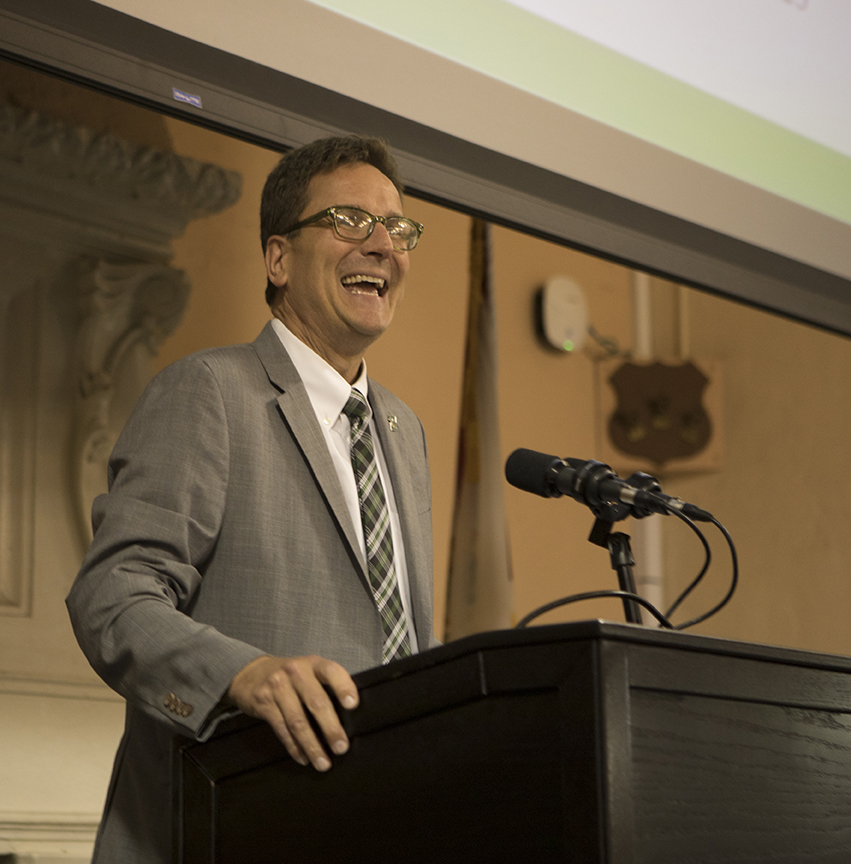
“Through its decades-long commitment to advocacy as a cornerstone of an excellent legal education, the College of Law has built a remarkable regional and national reputation and the Institute will help to support and further that reputation in the future,” said Stetson University President Christopher Roellke, PhD.
Advocacy: It’s “in our DNA”
As it continues to lead the nation in advocacy education, Stetson Law strives to innovate new ways to inspire students to be the best advocates they can be. The new Advocacy Institute will greatly enhance this effort.
Stetson Law Board of Overseers Chair Greg Coleman.
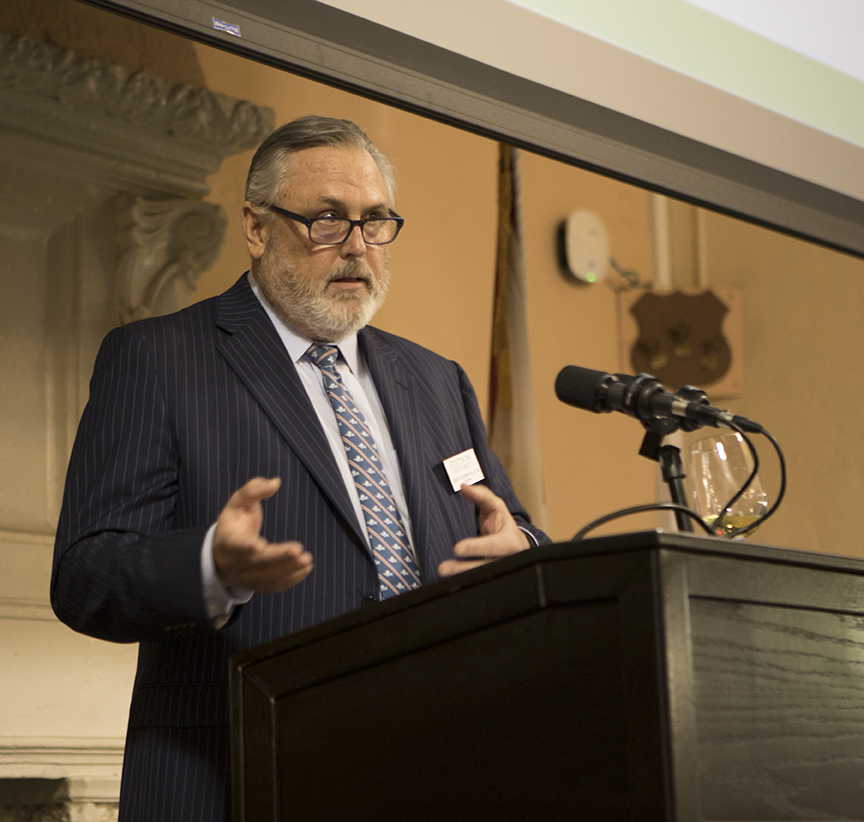
“At Stetson Law, advocacy is what we do – it’s in our DNA,” said Greg Coleman, Chair of Stetson Law’s Board of Overseers. “Although we are exceptionally proud of our high national ranking in Trial Advocacy and the success of our Advocacy Boards, advocacy goes far beyond just this. In fact, it extends to everything we do as lawyers. In addition to the courtroom, our alumni advocate on behalf of their clients in business matters, transactional exchanges, and fighting for the rights of the indigent and oppressed. Advocacy is simply part of being a Stetson lawyer.”
Benefitting Stetson University as a whole
Officials within the greater Stetson University community say the project is a symbol of the value the university sees in all of its students.
Stetson Board of Trustees Chair Maureen Breakiron-Evans.
“This facility will build upon the campus’s reputation as one of the top destinations for advocacy in the country,” said Stetson University Board of Trustees Chair Maureen Breakiron-Evans. “Yet it’s not just for those with an advocacy concentration who benefit from this strategic investment. Any success at Stetson, whether at the College of Law or at DeLand, belongs to the entire Stetson community.”
Prominently located in the old Dana Library, the Institute will serve as a welcome point for students and visitors alike; officials fully expect it to become the crown jewel of this campus.
For more information about the Advocacy Institute or to learn about naming opportunities, please contact the Stetson Law Development and Alumni Relations Office at (727) 562-7818 or [email protected].
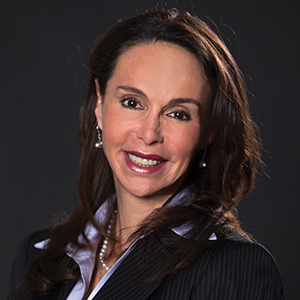
Her new role became official Saturday, May 14 at the 2022 NAELA Annual Conference in Scottsdale, Arizona. Founded in 1987, the organization offers resources to attorneys, professional organizations and other entities whose work involves helping older and disabled Americans resolve problems unique to those populations. This work includes helping clients make critical healthcare decisions, drafting of special needs trusts, and seeking income benefits.
Building the elder law community
For Flowers, the role is the culmination of many years of leadership in the elder law community. She said her new title is an honor.
“I am so honored to serve as the president of the National Academy of Elder Law Attorneys. NAELA attorneys are compassionate, talented, and professional,” Flowers said. “It is an amazing group and I am proud to be a member.”
Over her term, Flowers said she has big plans for the nonprofit that aim to continue the legacy of the organization’s founders in maintaining the “NAELA kindred spirit” while welcoming the next generation of elder and disability law attorneys.
She added that she will be looking for ways to encourage people of color to join the organization’s ranks so NAELA can continue to find ways to serve underrepresented communities. Concentrating on new technologies and ways to engage new elder and disability law attorneys will also be a priority.
A legacy of compassion & forward-thinking
A pioneering force for elder law at Stetson University College of Law and beyond, Flowers is director of Stetson Law’s Center for Excellence in Elder Law. Flowers and another elder law leader at Stetson Law, Professor Rebecca Morgan, were given the Florida Supreme Court Professionalism Award for a series of videos they created to train attorneys on how to confront ethical challenges that arise in elder law cases. They also created the first “elder-friendly courtroom” designed to accommodate the unique needs of elder Americans.
Under Flowers’ and Morgan’s leadership, Stetson Law hosts the annual National Conference on Special Needs Planning and Special Needs Trusts at the Vinoy Renaissance Resort & Golf Club in downtown St. Petersburg. This year’s event takes place October 12-14 and will feature nationally known speakers with critical insights on special needs trusts.
Stetson Law alumna and adjunct professor Theresa Jean-Pierre Coy (1981-2022).
An outpouring of loving tributes and fond memories from the Stetson Law community follows the loss of alumna, adjunct professor, mentor, and all-around powerful presence, Theresa Jean-Pierre Coy. Students and colleagues reflected on her humor, her passion, and her willingness to help students be the best advocates they can be.
Jean-Pierre Coy graduated from Stetson Law in 2004. While on campus, she was active with Stetson’s Black Law Students Association (BLSA). After graduating, she returned to campus as a mentor and as an adjunct professor and became known for being generous with her time in helping students.
“Theresa was a friend, mentor, and professor to so many of us within the Stetson Law community and beyond. She is the epitome of what it means to empower and serve, both through her legal expertise and her passion for the ‘Beloved Community’ that Dr. King asked us all to behold,” said alumna Carmen Johnson, who is now Stetson University’s Executive Officer for Diversity, Collaboration, and Inclusion.
Ambition, advocacy, & empowerment
In her 18 years as a legal professional, she quickly rose through the ranks to become a high-profile advocate. She worked for the Pinellas-Pasco Public Defender’s Office upon earning her J.D. before launching her own practice. In January of 2022, she was hired by the Hillsborough County State Attorney’s Office to lead the office’s Conviction Review Unit.
No matter her role, she always came back to Stetson Law to help students navigate law school – especially Black female law students, a historically underrepresented group within the legal profession.
“Theresa not only taught us about the essence of being a lawyer, but also how to get a seat at the table and promote diversity within the profession,” Johnson said. “Even as she accomplished so many impactful things throughout her life, she constantly checked in to encourage and empower others.”
Stetson Law alumna Valeria Obi said she first met Jean-Pierre Coy as a 1L. Well into her career, Jean-Pierre Coy had returned to campus to mentor students. After graduation, Obi said, the two developed a good friendship.
“Our connection came full circle when I was fortunate enough to become her vice president for the George Edgecomb Bar Association (GEBA),” Obi said. “Through GEBA, our relationship grew, and I quickly realized how her humorous personality, insightful words of wisdom, and keen knowledge of the law impacted everyone she interacted with, including myself. The legal profession really lost a beautiful soul and I’m so happy that I was able to know her.”
An adjunct who inspired
As an adjunct professor at Stetson Law, Jean-Pierre Coy sought to inspire students to be the best advocates they could be. 3L Deja Gordon, who is the current BLSA president, said she was a “phenomenal mentor” and a “stellar trial advocacy professor.”
“As a professor, she demanded that we bring our best to class,” she said. “She was passionate about advocacy and every day that she showed up to teach us, she brought all of her life experience and passion with her.”
Gordon added that Jean-Pierre Coy, not only showed up for students, but put in the extra mile when asked. As a 1L, Gordon said she asked her to meet for guidance on her law school journey, a conversation Jean-Pierre Coy ended by telling her “I am here for anything you need.”
“As a 3L, I can truly say that through this journey, she kept that promise,” Gordon said. “She was there for everyone. With each text, each phone call, and each Zoom meeting, Theresa was always there. Losing Theresa is a devastating blow to us all, but her legacy will live on through every person that she touched.”
A shining light
Stetson College of Law Dean Michèle Alexandre said Jean-Pierre Coy exemplified the Stetson Law community at its best: driven to succeed, passionate for advocacy, engaged in the community, and determined to help others succeed.
“Theresa’s light shone brightly and inspired us all. We are incredibly fortunate to have had such an exceptional person remain a consistent presence in this community,” Alexandre said. “Stetson Law is a better place because of Theresa, and we will deeply miss her.”
Just weeks prior to her passing, Jean-Pierre Coy delivered a virtual keynote address to students as part of the Office of Professional and Career Development’s annual Campus to Career programming. Sharing a screen with her husband, Travis Coy, a Stetson Law alumnus with whom she had a son named Thaddeus, Jean-Pierre Coy urged 1L and 2L students to keep going, and to always take a moment to breathe.
“Her work and enthusiasm for service will continue to live on as we pass on her example to the next generation of lawyers and advocates,” Johnson said.
Deputy Secretary of the U.S. Department of Veterans Affairs Donald Remy tours the Veterans Law Institute with Professor Stacey-Rae Simcox and Dean Michèle Alexandre.
Amid the bustle of graduation-day activities, Deputy Secretary of the U.S. Department of Veterans Affairs Donald Remy carved out some time for a tour of Stetson Law’s Veterans Law Institute.
Between the first and second of the three graduation ceremonies that took place Saturday, May 14, Remy, who delivered the commencement address at all three, joined Professor and VLI Director Stacey-Rae Simcox, Dean Michèle Alexandre, staff members, and graduates at the state-of-the-art facility.
“I wanted to come back and visit here just to see the place and see where you guys congregate, where you study, where you learn and where you build your future. Because it’s in your hands – you know that, right? It’s all about tomorrow,” Remy said.
A space for veterans
A veteran himself, Remy learned about how the building was outfitted with veterans in mind.
“This building is specifically designed for disabled veterans – both students and our clients who come in,” Simcox said.
Those affected by post-traumatic stress disorder will find curved ceilings and no hidden corners. The rooms are acoustically soundproofed for the comfort of those with tinnitus or hearing loss and outfitted with variable lighting that can be adjusted for student comfort.
During the tour, Simcox and graduates Barrett Hand, Andrew Zacherl, Richard Harrylal, and David Hines explained the types of cases the VLI assists with and the work the students do for veterans to improve their lives.
Remy noted how rare entities like the VLI are, and commended the team for their work on behalf of veterans.
Supporting the VLI mission
Simcox said the Remy’s visit to the VLI was important to its students and clients.
“The VA has been very supportive of veterans clinics at law schools across the country,” Simcox said. “VA’s relationship with these clinics and their students has truly impacted the future of veterans law and encouraged law students to practice veterans law and to help veterans pro bono in the future.”
The VA also supported the creation of the National Law School Veterans Clinic Consortium, a non-profit founded by Stetson’s VLI and two other law schools, which currently has members from thirty-five other law schools. In 2018, the agency appointed the Consortium as a Veterans Service Organization.
With help from volunteer lawyers, partner organizations, students, and others, the Veterans Law Institute aims to provide legal services to current and former members of the military throughout the Tampa Bay region who need it. Through the Veterans Advocacy Clinic, Simcox oversees students as they gain experience helping veterans appeal their cases when the U.S. Department of Veterans Affairs denies disability benefits.
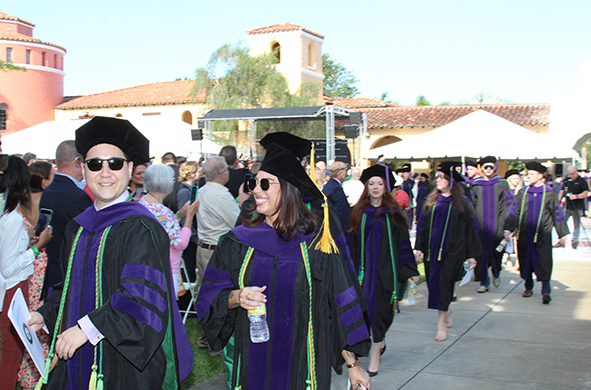
Graduates at the Spring 2022 enjoyed sunshine and camaraderie.
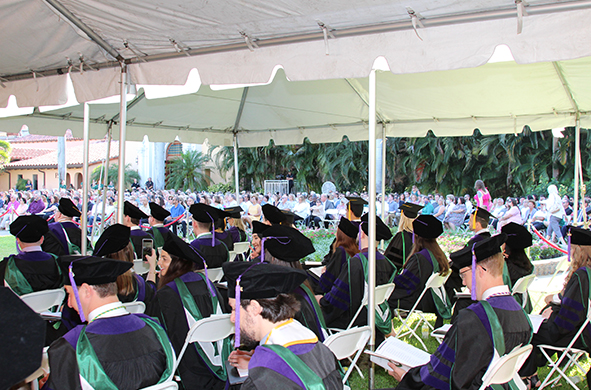
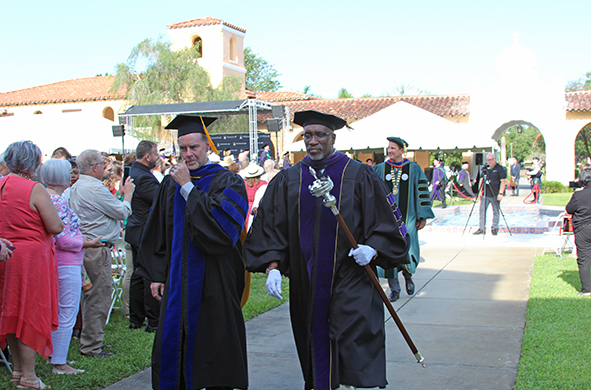
Under bright, sunny skies Saturday morning and afternoon, more than 250 Stetson Law students officially became Stetson Law alumni. Comprising three ceremonies, graduation took place in the Plaza Mayor.
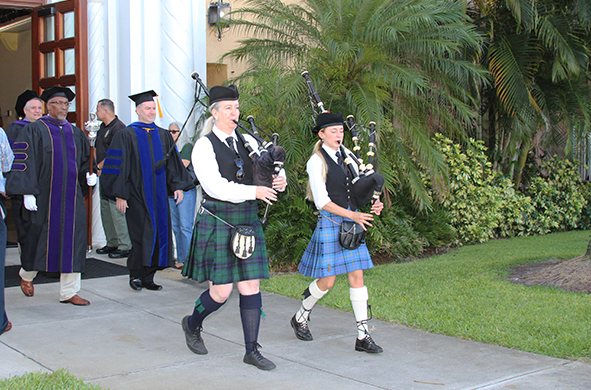
The three ceremonies took place at 8:30 a.m., 10:15 a.m., and 12:00 p.m. Each began with a ceremonial procession featuring bagpipes followed by marshals, graduating students, legacies, faculty, and the platform party.
A pair of bagpipers leads the commencement procession into the Plaza Mayor.
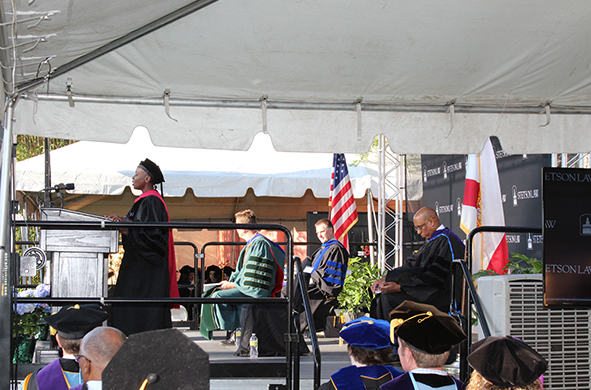
Once all were seated, Stetson University College of Law Dean Michèle Alexandre welcomed the graduates and their loved ones, acknowledge active-duty military and veterans among those gathered, and spoke about the graduates’ exceptional resilience and grit, which she said prepares them for meaningful advocacy careers.
Stetson Law Dean Michele Alexandre gave a moving speech to the graduating class.
“As I pondered the issues we face today in this increasingly complex world: climate change, global wars, and my conviction has reinforced that you are well prepared to join us in tackling these problems,” she said. “That is because you are the embodiment of the qualities that it takes to rise to this moment in our history. You, 2022 graduates, have had to adapt and transcend conditions and a national landscape for which there was no blueprint. You faced it all and excelled.”
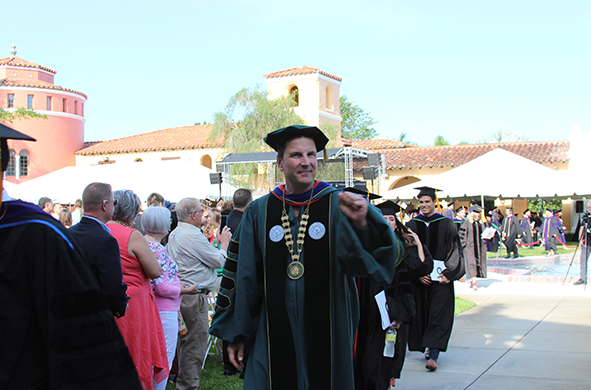
Stetson University President Christopher Roellke leads graduates out of a Spring 2022 commencement event.
In addition to the rigors of academic life at Stetson Law, the new graduates assembled there faced the unique challenge of attending the bulk of law school amid a global pandemic in a time of political upheaval – something not lost on those who spoke.
“You’ve made it to the end of a remarkable journey, and I commend you for your resilience, your tenacity and for all that you have accomplished during what I have been calling a ‘once-in-a-century set of challenges’ for higher education,” said Stetson University President Christopher Roellke, PhD. “You made it. You made it through lockdowns, online learning, virtual meetings, lost internet connections, masks, handwashing, and physical distancing. You endured and you made it.”
Students wait as a Spring 2022 commencement ceremony begins.
A keynote from the Deputy Secretary of the V.A.
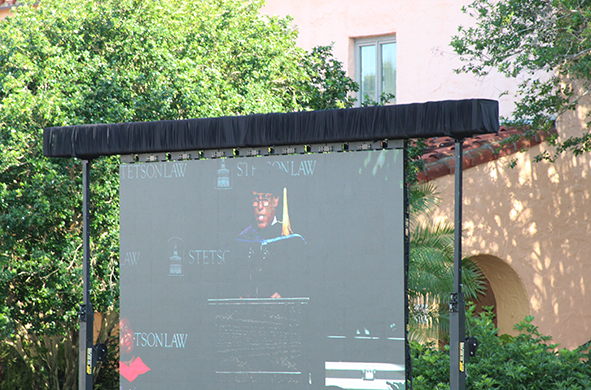
After President Roellke bestowed on him an honorary doctor of laws, Deputy Secretary of the U.S. Department of Veterans Affairs Donald Remy gave a lively commencement address that expressed the gravity of the work the grads will soon be doing as lawyers. But his speech was not without levity.
Deputy VA Secretary Donald Remy gave the Spring 2022 commencement keynote.
He said his friend and former colleague, Stetson Law Professor Royal Gardner, offered him pointers for giving the address: keep it short, keep it simple, and avoid cliches like telling the students “to be courageous as you go out into the brave new world.” It was that last bit of advice, Remy joked, that he couldn’t completely follow.
“I’m going to come dangerously close to telling you all ‘to be courageous as you go out into the brave new world,’” Remy said. “Because that’s part of your responsibility as new lawyers. In accepting this call to become lawyers, to join this profession of law, you have an opportunity, but you also have a responsibility. And that responsibility is to right wrongs. It’s to look at challenges both large and small and make a difference. And most importantly, it’s to hold our great nation accountable to its promises.”
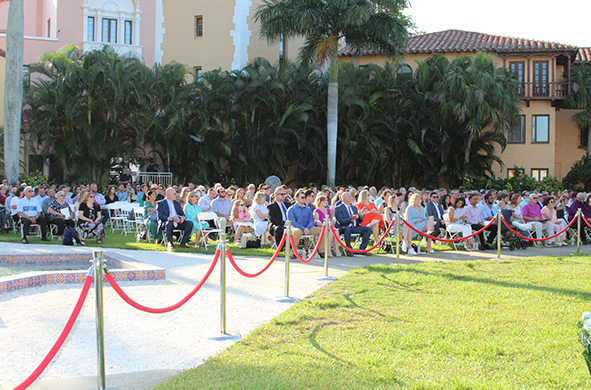
Family and friends gathered in the Plaza Mayor to watch the Spring 2022 graduation ceremony.
He told the graduates that as lawyers, they help ensure that the words in the U.S. Constitution and Declaration of Independence will never ring hollow – and they will defend the fundamental promises upon which the U.S. was founded.
Friends and family looked on as the ceremony took place.
“After three years of law school, you know better than many that democracy isn’t destiny,” Remy said. “It doesn’t just survive on its own. It’s on you to preserve and protect it. You know better than anyone that progress doesn’t just happen. It’s on you to make it happen.”
Provost Noel Painter and Assistant Dean Darryl Wilson exit the Plaza Mayor after a Spring 2022 commencement ceremony.
Virtual words of encouragement from key leaders
In short, pre-recorded videos, some of the most prominent Stetson Law community leaders congratulated the graduating classes and encouraged them to advocate for a better world.
Stetson University Board of Trustees Chair Maureen Breakiron-Evans said the graduates join a community of Stetson Law alumni that has spanned a century and urged them to stay connected with the Stetson Law community with which they shared a law school journey in unprecedented times.
Stetson University Board of Trustees Chair Maureen Breakiron-Evans.
“You are graduating at a time of political polarization and fake news,” she said. “You’ve had to navigate through a global pandemic to complete your studies, and that’s been challenging for everyone. Your future lies before you as blank pages in a book in which you will write the story of your personal life’s journey.”
Mitchell Schlermer, current president of the Stetson Lawyers Alumni Association, told the new alumni that this is a monumental moment for their careers and that he looks forward to having them join the ranks of Stetson Law alumni and lawyers.
“Enjoy the moment,” he said. “Enjoy bar study, as hard as it might be, because soon you’ll have a lifetime of law practice to look forward to.”
Tala El-Ghali, who served as Student Bar Association president in her 3L year, encouraged her fellow grads to use their hard-won advocacy skills to fight for a better world.
“Whether you make $40k or $400k, we as attorneys will carry substantial power and influence within our communities, and I encourage you all to make good-faith efforts to exercise this power in impactful ways both inside and outside of the legal profession,” she said.
Stetson University College of Law Dean Michèle Alexandre speaks to the spring 2022 Honors & Awards recipients
For the first time since 2019, Stetson University College of Law held an in-person ceremony to recognize the graduates who excelled in their academic achievements.
Held in the Great Hall and streamed online on Friday, May 13, the eve of the spring commencement ceremony, the event heralded students who graduated with honors, earned certificates of concentration and joint degrees, participated in advocacy competitions, or worked on one of Stetson Law’s academic journals. Over 150 awards were bestowed. Honorees included December 2021 graduates in addition to the spring 2022 graduating class honorees.
“Graduates, being honored today is a defining moment in your legal careers,” said Stetson College of Law Dean Michèle Alexandre. “At our Honors and Awards ceremony, we recognize your numerous achievements during law school above and beyond the already very high standards expected of you. Today, we recognize your contributions to this community, and to society at large.”
Alexandre urged the honorees to continue going above and beyond what is expected of them as legal professionals in serving their communities – and commended them for helping Stetson Law earn national recognition for trial advocacy, legal writing, and dispute resolution as well as logging thousands of pro bono hours while helping others.
“You have earned this time to celebrate your achievements in law school,” she said. “Your law school friends celebrate with you here today, and those at home are rewarded at seeing the years of support that brought you to this moment.”
In brief remarks to those gathered, Stetson University President Christopher Roellke, PhD, congratulated the students for persevering despite unprecedented challenges.
“I will give you more remarks tomorrow, but I would be remiss if I didn’t tell you the entire Stetson University community is incredibly proud of you,” Roellke said. “This has not been easy over the last couple of years, and you have persevered. You were resilient, and you made it. Congratulations.”
Next, Dr. Noel Painter, Vice-President and Provost of Stetson University addressed the honorees, noting that the characteristics that helped them earn honors that evening reflect Stetson’s values as an institution.
“Today, you are recognized not only because you are aligned with what Stetson is, but because you have excelled at those things that Stetson values: hard work, the highest academic learning, and developing a caring, ethical community,” Painter said. “I am proud to be part of a community that celebrates those values, and exceptionally pleased to be here tonight to honor each of you who embody the characteristics that have made Stetson what she is today. Congratulations to each of you.”
Law Professor Judith Scully presented the first series of awards, starting with the William F. Blew Pro Bono Service Awards, named for an alumnus and Stetson Law Hall of Fame member.
“All of our students are required to perform 60 hours of pro bono in order to qualify for graduation,” Scully said. “These students, however, have gone far beyond the extra mile; and as a group they have selflessly given over 20,000 hours of their time to legal agencies and nonprofit organizations serving low-income communities, the elderly, war veterans and other vulnerable populations.”
Law Professor Stephanie Vaughan announced and issued the second half of the awards, starting with the Stetson Law Review awards. Vaughan is chair of Stetson Law’s Honors and Awards committee, which identifies students deserving of awards.
The event culminated with the announcement of three major awards: the Walter Mann Award, the Dean’s Excellence Award, and the Edward D. Foreman Most Distinguished Student Award.
The Walter Mann award was given to Jessica Lauren Merkel. This award’s namesake is perhaps best known for helping organize the College of Law Board of Overseers and serving as its first president.
The recipient of the Dean’s Excellence Award was Deja Monét Gordon, who was president of the Black Law Students Association (BLSA) and competed as part of the Trial Team.
Jennifer Lynn Rex was given the Edward D. Foreman Most Distinguished Student Award. This award is meant to honor the “best all-around student” who has shown passion for advocacy and community service. It was established by Bonnie Foreman in her late husband’s name. The couple were jointly inducted into the Stetson Law Hall of Fame in 2010. In addition to the award, Rex’s name has been cast in bronze and will be secured to the plaque outside the Great Hall, and she was given a $5,000 check.
Professors Anne Mullins, Joseph Morrissey, and Kirsten Davis were recognized for excellence in teaching, scholarship, and research, respectively, in spring of 2022.
As the 2021-2022 academic year drew to a close, Stetson University College of Law Dean Michèle Alexandre recognized Stetson Law faculty members whose work best reflects the law school’s mission. The series of awards honored them for their impact on student achievement and Stetson Law’s national reputation.
The Homer & Dolly Hand Award in Faculty Research: Professor Kirsten Davis
Stetson Law alumna Dolly Hand established this award to honor faculty who are dedicated teachers, have recent notable scholarship or creative work achievements in their areas of expertise, and who strive to make a difference within their communities.
In recent years, she has been exploring the role of lawyers as citizens with a special responsibility for justice, a role that every state’s ethics rules recognize. Through a lens guided by rhetorical theory, her scholarly, creative, and service work has explored lawyers’ professional identity as a rhetorical practice – in particular, the lawyer’s ability and obligation to speak as public citizens on matters of public concern, including social justice.
This work includes two scholarly articles, a book chapter, regular posts on LawProf Blog Network Appellate Advocacy Blog, and service that includes participating in the Florida Bar’s Special Committee to Review Professionalism in Florida.
The Dickerson-Brown Award in Faculty Scholarship: Professor Anne Mullins
Selected by the Dean with input from the Faculty Scholarship Committee, this award recognizes a faculty member who has published a book in the past two years, or multiple, highly regarded works of scholarship over a two-year period, thereby helping significantly enhance the College of Law’s academic reputation.
Professor Anne Mullins, who said she was “thrilled to receive the award,” said three projects were critical in helping her earn the recognition. She authored the new textbook Florida Legal Research, which multiple law schools throughout the state have adopted. As part of the Feminist Judgments Project, she reimagined U.S. Supreme Court Justice Clarence Thomas’s opinion in Desert Palace, Inc. v. Costa in a way that reached “the same ultimate result but through the application of feminist theory and very different rhetorical techniques.” The third project, Unending Conversation, involves working with the Stetson Law Review Forum to “feature essays responding to extant legal writing scholarship.”
She said working with students on Unending Conversation has been incredibly rewarding.
“I had the opportunity to work with an exceptional team of Stetson Law Review staffers, led by Liz Kellar, alongside a group of nationally known legal writing scholars,” Mullins said. “Every member of the project was incredibly thoughtful, engaged, and hard-working. They really inspired me in my work on the project.”
The Excellence in Teaching Award: Professor Joseph Morrissey
This award is given to a full-time professor who has made outstanding contributions in teaching students both inside and outside the classroom – as well as by example. A professor who is part of Stetson Law’s business law concentration faculty, Professor Joseph Morrissey was named the 2021-2023 Leroy Highbaugh Research Chair in May of 2021. Under that designation, he is researching and writing a book on surrogacy. He said it’s an honor to yet again be recognized for his passion for teaching and mentoring students.
“I’m deeply honored to receive this year’s Excellence in Teaching Award,” said Morrissey. “For me, working with and mentoring students is the reason I came to academia. It’s truly a privilege to be a part of each student’s personal and professional development. Moreover it is absolutely energizing to work with our students, who are generally infectiously enthusiastic about the future.”
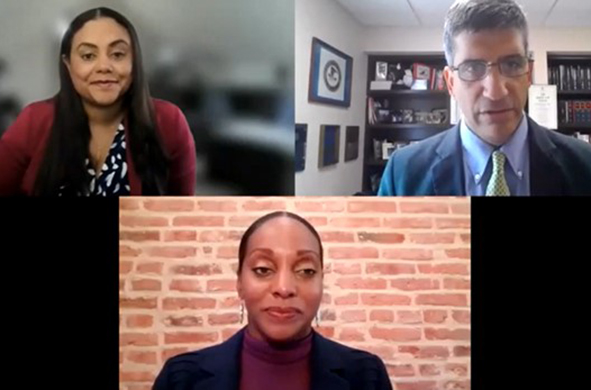
Clockwise from top left: University of Notre Dame Law Professor Veronica Martinez, Stetson Law Professor Louis Virelli III, and Kimberly Humphrey, senior legislative counsel at the Alliance for Justice
Hours before a leaked U.S. Supreme Court opinion on Roe v. Wade sent shockwaves through the public sphere, a panel of legal experts that included Stetson Law Professor and constitutional law expert Louis J. Virelli III talked ethics standards on the high court and why they’re hard to enforce.
The American Constitution Society discussion focused heavily on recusals in light of calls for Supreme Court Justice Clarence Thomas’ recusal on cases involving his wife, activist Ginni Thomas, and her involvement in the events that took place at the U.S. Capitol on January 6th, 2021. The conversation was called “Supreme but not Immune: Creating a Binding Code of Ethics for Supreme Court Justices.” ACS president and former U.S. Senator from Wisconsin Russ Feingold called the controversy over Justice Thomas “the proverbial elephant in the room.”
“This is an egregious ethical lapse given the Thomases’ close connection as spouses and the existential threat to democracy that its offenders represent,” Feingold said.
The lack of a clear solution
The panel explored how to impose greater accountability to prevent ethical lapses among U.S. Supreme Court justices and why Congress has been limited in its ability to do so. There is, for example, a code of conduct for United States judges, but it doesn’t apply to Supreme Court justices.
“Supreme Court justices are not replaceable,” Virelli, a faculty advisor on Stetson Law’s student ACS chapter, said. “So when a Supreme Court justice is recused or recuses themselves, it changes the number and makeup of the court, and therefore you have a different institution.”
Congress can technically pass a law enforcing ethical standards, but as Virelli pointed out, there have been 18 proposed laws introduced that would have done this – and none have passed. Virelli said that every case the court hears has enough of its own nuances that a policy governing recusals and other ethical issues would be weak and unsatisfactory.
“My view is, the best way to do this is to focus on the due process clause and the equivalent of public shaming, where instead of saying a justice did or did not follow a legal standard, the justice is just wrong and being unethical,” he said.
Panelist Veronica Root Martinez, a professor of law at the University of Notre Dame Law School, who researches professional and organizational ethics, countered that public shaming won’t work in the current polarized media environment because of social media.
“I don’t think you can be a Supreme Court justice right now without choosing to ignore a lot of the commentary about you,” Martinez said.
The congressional route
Martinez said she supports congressional action, given how the state intervenes in many other instances of professional misconduct – and how Congress already determines the number of Supreme Court justices, what constitutes a quorum, and other factors. An enforceable ethics code might help improve public trust in the court, which is heavily damaged, she said.
“It is eroding the legitimacy of the court for people to continue to think the court is increasingly partisan,” Martinez said. “And whether that is or is not true, the lack of an ethics standard is contributing to the belief of the public that the court is just a partisan show that isn’t actually putting out objective and legitimate decisions. And that is bad for the rule of law, and that is bad for the country.”
If Congress can’t enforce ethical standards and the Supreme Court won’t do it on its own, the solution may need to be a creative one.
“I think the blame is in justices who are willing to be fast and loose with their ethical obligations. And I don’t know that we can fix that in a traditional legal way,” Virelli said.
While debate remained over how to create accountability, the panelists agreed that something needs to be done.
“We know that these issues have been percolating for some time,” said moderator Kimberly Humphrey, senior legislative counsel for the Alliance for Justice. “I do believe that it has gotten to a point where it can’t be ignored.”