Skip to content

Judges, FL Supreme Court Justice Talk Clerkships at Stetson Law

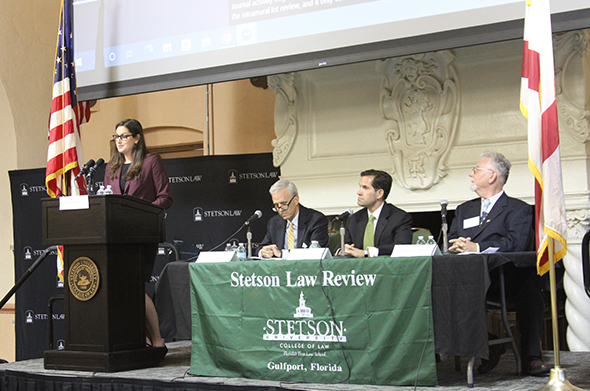
A law student stands at a podium to introduce several judges on a panel.
Law Student and Stetson Law Review Editor-in-Chief Kathryn Alkire introduces a distinguished panel of judges for a discussion about judicial clerkships.

If all the intensive reading, research, writing, and analysis law school entails leaves a 3L wanting more, members of the federal and state judiciaries in Florida want to hear from them.

That was the big takeaway from an engaging panel discussion at Stetson Law hosted by Stetson Law Review. Judges from a range of backgrounds and jurisdictions gave the audience a glimpse of what a judicial clerkship looks like in their courtroom.

Judicial clerkships are generally one- or two-year positions – but some are longer. They involve working closely with the judiciary to conduct research, write memoranda, draft decisions, and discuss ongoing cases with judges and other clerks. Most judges have one or two clerks, though some have a pool of several attorneys often referred to as staff attorneys.

For a recent law school graduate or working legal professional exploring a potential new direction, the position can be a capstone to one’s legal education, a critical career launching (or turning) point, and an immersive look at how judges operate. The judges on Tuesday’s panel went into detail on what that looks like day to day and how it can benefit one’s entire career.

Insights on judicial clerkships from high-caliber officials

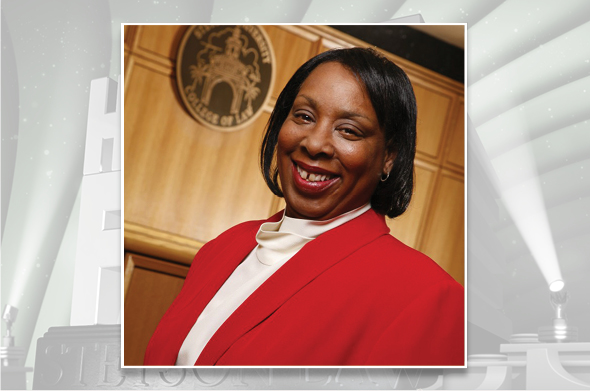
Speaking to an audience consisting of dozens of students who work on the Law Review, Kathryn Alkire, the publication’s editor-in-chief, introduced the panel’s four judges: Florida Supreme Court Justice John D. Couriel; Hon. Charlene Edwards Honeywell, District Judge for the United States District Court, Middle District of Florida; Hon. Christopher J. Tuite, Magistrate Judge for the United States District Court, Middle District of Florida; and Hon. Craig C. Villanti of Florida’s Second District Court of Appeal (who is also a Stetson Law alumnus; J.D. ’77).

Each spoke candidly about what their judicial clerks do, the lifelong connections they develop with them, and how they vet candidates for the role.

“It’s really a fun job because every day you come in and solve a puzzle. And the beauty of the job, which you’ll never find again unless you ascend to the bench, is your sole objective is to do the right thing,” Judge Tuite said.

The panel was moderated by Law Professor Louis Virelli III, who noted how rare it is to hear directly from such high-profile judges and reflected on his own experience as a judicial clerk.

“I also had the absolute distinct pleasure of being a clerk twice myself at the district court and circuit court levels,” he said. “They were the two best jobs of my life prior to this one – but it’s still close. It really is an extraordinary opportunity.”

Unforgettable role, lifelong connections through mentorship

While the position is heavy on research and writing, it also brings those in it face to face with the inner workings of a courtroom – a valuable experience for any legal professional at any point in their career. They can see what makes a good lawyer, what makes a less effective one, and even how and why high-profile cases unfold the way they do.

“I like to refer to the trial court as the court where all of the action is, and so our clerks not only get to do research and writing, they also get to observe,” Honeywell said.

The panelists stressed how clerks play a critical role in assuring the judiciary gets it right in their decisions, thereby ensuring a courtroom is delivering on the promise of justice for all.

“I tell my law clerks that their first job is to protect me from error. It really is that simple: save our court from error. And therefore, it is a critical job,” Justice Couriel said. “It involves a lot of diagnosis. It involves a lot of figuring out what the law tells us about how a particular case or controversy ought to be solved.”

Trust is a centerpiece of a judge’s relationship with their clerk, Couriel added. While the days may be long and the pressure high, a lifelong alliance develops over time.

“While the term of the job is only a year, I really view the job as a lifelong commitment,” he said. “My law clerks have me in their corner for the length of his or her career.”

While the justice and judges shared details unique to what the role entails in their courtrooms, one common thread persisted: a knack for legalese and a love for the written word are paramount.

“Being on law review is the perfect segue into being an intern or a law clerk because you do what we do: read, research, write,” Villanti said. “It’s what you do, 24/7. It’s all you do. I used to read a thing called books. I don’t read books anymore. I read briefs.”

To explore more ways Stetson Law students can develop their ideal career path while still in school, visit the college’s Office of Career and Professional Development website. Learn more about Stetson Law Review.

Recap: SNT 2022 Delivers on Elder Law Insights, Updates

A group of attendees at a conference in a large hotel meeting room.
Stetson Law’s 24th Annual National Conference on Special Needs Planning and Special Needs Trusts at the Vinoy Renaissance in downtown St. Petersburg

From the informative to the transformative, Stetson Law’s 24th Annual National Conference on Special Needs Planning and Special Needs Trusts fostered important conversations as it unfolded over three days in downtown St. Petersburg.

Organized by Stetson Law’s Center for Excellence in Elder Law, the event brought together  hundreds of legal professionals who work in elder law and special needs law to hear from important voices on the latest issues affecting special needs planning and special needs trusts. Some 60 nationally recognized speakers from a variety of backgrounds offered insights and updates on all aspects of this highly specialized field – from a detailed overview of proposed changes to federal regulations to the role of self-care for those who do this important but often difficult work.

Once again, the event took place at the picturesque Vinoy Renaissance Resort & Golf Club, an inviting venue familiar to those who had attended in prior years. Stetson Law Professor Roberta Flowers, who is director of the Center for Excellence in Elder Law and president of the National Academy of Elder Law Attorneys, welcomed attendees back for another series of thoughtful discussions and meaningful connections.

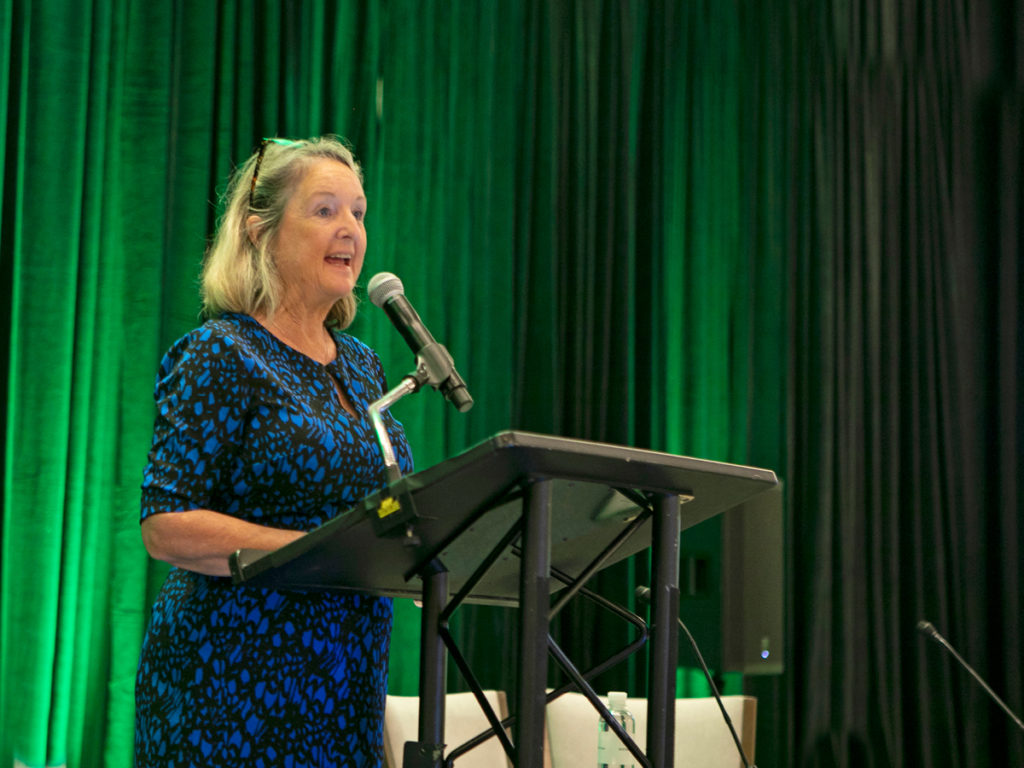
Stetson Law Professor Roberta Flowers speaks at SNT 2022.

“What a thrill it was to host this incredible community once again,” Flowers said. “The speakers were compelling, the sessions were thought-provoking, and our network yet again felt like family.”

Storied speakers, important insights

As always, the conference schedule was packed with engaging sessions where attendees could glean information critical to their work.

Among headliners was Dr. Amanda Flood of the U.S. Social Security Administration, who spoke on the Supplemental Security Income (SSI) eligibility requirements of Section 1917(d)(4)(A) and (C) Trusts. Former Social Security Administration Deputy Director Kenneth Brown offered insights on navigating the Program Operations Manual System (POMS), an SSA tool for processing benefits. Dr. Lisa Iezzoni of Harvard Medical School Health Policy Research Center gave a session on what physicians experience and perceive when caring for disabled individuals.

Upcoming Medicare & Medicaid changes

In his overview of proposed changes to U.S. Centers for Medicare and Medicaid Services (CMS) rules, Gene Coffey, technical director of CMS’s Children & Adult Health Program Group, said the agency aims to expand Medicaid eligibility to reach populations the agency has historically missed.

“The major focus of our NPRM (Notice of Proposed Rulemaking) is the facilitation of Medicaid eligibility and enrollment,” Coffey said during a Friday morning session. “What we are looking to do in this NPRM is largely to confront some of the barriers that prospective Medicaid applicants have to enrolling in the Medicaid Program.

A “Death Doula” confronts compassion fatigue

In her Friday morning talk, Brenna Galvin, managing shareholder and elder law attorney at Maser, Amundson & Boggio, P.A., a Minnesota-based firm, addressed a lesser-known occupational hazard for professionals who work in elder law and related spaces: compassion fatigue.

“When it comes to the practice of law and fiduciaries who work with their clients for a long amount of time and then often watch them as they decline or pass away, there’s not a lot of conversation about how that impacts us as people and as practitioners,” said Galvin, who is certified as a Death Doula, a role that helps people deal with a host of end-of-life issues. “I think that this topic is so important because the weight of caring comes at a cost to us. It comes at a cost to us personally, it comes at a cost to our families, and our clients, and as a ripple effect, our communities at large.”

Galvin outlined some of the physical, psychological, and spiritual symptoms one might experience working with clients who are late in life or who are dealing with trauma. The combined effects of burnout and secondary trauma can be detrimental, she said, which is why it’s critical to care for one’s health and well-being by getting enough sleep, exercising, setting clear boundaries, and adopting other healthy habits.

“In our practices, we experience more death than the average Joe,” she said. “The good news is, there is a cure to burnout and there is a cure to compassion fatigue. It comes in the form of self-care.”

The “Roberts” return

A beloved fixture at SNT, attorneys Robert Fechtman and Robert Fleming delivered their “Roberts Update” Friday morning. Since it was earlier in the day than their usual time slot, their customary glasses of wine were replaced with a pair of Bloody Marys. They gave an often-humorous retrospective on the past year’s most significant court cases related to special needs and trusts, changes to federal law, and more.

Learn more about Stetson’s Center for Excellence in Elder Law or read the latest in the Elder Law Blog, an outlet edited by Stetson Law Professor Rebecca Morgan, who, like Professor Flowers, was also president of NAELA.

Student, Veteran Wins National Award for Women in the White-Collar Field

Law student Nancy Eriksen stands outdoors and smiles for the camera
Stetson Law student Nancy Eriksen

Each year, the Women’s White Collar Defense Association® (WWCDA) recognizes individuals and groups whose work impacts white collar law while serving to elevate women in the practice, from late-career pioneers to law students who show promise in the law. This year, the international nonprofit has chosen Stetson Law student Nancy Eriksen the recipient of the Justice Ruth Bader Ginsburg Outstanding Law Student Award.

Stetson Law Professor Ellen Podgor nominated her for the award, for which she was chosen from an international pool of contenders. This fall, Eriksen will travel to Washington, DC to accept the award on November 29 at the annual WWCDA Awards Gala, where she will have the opportunity to connect with women who are leaders in the field.

“I am thrilled and honored to receive this award, and I am so thankful to Professor Podgor for nominating me,” Eriksen said. “I am particularly pleased that as this year’s recipient, I will have the opportunity to be mentored by a member of the Women’s White Collar Defense Association. I appreciate the WWCDA’s enthusiasm for encouraging the next generation of criminal defense attorneys.”

Honoring a trailblazer

Now in its second year and in honor of the late Justice Ginsburg, the award is given to a female law student in the final year of her legal education who demonstrates unwavering dedication to justice for all, an exceptionally strong work ethic, a commitment to perseverance, and other qualities for which Justice Ginsburg was known. The award was created in the wake of her 2020 death.

A 3L who came to Stetson Law after graduating from Tufts University with a B.A. in political science and anthropology, Eriksen spent six years as an officer in the U.S. Air Force and the U.S. Air Force Reserve. She is a mother of three who participates heavily in campus activities, including as an editor of the Stetson Law Review and Moot Court Board.

“We honor Justice Ginsburg because she was the ultimate trailblazer – none of us would be where we are in the practice of law had she not accomplished all that she did for us,” said Karen Popp, WWDCA’s global chair and co-founder. “Recognizing a female law student like Nancy Eriksen, who reflects Justice Ginsburg’s commitment to hard work and service to others , is also intended to  pay tribute to one of the most consequential women the legal profession has ever known.”

Founded in 1999 – when there were only a few women working in the field – WWCDA currently has 45 chapters with 3000 members throughout the world.  WWCDA strives to bring more diversity to the white collar defense space, connecting women in private practice with information, resources, and opportunities while celebrating those whose pioneering work helped open the area of practice to women. WWCDA has a number of initiatives to help advance women in the field. The Awards Program is a way to honor those who have helped women and to recognize the women who are the future of the practice. Popp said it is also part of the organization’s mission to connect with women still in law school through the Justice Ginsburg award and to offer them mentoring opportunities as they begin their practice.

Generations of passionate advocacy

To Podgor, who is Stetson Law’s Gary R. Trombley Family White-Collar Crime Research Professor of Law, the award is well-deserved recognition of a student whose exceptional ability to balance the pressures of multiple roles reflects Justice Ginsburg’s legacy. The fact that this is only the second award of its kind to be given should also be a point of pride, she said.

“Ruth Bader Ginsburg is surely looking down and smiling knowing that Nancy Eriksen is receiving an award in her name,” said Podgor. “Like Justice Ginsburg, Ms. Eriksen has juggled it all: family, service to our country, and law school. Importantly, she makes Stetson Law School proud being only the second law student to receive this prestigious award.” 

Ellen S. Podgor close-up image
Law Professor Ellen S. Podgor

The gala will take place in Washington, DC on November 29 and will be emceed by former U.S. Attorney General Loretta Lynch, who is now a partner with the firm Paul, Weiss. Eriksen will attend to accept her award; Podgor plans to speak at the event.

“We are thrilled that Professor Podgor will be speaking at the WWCDA Awards Dinner Gala this year. Her work in white collar crime – in the courtroom and through her scholarly contributions – have helped shape this ever-evolving area of law,” Popp said. “Her life’s work, along with her passion for helping women pursue careers in this space exemplify this organization’s mission and values.”

The event is open to the public with members of the white-collar defense and greater legal community in attendance. Single tickets and tables of eight are now available; those who are interested are encouraged to reserve early to ensure their spot. Learn more about WWDCA and find details about the 2022 Awards Gala.

Writer, Scholar Stephanie Burt Talks Poetry and Belonging at Stetson Law

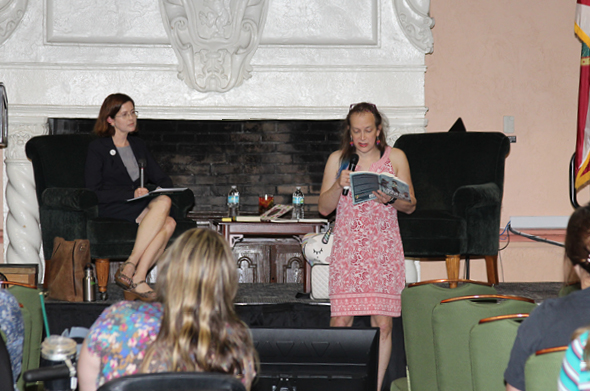
Professor Kristen Adams and Dr. Stephanie Burt sit on a stage in the Great Hall; Dr. Burt is reading from a book of her poetry.
Dr. Stephanie Burt (right) reads from a book of her poetry

Speaking to the Stetson Law students, faculty, and staff gathered in the Great Hall as well as students and faculty joining remotely from Stetson University’s main campus in DeLand, scholar Dr. Stephanie Burt explored the relationship between one’s work and oneself.

A poet, literary critic, and professor of English at Harvard, Burt gave a talk titled “Professional Identity and Belonging.” It was presented as part of Stetson Law’s LGBTQ+ History Month events.

Throughout the conversation, Burt read excerpts of her poetry and related them to critical life events, including “Hermit Crab,” a poem inspired by her struggles with her identity before she ultimately came out as a trans woman in 2017.

Connecting poetry & law

For Law Professor Kristen Adams, who hosted Burt on stage, it was After Callimachus, Burt’s 2020 collection of translations and adaptations of works by the Greek poet Callimachus, that had an interesting appeal for legal scholars.

“It engages my lawyer brain in a different way,” Adams, who teaches courses that relate poetry and law, said.

Burt said she could see why someone with a background in law and legal theory might find the text interesting.

“The poems really are often acts of persuasion, and often they’re acts of recitation,” Burt said.

Callimachus had a way of challenging incorrect or outdated ways of thinking, she added, and voiced his challenges “in a way that is sympathetic and funny rather than boastful and from on high.”

Community & belonging

As he introduced Burt, 3L Kyle Ridgeway said he was grateful that he and his classmates could be part of a conversation with a celebrated scholar whose work explores important issues like identity and social change.

“Dialogues such as the ones we are having this evening are important for us to be a community that welcomes others to express themselves in their professional and personal identity and feel as though they belong,” Ridgeway, a member of Lambda Legal Society’s Stetson Law Chapter as well as the college’s Social Justice Advocacy Concentration program, said.

A “quiet” space

A well-known literary critic and poet, Burt has published three poetry collections and two critical books on poetry, including, most recently, the poetry collection We Are Mermaids. The New York Times Book Review, the London Review of Books, the Boston Review, and many other publications have featured her work.

Law Professor Anne Mullins commended the audience for taking time away from study and work to be part of the “quiet space” where, outside of rigorous schedules and nonstop chatter, they can explore critical, fundamental questions through conversations about art.

“The importantis winning,” Mullins said at the beginning of the event,” Mullins said. “When we give ourselves the opportunity to engage in poetry, and literature, and art, and music… we open ourselves up to the invitation to that quiet space. And we can pause, and think, and reflect on the most important questions, which are: ‘who are we?’ and ‘who do we want to become?’”

The event was held in collaboration with Stetson Law’s Social Justice Concentration, Lambda Legal Society, the Gulfport LGBT Resource Center, and Stetson University’s Office of Diversity, Collaboration, and Inclusion, and Tombolo Books.

30 Years On, Pro Bono Still Embodies Stetson Spirit of Public Service

Two law students present on their pro bono experience in Stetson Law's Mann Lounge
Stetson Law students Anne Copeland and Brent Schneider share their experience working with Ukrainian Mothers and Children Transport during the 2022 Pro Bono Showcase.

For Stetson Law 3L Francesca Little, whose family emigrated to the U.S. from Venezuela when she was five, using her growing set of legal skills to help other immigrants was an obvious choice.

As a law student, Little is required to complete a minimum 60 hours of pro bono (volunteer work), at least 30 of that in a legal capacity, as part of Stetson Law’s pioneering pro bono program. So, she harnessed her passion for helping families deal with the daunting immigration process through volunteer work with entities like Bay Area Legal Services and an immigration law clinic offered through Gulf Coast Legal Services.

“I have gone through what they have gone through, so I want to help them as much as I can,” she said.

Little gave one of five presentations at Stetson Law’s Sixth Annual William Reece Smith, Jr. Pro Bono Challenge, an event that invited 3L students to share their experiences doing legal pro bono work for social justice-related cases and causes Tuesday afternoon in Mann Lounge. Named for a former American Bar Association president who advocated for equal access to justice in Florida and beyond, the event showed how law students interested in social justice advocacy at Stetson Law can work on behalf of clients and nonprofits who cannot afford traditional legal representation.

There’s a mutual benefit for students: they get real-world experience, they make professional contacts in the areas and causes of most interest to them, and they get to make a difference.

“There’s a global impact at stake here,” Little said.

Showcasing pro bono opportunities

A number of students applied to be part of the program, including quite a few submissions that were “really impressive,” said Law Professor Kristen Adams, who co-organized the event with Law Professor Judith Scully. Their range of experiences demonstrated how easy it is to gain fulfilling pro bono experience tailored to their schedules and workloads.

Law Professor Judy Scully smiles as she speaks into a microphone at a Stetson Law event.
Law Professor Judith Scully explains the purpose of the Pro Bono Showcase and why it’s named for William Reece Smith, Jr.

“Some of the students had done really intensive work at a single organization; others had experiences at a lot of different organizations,” Adams said. “Some of the students work remotely. Others did in-person work. Some work was civil in nature. Other work was focused on criminal-oriented work. Some was litigation-focused; other work was transactional.”

The student speakers at Tuesday’s showcase did extensive work in immigration law, advocated on behalf of child abuse victims, and more. Two helped Ukrainian women apply for U.S. travel visas through their work with Ukrainian Mothers and Children Transport, a network of lawyers, professors, and law students that works to help women and children flee war-torn Ukraine.

A storied tradition

The Pro Bono showcase may be in its sixth year, but pro bono work has been a priority at Stetson Law for much longer.

Back in 1990, Stetson Law officials announced a novel approach to legal education: requiring all law students and faculty to perform a minimum number of pro bono hours in service to low-income individuals and community causes. It went into effect in 1992.

A 1991 story in the Tampa Bay Times marveled at how it was “quiet little” Stetson Law – which at the time was just beginning to raise its profile as an advocacy powerhouse – that was instituting such an innovative program, and not a more famous law school. To Stetson Law leadership, the answer was obvious:

“It’s a really good educational opportunity for students to become aware of the need for public service, and of the ability as lawyers, and just as people, to help out,” Law Professor Rebecca Morgan said at the time.

Pro bono opportunities abound

As the students shared their pro bono stories in Mann Lounge, the was a flurry of related activity across the way in the Great Hall.

Three students stand at a table as a person sitting explains their organization.
Students learn about the wealth of pro bono opportunities available at organizations throughout the Tampa Bay region.

There, students explored tables from a variety of organizations offering pro bono opportunities, including private law offices, agencies like Florida Department of Environmental Protection, Gulf Coast Legal Services, and others.

Couldn’t make it to either event? Learn more about pro bono service at Stetson Law.

Enter this year’s pro bono challenge.

Student Publishes Paper on Federal Funding Inequities for Black Farmers

A farm worker silhouetted at twilight

Despite hard-fought gains in social and economic justice over the years, not all sectors appear to be delivering progress for Black Americans.

One such area, writes Stetson Law student Kyle Ridgeway in a recent paper, is agriculture, where instead of growing or maintaining a presence reflective of the overall population, Black farm ownership has dropped drastically. While Black farmers once represented 14 percent of farm owners in the U.S., he notes, that number has plummeted to just two percent.

Ridgeway’s paper, which he originally wrote for Law Professor Lance Long’s Food Law & Policy course, explores the possible reasons for this decline and why it’s critical for the federal government to address it. The paper was recently selected for publication by the UC Davis Social Justice Law Review.

Law student Kyle Ridgeway smiling
Kyle Ridgeway, ’23

Ridgeway said a key culprit is unfair distribution of federal funding for farmers, both by way of federally backed farm loans and national farm subsidies.

“This decline is fundamentally connected to the well documented history of discriminatory lending practices by the United States Department of Agriculture, and as such is a national issue that demands a federal response and remedy,” Ridgeway, who is a member of Stetson Law’s Social Justice Advocacy concentration program, said.

Rare insight, pervasive problem

The disparity remains, Ridgeway writes, despite numerous past attempts to remedy the long history of discriminatory lending practices by the USDA and to stop the decline. Most recently, the American Rescue Plan Act (ARPA) attempted to provide a remedy to all socially disadvantaged farmers and ranchers – but white operators have fought to stall the progression of debt cancellation under the ARPA through legal action.

Long said this topic, though unexplored, is incredibly timely – and Ridgeway did such a good job with it that he encouraged him to seek to have it published in a law review. Though student contributions to such publications are uncommon, three law journals accepted the paper. Ridgeway went with UC Davis, a law school with a lauded social justice advocacy program.

Lance N. Long
Stetson Law Professor Lance Long

“It is significant that a prestigious journal from a top social justice law school (and two other law reviews) offered to publish his article because, generally, articles from student authors are not sought and published in such journals,” Long said.

Ridgeway said he couldn’t have done it without Law Professor Ellen Podgor, who helped him navigate the process of submitting a paper for publication.

“Being published as a law student is a great honor,” Ridgeway said. “I want to thank Professor Podgor for her help through the entire publication submission process. She was instrumental in my success.”

A reflection of Social Justice Advocacy at Stetson Law 

Judith Scully
Stetson Law Professor Judith Scully

As part of Stetson Law’s Social Justice Advocacy (SJA) concentration, Ridgeway and his classmates are encouraged to apply the legal skills they’re cultivating in ways that can help foster a more equitable society. The program was designed to provide students with the support, mentorship, and curriculum to advance research and activism in a way that will shed light on inequities in our society while promoting meaningful change.  

“Kyle Ridgeway’s work focusing on Black farmers, represents the type of research that SJA students at Stetson are doing every day,” said Law Professor Judith Scully, a founder of the program. “Their goal is to bring attention to issues of injustice and participate in the development of solutions. I am so proud of Kyle and our entire SJA community.”

Learn more about Social Justice Advocacy at Stetson Law.

Stetson Law Hurricane Ian Update

Classes at the Stetson Law Gulfport and Tampa Law Center campuses will resume Monday, October 3. 

Amenities and services on the Gulfport campus will resume as follows:

  • The Library and the Gym will resume regular hours starting Saturday, Oct. 1.
  • The Bookstore and the Café will resume normal hours on Monday, Oct. 3.  

We wish all members of the Stetson Law community a safe return back to campus. 

Stetson Law Student Wins 2022 “LawHER” Scholarship

A headshot of Stetson Law student Savannah Green
Stetson Law student Savannah Green

From an applicant pool featuring numerous contenders, Buffalo, New York-based firm Milestone chose Stetson Law 3L Savannah Green as the recipient of its 2022 Trial LawHER Scholarship, an award of $10,000.

Milestone holds the annual competition to empower women who aspire to be plaintiff trial lawyers while increasing awareness in the area of settlement planning. The competition attracts applications from female law students across the country. The application process includes an essay and a video portion – and to those who reviewed the applications, Green’s submission dramatically stood out.

“Savannah’s grasp on the scope and magnitude of settlement planning truly stood out among the applications we received,” said Amy Fogle, CEO of Milestone and member of the scholarship selection committee. “It’s encouraging to see the next generation of trial lawyers embracing this crucial step in the civil justice process.” 

An active presence on campus

Green, who is originally from Pensacola, is incredibly involved on campus at Stetson Law. She is president of the Florida Association of Women Lawyers at Stetson (FAWLS) and serves as editor of the Stetson Journal of Advocacy and the Law. In the classroom, she stands out as a student who is quick to grasp the principles that will form the foundation of her practice.

Green was in Law Professor Elizabeth Boals’ Evidence class last fall and is currently in Boals’ Evidentiary Foundations class. Boals said she excels in her understanding of her chosen area of study.

“Savannah is an excellent advocate who has demonstrated her mastery of procedural and substantive law in class after class,” Boals said. “She is poised, organized and passionate in her courtroom advocacy – so it’s no wonder she stood out among a national pool of applicants.”

Passion & diligence pays off

Over the summer, Green said she spent extensive time learning about the settlement process of civil litigation. She was able to use that experience and research in her scholarship essay and accompanying video. Her submission featured elements at the core of the award’s purpose: well-focused research and a demonstration of passion behind the subject at hand.

“I am incredibly honored and grateful to have been chosen for the 2022 Milestone Trial LawHER Scholarship,” said Green. “I am proud to play a role in promoting education around female empowerment in the legal field and the importance of settlement planning in the civil justice system, especially as an eager future plaintiff’s attorney.” 

After she graduates in spring, Green plans to work at Pensacola-based firm Aylstock, Witkin, Kreis, & Overholtz, where she has already accepted a position. She said she is thankful for the recognition Milestone has given her and excited to be part of an effort to empower women in the legal profession.

Stetson Law Wins Third INSIGHT Into Diversity HEED Award in a Row

A group of students and mentors take a group shot in a courtroom.
The 2022 participants of the Youth Civic Engagement Program, which invites local teens to explore their potential as advocates for themselves and their communities.

Call it a trifecta.

For the third consecutive year, Stetson University College of Law has won INSIGHT Into Diversity magazine’s 2022 Higher Education Excellence in Diversity (HEED) award. The award recognizes colleges and universities that demonstrate a sustained, measurable commitment to diversity, equity, and inclusion on campus and beyond.

As the oldest and largest publication dedicated to promoting diversity in higher education, INSIGHT Into Diversity is uniquely equipped to recognize institutions with outstanding initiatives related to diversity.

Two headshots of students selceted for a special fellowship program
Left: Jessica King; Right, Zenea Johnston, Stetson Law’s 2022-23 racial justice fellows

The publication cited multiple reasons for recognizing Stetson Law, including:

  • Continued follow-through on the College’s Anti-Racism Action Plan
  • An immersive Youth Civic Education Program that focuses on advocacy, meaningful civic engagement, and civil dialogues across differences
  • A university-wide Civil Rights Movement Education Initiative that includes an enlightening travel course
  • Our work through the American Association of Colleges & Universities’ Truth, Racial Healing & Transformation effort, including an impactful student-fellow program through the St. Petersburg Higher Education Racial Equity (SPHERE) Consortium
  • Creation of the executive diversity officer role and office

As part of this recognition, Stetson Law will be featured in the publication’s November, 2022 edition.

Years of targeted efforts

Upon hearing news of the latest award, members of campus leadership said the award was an encouraging sign that the Stetson Law community is taking important strides to live up to its commitment to promote justice for all.

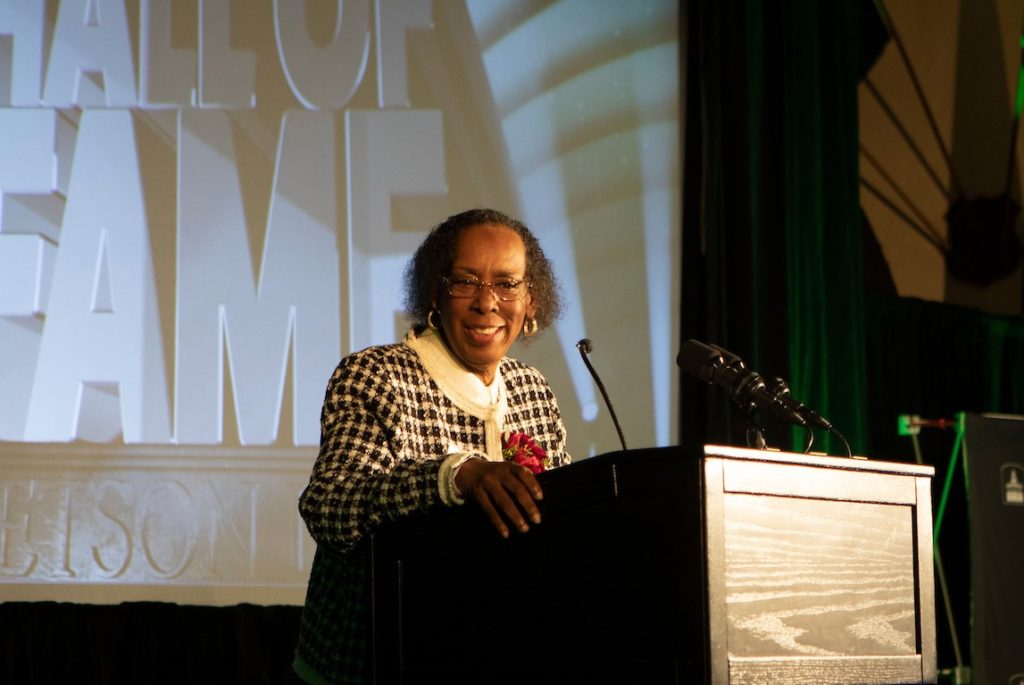
Theresa Pulley Radwan speaks at podium
Interim Dean Theresa Pulley Radwan speaks to 2022 Youth Civic Engagement Program participants and their families.

“We’re very proud of this latest HEED award and the hard work it recognizes,” said Stetson Law Interim Dean Theresa Pulley Radwan. “Whether it’s through thoughtful coursework, student-focused initiatives, or community outreach, the Stetson Law community is committed to growing as a space where students, faculty, and staff from myriad backgrounds will not only feel accepted here, but celebrated for their unique contributions.”

Stetson University College of Law will continue to identify opportunities for fostering greater diversity on campus as well as leveraging its greatest strengths to lift others within the greater community. Though challenging at times, this work is a reflection of the passion that drove those who have undertaken it to pursue legal education in the first place.

Carmen Johnson speaks at a podium.
Carmen Johnson, Stetson University’s Executive Officer for Diversity, Collaboration, and Inclusion.

“As educators with a passion for creating a better society for all, we develop these initiatives with the intent of creating meaningful outcomes for our Stetson communities as well as the students as they diligently prepare to become advocates and professionals who will lead an increasingly diverse and inclusive world,” said Carmen Johnson, Stetson University’s Executive Officer for Diversity, Collaboration, and Inclusion. “We will continue to strategically use the expertise throughout the Stetson community along with best practices in higher education and the legal academy– and recognition like the HEED Award only inspires us to build on this continued momentum.”

One of three law schools recognized

This year, INSIGHT Into Diversity recognized 104 U.S. higher education institutions with a HEED award out of thousands nationwide, from community colleges to state university systems and postgraduate institutions. Stetson Law is one of just three law schools to receive a 2022 HEED award.

To even be considered for the award requires an intensive application and review process.

“The HEED Award process consists of a comprehensive and rigorous application that includes questions relating to the recruitment and retention of students and employees — and best practices for both — as well as continued leadership support for diversity and other aspects of campus diversity and inclusion,” said Lenore Pearlstein, publisher of INSIGHT Into Diversity magazine. “We take a detailed approach to reviewing each application in deciding who will be named a HEED Award recipient. Our standards are high, and we look for institutions where diversity and inclusion are woven into the work being done every day across campus.”

A community that embraces diversity

A look back at the factors behind the previous two years’ awards shows a broad swath of diversity-related initiatives that continually build on past successes.

In 2021, the magazine chose Stetson Law for curriculum initiatives that focused on inclusion, such as Criminal Law and Research and Writing courses; efforts to Americans with Disabilities Act initiatives, such as the creation of the Disability Allied Law Student Association; and development efforts, scholarship, and alumni engagement driven by diversity.

In 2020, Stetson Law was recognized for concentrated efforts to, among other things, recruit and retain historically underrepresented and first-generation students via a “pre-law pipeline” program that featured mentorship throughout participants’ academic journeys and targeted development efforts to ensure they had the financial capability to finish law school. As the 2022-2023 academic year advances, there’s even more in store.

Student Sea-Level Rise Essay Wins Florida Bar Competition

In her award-winning essay about the potential legal challenges stemming from sea-level rise, law student Brooke Cleary points to the erosion of waterfront land in communities like Vilano Beach, Florida (pictured). Photo credit: Felix Mizioznikov

Exploring a critical, ever-evolving aspect of climate change that affects – among many other places – her hometown proved a winning strategy for Stetson Law 2L Brooke Cleary.

Earlier this month, the Environmental Land Use Law Section (ELULS) of the Florida Bar Association selected Cleary’s submission as the winner of its annual Law School Note Competition. Ahead of its annual conference, which this year celebrates ELULS’s 50th anniversary, the competition was open to all law students in Florida.

Under the theme “Looking Backwards, Looking Forwards: 50 Years of Florida Environmental Law,” they were asked to write about “an important or pressing environmental and/or land use topic of the writer’s choosing” and its intricacies in the legal realm.

A subject close to home

Cleary went with a topic that could profoundly affect her hometown, Ponte Vedra, a community on Florida’s Atlantic coast.

A headshot of Stetson Law Student Brooke Cleary
Stetson Law Student Brooke Cleary

“I decided to write about the legal implications of sea-level rise,” Cleary, who recently joined Stetson Law’s environmental law concentration program, said. “In my paper, I wrote about how sea level rise will impact public health, freshwater supplies, real estate, coastal habitats, climate refugees, resources, and international relations/securities.”

She said that when Law Professor Royal Gardner sent her information about the writing competition, she decided to write the piece for fun – and to deepen her understanding of sea-level rise and its relation to public policy.

It took her a couple of weeks to research and write the essay. She reached out to Neptune Beach’s Community Development Director, with whom she talked about how sea-level rise should start factoring into building codes, comprehensive plans, and property boundary lines – as well as what cities, property owners, and entities like the military need to do to minimize potential property damage from rising seas.

Advocating for a proactive approach

Her paper calls for more deliberate efforts among federal, state and local governments as well as citizens to proactively tackle coming challenges related to sea-level rise, from sea water contaminating Florida’s freshwater aquifer to shifting property lines as a result of coastal erosion. She enjoyed the work – so winning was an added bonus.

“I didn’t have any intentions to win; I truly did the research because I wanted to learn more about sea-level rise and how coastal cities should be preparing for it and its repercussions,” Cleary said. “So, to hear I won the contest was very rewarding because I wrote about something that I care a lot about.”

To Professor Gardner, who is also co-director of Stetson Law’s Institute for Biological Diversity & Policy, the recognition demonstrates how law students can meld their legal studies with the passions that drive them in meaningful ways.

“One of the biggest reasons for teaching law is to empower future lawyers to work toward solutions to the challenges we face in the coming decades,” Gardner said. “I hope achievements like this inspire Brooke and others to keep working toward a more sustainable tomorrow – and I know it will.”

As the essay contest winner, Cleary will get to attend ELULS’s 50th Anniversary Conference and Celebration, including presenting at the event’s Executive Council Meeting. She will be featured in the ELULS Section Reporter and may even see her note get published in the Reporter.

“She showed an impressive amount of initiative and diligence by developing her thoughts [and] refining her research,” said Joan Matthews, chair of ELULS’ Law School Subcommittee. “It was a winner!” 

Here are Stetson Law’s 2022 Racial Justice Fellows

Two headshots of students selceted for a special fellowship program
Left: Jessica King; Right, Zenea Johnson

With a sharp focus on racial justice, two Stetson Law students will spend the next year building a more equitable community through collaboration with fellow students from a range of backgrounds.

As part of the St. Petersburg Higher Education Racial Equity Consortium (SPHERE), the two will serve as Racial Justice Fellows alongside students from each of St. Petersburg’s higher-learning institutions. The fellowship program, now in its second year, consists of students from Eckerd College, St. Petersburg College, Stetson University College of Law, and University of South Florida St. Petersburg. Through an application process, consortium organizers selected two students from each institution.

The aim is to bring participants face to face with community leaders, faculty, and mentors to collaborate on projects that will help create progress within St. Petersburg through influencing public policy and challenging the status quo.

“Working with leaders in the community and the SPHERE consortium, this class of Racial Justice Fellows will build on the work of the first cohort and help to establish real change through projects focused on shaping policy and transforming systems to create more equitable outcomes for all,” said Michelle Madden, campus diversity officer at USF’s St. Petersburg campus.  

Meet Stetson Law’s two student fellows

Though their backgrounds differ, the students selected share a deep passion for advocating for the underserved – and the hope of applying skills and tools they are gaining through their legal education to do so.

For Stetson Law student Zenea Johnson, who is pursuing a J.D. with a social justice advocacy concentration, the fellowship is her next step in understanding the many fights taking place within the space of social justice. It would build on lessons from a career she has so far spent dedicated to helping women from underrepresented populations, from domestic abuse survivors to refugees in the process of resettling in the U.S. She said her own experience as a woman from an underrepresented group has inspired her to keep going.

“After years of experiencing life through the lenses of the many intersections of my identity, there is one lens that will always have a greater impact on how I see society and that just so happens to be the one part of my identity that society sees first,” Johnson said. 

Law student Jessica King, who earned her B.A. in sociology with minors in history and leadership studies, said she came to law school with a dream of using her law degree in the service of progressing racial equality in the South. She believes the fellowship can help give her the mentorship and direction she needs amid the rigors of her studies. The program is a win-win, she added, given how she gets to help others while connecting to people, places, and opportunities she may not have otherwise known.

“I believe this fellowship will greatly shape my leadership journey and career because I came into law school with a dream to use my law degree to work and progress racial equality in the South and I believe this fellowship would give me the direction and mentorship I need,” King said.

What the fellowship entails

As with the inaugural 2021 edition of the program, the Racial Justice fellows will participate in regular meetings on how to build on the previous cohort’s strategic vision for what’s known as a Truth, Racial Healing and Transformation Center for Pinellas County.

Each student will receive a stipend of up to $2,000 for the 2022-2023 academic year and will work as interns in summer of 2023. Last year’s participants interned at organizations like the NAACP, the City of St. Petersburg, the Youth Farm, and Community Tampa Bay.  

The students will also serve as interns in the summer of 2023 and will meet regularly for meaningful discussions surrounding diversity, equity, and inclusion. One such discussion that took place last year revolved around the idea of a “new normal” and how the struggles of 2020 have made campus life for underrepresented students even more difficult than before.

Faculty mentors see the program as a building block for meaningful careers current participants will spend advocating for those who need it most.

“We hope that SPHERE’s one-year fellowship and summer community internships will introduce our students to a lifetime commitment of addressing racial injustices,” said Stetson Law Professor Judith Scully, director of Stetson Law’s Social Justice Advocacy program. “Our curriculum is merely a foundation for our students to stand upon as they begin to see themselves as courageous leaders with a focus on racial equity.”   

Stetson Law Alum Paper Proposes Stronger Hawaiian Lands Protections

An antique compass on top of a map of Hawaii

For indigenous Hawaiians – or, as they’re known in the Hawaiian language, Kanaka Maoli – the land, or ‘aina, has a sacred place in Hawaiian religion, culture, and identity. Despite recent attempts at stronger protections and restoring lands, much is still lost to development, military exercises, and certain agricultural practices.

Recent Stetson Law alumnus Will Davis laments the status quo – but sees a potential solution.

Through his pro bono work with the Office of Hawaiian Affairs in 2021, Davis said he saw possible ways to prevent harmful activities from further impeding on some Kanaka Maoli land rights. He wrote about it in “Perpetuated in Righteousness: Proposals for Strengthening Hawai‘i’s ‘Ceded Land’ Protections,” a paper published in Environs, a University of California Davis environmental law journal.

A headshot of Stetson Law alumni Will Davis
Stetson Law alumni Will Davis, J.D. ’22

His first published article, the paper reflects a lifelong passion for promoting Indigenous rights, social justice, and environmental protection. He said in the research and writing of the article, he was mindful of his position as a haole (person of European descent), and tried to take a tone that respects Hawaiians while sharing legal insights that could inspire a new way forward. 

“The daily and unwavering commitment by activists and leaders of the Kanaka Maoli people to protect their rights and land is something that I have a deep and lasting respect for and is why I decided to write this article,” he said.

A new way forward for ‘ceded lands’?

A controversial phrase dating back to the U.S.’s 1893 overthrow of the Hawaiian monarchy, “ceded lands” refers, loosely, to some of the land the U.S. took at the time with no compensation to Hawaiians. It is now considered public land subject to protection. These lands are, by law, set aside for the benefit of Native Hawaiians.

While at OHA, Davis said he saw a large gap when it came to protections for ceded lands, specifically land under lease to another government agency – like the U.S. Department of Defense – or a private entity. Despite what he viewed as a clear need for better protections for these lands, he said he didn’t trust the Hawai‘i State Legislature to act.

A state constitutional amendment looked like the safest bet – so he got to work.

“I enjoy drafting rules and legislation, and so drafting a series of constitutional amendments was great fun,” he said.

There are two ways of getting a proposed amendment on the ballot: either by a two-thirds majority vote in both legislative chambers or by constitutional convention. Unlike some states, Hawaii law does not allow for citizen-driven ballot initiatives.

In all, he presents five amendment options, along with their strengths and weaknesses. Option one, for example, would set forth a clear policy barring sale, lease, or transfer of “ceded lands.” While it would offer the strongest protections, its rigidity could doom it from passage by the legislature, or even voters.

His work impressed Stetson Law faculty members he worked with.

“Will’s scholarship is capturing an important moment in the law of Indigenous people,” said Law Professor Grant Christensen, who specializes in law relating to Indigenous populations. “The field has moved from focusing on the federal-Indigenous relationship to asking what we can learn from Indigenous law and how we can revive and implement Indigenous traditions. Will’s piece captures this trend perfectly.”

One striking thing about the piece, Christensen said, is how it incorporates Hawaiian language.

“Language constructs law,” he said. “His piece builds an argument from the conceptualization of land rights based in the Hawaiian language which doesn’t have any perfect analogy in the common law. This cultural understanding makes his scholarship both more important and directly responsive to the issues raised by Native Hawaiians.”  

A striking example of sacred lands lost

The Hawaiian island of Kaho‘olawe is, to Davis, a dramatic example of how lands that ought to be protected because they are sacred to Kanaka Maoli – the Hawaiian people – can fall prey to destructive interests.

The uninhabited Hawaiian island of Kaho’olawe, seen here from the South Shore of Maui, was a U.S. military bombing range for decades.

Visible from the South Shore of Maui, it never had many inhabitants due to sparse freshwater sources. Yet Hawaiians farmed, mined basalt rock, fished, made petroglyphs, conducted rituals, and even had a penal colony there.

It became a bombing range for the U.S. during World War II and remained one for roughly five decades, including for Operation Sailor Hat, a series of powerful blasts in 1965 intended to mimic the power of a nuclear blast using hundreds of tons of TNT.

The island is now part of Hawaii’s Public Lands Trust, an entity that aims to protect areas throughout the Hawaiian Islands from exploitation. Other places, like a stretch of The Big Island between Mauna Kea and Mauna Loa, haven’t seen what Davis views as adequate protections – they’re used for live-fire training and testing that includes use of depleted uranium.

From Stetson Law to Palau

Davis is currently clerking with the Supreme Court of Palau, a nation consisting of hundreds of islands in the South Pacific – an opportunity he said he learned of through Professor Christensen.

A headshot of law professor Grant Christensen
Law Professor Grant Christensen

Born and raised in Panama City, Florida, Davis received his bachelor’s in political science from University of Central Florida in 2019 before enrolling at Stetson Law to earn a J.D. with an environmental law concentration. He said he believes people in positions of privilege have the responsibility to “right the wrongs of the past and build a better, freer, fairer world for tomorrow.”

When he returns to the U.S., he plans on taking the Navajo Bar Exam to practice Indian Law for the Navajo Nation.

“He has a clear passion for a niche but critically important area of law and is fast moving from student to expert in the field,” Christensen said.